Temporary remote and hybrid working is over. Employee monitoring software, productivity analytics, and time tracking software are essential tools for businesses in 2026 to efficiently manage distributed teams.
That’s exactly why many companies are weighing Tivazo vs Hubstaff before deciding on a workforce management solution.
Both solutions enable companies to keep an eye on productivity, record hours worked, manage remote teams, and increase transparency when it comes to operations. They have different ideas about workforce management, however.
Tivazo is more user-centric, with its payroll and contractor management features also being more transparent and focused on productivity improvement.
The right platform can make all the difference for startups, agencies, freelancers, and expanding remote teams in terms of accountability, employee trust, and operational expenses.
In this guide, we’ll be comparing Tivazo and Hubstaff in detail to help you make an informed choice about which one best suits your workflow.
Tivazo Overview?
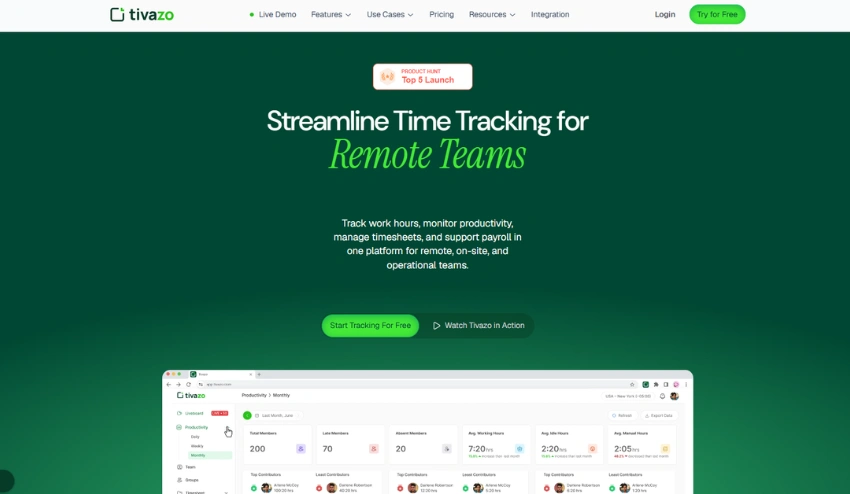
Tivazo is a modern workforce management software designed to enhance team productivity, track work activity, and make managing a workforce remotely easy.
The platform integrates time tracking, employee monitoring, workflow analytics, and reporting on a single platform automatically.
Tivazo is particularly popular among:
- Remote teams
- Small businesses
- Agencies
- Hybrid workplaces
- Startups managing distributed employees
The platform centers on accountability and transparency. Tivazo prioritizes practical productivity tracking and actionable insights, as opposed to bombarding managers with too many surveillance options.
The features of Core Tivazo include:
- Time tracking
- Employee activity monitoring
- Live screenshots
- Productivity insights
- Team management
- Timesheets and reports
- Attendance tracking
- Workforce analytics
Tivazo is used by businesses to:
- Reduce time theft
- Improve operational visibility
- Track remote employee tasks.
- Understand productivity trends
- Simplify attendance workflows
To achieve easier workforce visibility, teams can consider using Tivazo time tracking capabilities in combination with its employee monitoring and performance insights capabilities to see how working hours are distributed throughout the day.
In contrast to some systems that rely heavily on surveillance, Tivazo focuses on transparency that extends to its monitoring mechanisms, which can be more employee-friendly.
This makes it appealing for businesses that are working on subjects such as employees who are thinking about an honest time tracking system and ethical staff surveillance.
Hubstaff Overview
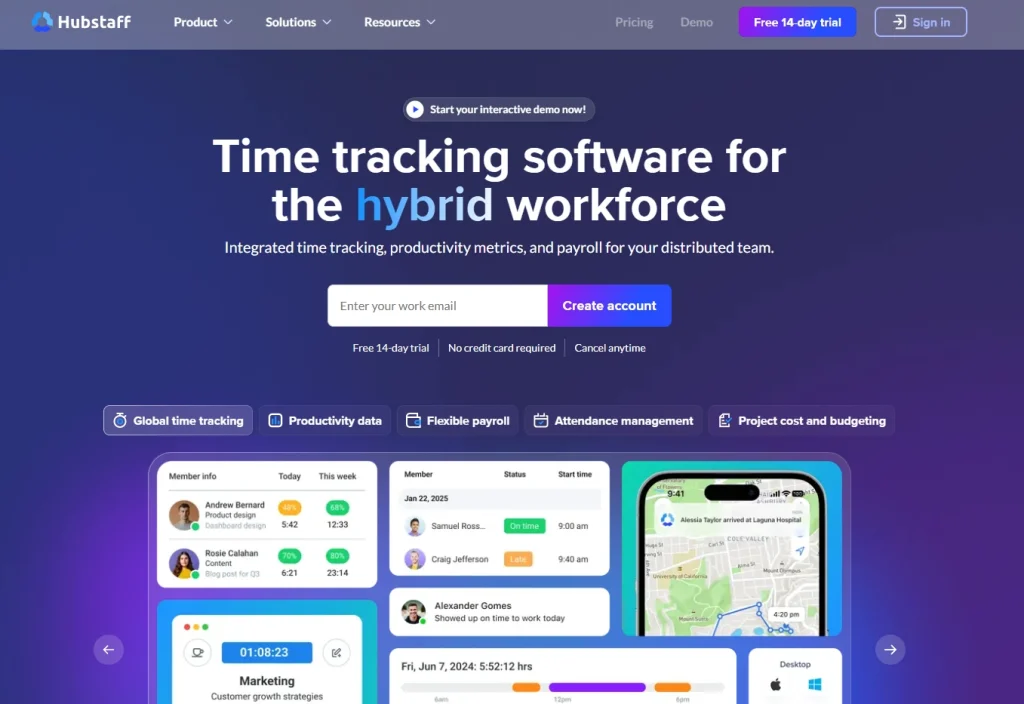
Hubstaff is a proven employee productivity tracking solution that’s adopted by agencies, distributed teams, freelancers, and businesses. It’s no secret that the platform offers some of the most sophisticated monitoring features and integrates with payroll, invoicing, GPS tracking, and project management.
Hubstaff’s main features are:
- Automatic time tracking
- Use of screenshots and activity monitoring.
- GPS tracking
- Payroll automation
- Freelancer payments
- Timesheets
- Productivity reporting
- Project budgeting
A key factor that Hubstaff businesses opt for is its mature ecosystem. It will work with numerous third-party project management and collaboration tools, making it ideal for larger operations.
Some of the best uses for Hubstaff are:
- Billable client hour agencies.
- Freelancers tracking contracts
- Companies need specific monitoring.
- Field teams with GPS tracking.
- Businesses managing contractor payroll.
The comprehensive reporting and payroll automation capabilities can streamline administrative tasks for teams dealing with multiple contractors or international freelancers.
But certain businesses believe the Hubstaff monitoring method can be intrusive based on the company culture and employee expectations.
One of those concerns is why businesses are increasingly looking for Hubstaff alternatives that have more transparent monitoring.
Tivazo vs Hubstaff: Quick Comparison Table
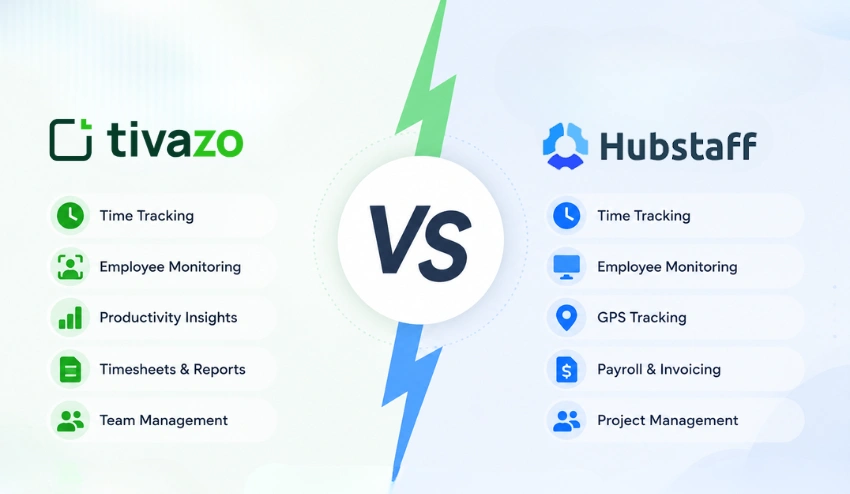
| Feature | Tivazo | Hubstaff |
| Time Tracking | Automatic & manual | Automatic & manual |
| Employee Monitoring | Yes | Advanced monitoring |
| Screenshots | Live screenshots | Random screenshots |
| Productivity Analytics | Strong productivity insights | Detailed activity reports |
| Payroll | Basic payroll support | Advanced payroll automation |
| Reporting | Workforce analytics & reports | Deep reporting tools |
| Integrations | Growing integration library | Extensive integrations |
| Ease of Use | Beginner-friendly | More advanced setup |
| Mobile Support | Yes | Yes |
| Scalability | SMBs & growing teams | SMBs to enterprises |
| Best For | Transparent productivity tracking | Agencies & contractor management |
| Free Trial | Yes | Yes |
| Pricing | More affordable for small teams | Higher cost at scale |
| Customer Support | Responsive support | Mature support ecosystem |
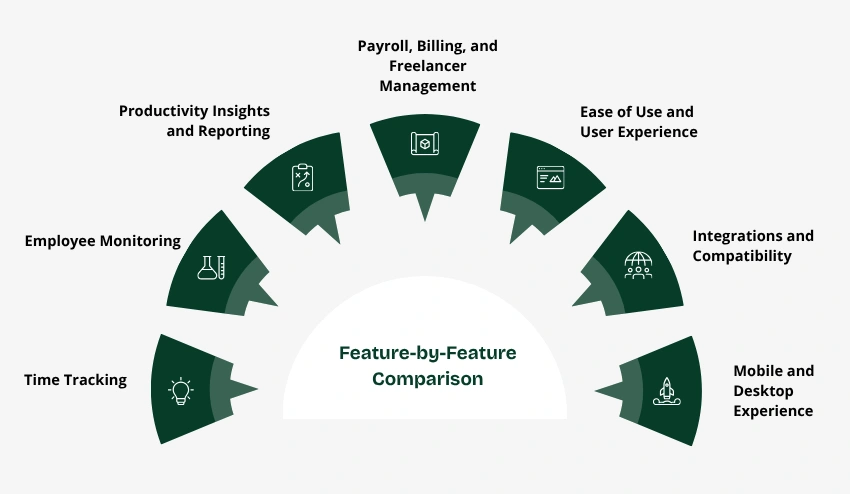
Tivazo vs Hubstaff: Feature-by-Feature Comparison
Time Tracking
Time tracking is the foundation of both platforms, but their workflows differ significantly.
Tivazo focuses on simplicity and employee transparency. Employees can track hours automatically or manually, while managers receive clear visibility into attendance, active hours, and productivity trends.
Hubstaff, on the other hand, provides more advanced tracking controls with optional keyboard and mouse activity measurement.
Tivazo Strengths
- Easy-to-use tracking dashboard
- Transparent activity visibility
- Simplified timesheets
- Cleaner user experience
- Helpful for hybrid teams
Hubstaff Strengths
- Advanced automation
- Better contractor billing workflows
- Detailed activity percentages
- Stronger payroll integration
For teams needing a lightweight clock-in clock-out app, Tivazo often feels easier to adopt. Businesses managing complex billing operations may prefer Hubstaff’s advanced workflows.
Companies focused on simplifying employee attendance often pair Tivazo timesheets and report systems with their automatic time-tracking capabilities to improve operational accuracy.
Real-world example:
A 15-person design agency may prefer Hubstaff because it tracks billable client work alongside payroll automation. Meanwhile, a startup with remote developers may choose Tivazo for easier onboarding and less intrusive monitoring.
Employee Monitoring
Employee monitoring remains one of the biggest decision-making factors in the Tivazo comparison with Hubstaff.
Both tools offer:
- Activity tracking
- Screenshots
- App usage monitoring
- Website tracking
However, the philosophy behind the monitoring differs.
Tivazo leans toward transparent workforce accountability. Its monitoring features are designed to help managers identify workflow inefficiencies without creating a culture of excessive surveillance.
Hubstaff provides more aggressive monitoring controls, including detailed activity percentages and frequent screenshots.
Tivazo Monitoring Approach
- Transparency-focused
- Balanced oversight
- Productivity-oriented insights
- Better employee comfort
Hubstaff Monitoring Approach
- Highly detailed oversight
- Strong compliance tracking
- Better for strict operational control
- More intensive monitoring
This becomes especially important for businesses researching:
- What is employee monitoring software
- cloud vs on-premise employee monitoring
- transparent time tracking system for employees
Many modern remote teams now prioritize trust-based productivity tracking rather than heavy surveillance systems.
Tivazo Live Screenshots and Employee Monitoring features support this more balanced approach while still helping businesses reduce time theft and maintain accountability.
Privacy considerations also matter. In 2026, employees increasingly expect visibility into how monitoring data is collected and used. Companies adopting remote team productivity tools must balance accountability with workplace trust.
Productivity Insights and Reporting
Both platforms provide reporting dashboards, but they prioritize different types of insights.
Tivazo focuses heavily on workforce analytics and productivity visibility. Managers can quickly identify:
- Productivity trends
- Team activity patterns
- Attendance issues
- Workload imbalances
- Efficiency gaps
Hubstaff delivers deeper operational reports, especially around billable hours, payroll, budgets, and contractor activity.
Tivazo Reporting Advantages
- Cleaner dashboard
- Easier report interpretation
- Productivity-focused analytics
- Better workforce visibility for managers
Hubstaff Reporting Advantages
- More advanced operational reporting
- Budget management
- Client billing insights
- Detailed activity tracking
Businesses researching the best employee tracking methods often prioritize reporting clarity over excessive data complexity. For smaller teams, Tivazo simplified analytics may feel easier to use daily.
Its Performance Insights system helps managers identify trends without overwhelming them with unnecessary metrics.
Payroll, Billing, and Freelancer Management
This is one area where Hubstaff has a clear advantage for some businesses.
Hubstaff includes mature payroll automation and contractor payment functionality, making it especially useful for:
- Agencies
- Outsourcing firms
- Freelance marketplaces
- Distributed contractor teams
It simplifies invoicing, billing, and automated payments.
Tivazo supports workforce tracking and reporting workflows effectively but focuses less on complex payroll infrastructure.
When Hubstaff Works Better
Hubstaff may be the better fit if your business:
- Pays multiple contractors internationally
- Requires automated payroll
- Manages billable client hours
- Needs project budgeting features
When Tivazo Works Better
Tivazo may suit businesses that prioritize:
- Employee productivity visibility
- Workforce accountability
- Simpler operations
- Affordable tracking software
For example, a software agency billing hourly client work may gain more value from Hubstaff’s invoicing tools. A customer support team managing productivity internally may prefer Tivazo’s cleaner workflow.
Ease of Use and User Experience
Ease of adoption often determines whether employee tracking software succeeds long-term.
Tivazo offers a cleaner onboarding experience with a dashboard that feels intuitive for non-technical users.
Hubstaff includes more advanced settings and controls, which may create a steeper learning curve for smaller teams.
Tivazo User Experience
- Simple interface
- Faster onboarding
- Easier navigation
- Better for startups
Hubstaff User Experience
- More advanced workflows
- Greater customization
- Strong operational controls
- Better for experienced managers
Small businesses often prefer Tivazo because employees can quickly understand the platform without extensive training.
Larger operational teams may appreciate Hubstaff’s broader administrative controls despite the added complexity.
Integrations and Compatibility
Integrations matter significantly for businesses already using project management and collaboration tools.
Hubstaff currently offers a more mature integration ecosystem.
Supported integrations include:
- Trello
- Asana
- Slack
- Jira
- ClickUp
- QuickBooks
- PayPal
Tivazo also integrates with productivity and workforce management tools, though its ecosystem is still growing compared to Hubstaff.
Hubstaff Advantages
- Extensive API ecosystem
- Better enterprise compatibility
- Strong payroll integrations
Tivazo Advantages
- Simpler workflow setup
- Less integration complexity
- Easier onboarding for SMBs
Businesses heavily dependent on automation workflows may prefer Hubstaff’s mature integrations.
Mobile and Desktop Experience
Both platforms support desktop and mobile tracking.
Tivazo emphasizes consistency and simplicity across devices. Employees can easily manage tracking from a desktop or mobile without navigating overly complex settings.
Hubstaff offers stronger GPS and field tracking functionality, making it valuable for businesses managing remote field workers.
Tivazo Mobile Experience
- Clean mobile dashboard
- Consistent syncing
- Easier for remote office teams
Hubstaff Mobile Experience
- GPS tracking
- Better field workforce support
- Advanced mobile tracking controls
Tivazo vs Hubstaff Pricing Comparison
| Pricing Factor | Tivazo Pricing | Hubstaff pricing |
| Entry-Level Cost | Lower pricing | Higher starting price |
| Mid-Tier Plans | Affordable scaling | Moderate-to-high pricing |
| Enterprise Plans | Custom pricing | Enterprise pricing available |
| Payroll Features | Limited | Advanced payroll included |
| Reporting Access | Included in plans | Advanced reports in higher tiers |
| Monitoring Features | Included early | Some advanced tools cost extra |
| Scalability Cost | Budget-friendly | Can become expensive at scale |
| Free Trial | Yes | Yes |
| Best ROI | SMBs & startups | Agencies & contractor teams |
Which Offers Better Value?
Tivazo generally provides stronger value for:
- Startups
- Small businesses
- Hybrid teams
- Companies want transparent monitoring
Hubstaff may provide a stronger ROI for:
- Agencies
- Freelancer-heavy businesses
- Payroll-focused operations
- Teams managing billable work
One major reason businesses search for Hubstaff alternatives is rising software costs as teams scale.
A company with 80 remote employees may experience noticeably higher operational costs on Hubstaff depending on required features and integrations.
Pros and Cons of Tivazo
Pros
- User-friendly interface
- Affordable pricing
- Strong productivity-focused reporting
- Helpful workforce analytics
- Transparent monitoring approach
- Good fit for remote teams
- Easier onboarding
Cons
- Smaller integration ecosystem
- Less advanced payroll automation
- Fewer enterprise-level workflow controls
- Still expanding advanced feature depth
Pros and Cons of Hubstaff
Pros
- Advanced employee monitoring
- Strong payroll functionality
- Mature integration ecosystem
- Excellent for contractor management
- Detailed operational reporting
- Strong project budgeting tools
Cons
- Higher pricing for larger teams
- Can feel invasive for employees
- Steeper learning curve
- More complex setup process
What is the best tool for various businesses?

1. Startups
Because Tivazo can be more effective for startups, it can provide several advantages, such as:
- Affordable pricing
- Simpler onboarding
- Easy workforce visibility
- Less administrative complexity
2. Agencies
Agencies that deal with:
- Billable client hours
- Freelancers
- Contractor payroll
- Budget tracking
- Enterprises
Hubstaff’s advanced integrations and reporting controls could be beneficial for large enterprises.
But companies that value transparency amongst their staff might still choose Tivazo.
3. Freelancers
Hubstaff is perfect for freelancing and hourly billing clients who are looking for an invoicing solution.
4. Hybrid Teams
With Tivazo, monitoring is less intrusive but still effective, making it easier for hybrid workplaces.
5. Remote Teams
Both of these platforms work well for remote teams.
Tivazo is suitable for remote organizations that have a culture focus.
Hubstaff is ideal for workplaces that are more stringent with operations and need more oversight.
6. Small Businesses
The ease of use of Tivazo’s workforce management features makes it a great option for small businesses, especially when cost is a major concern.
Why Businesses Look for Hubstaff Alternatives?
Hubstaff alternatives have been in demand for quite a while these days for various reasons.
1. Rising Software Costs
The price of Hubstaff can quickly skyrocket as teams grow.
2. Employee Privacy Concerns
Others believe that too much monitoring will impact morale and trust.
3. A more complex version for smaller teams
Advanced enterprise controls may not be necessary for small businesses.
4. Demand for Transparency
Today’s businesses are more likely to lean on easy-to-use, clear productivity-monitoring tools.
5. Simpler Workflow Preferences
Many businesses are looking for workforce management software that can be implemented quickly with little to no employee hand-holding.
This is where Tivazo’s role becomes obvious as a more straightforward, more well-rounded option.
When most businesses are looking for an alternative to Hubstaff, they tend to focus on the ease of use, transparency, cost-effectiveness, and streamlined workflows that the software offers, rather than on the aggressive monitoring that is offered.
Conclusion
There is no overall winner between Tivazo and Hubstaff. It will be up to you to decide which is the best option for your business based on your business structure, complexity, and monitoring philosophy.
Choose Tivazo if you want:
- Budget-friendly labor management software program.
- Transparent employee monitoring
- Simpler onboarding
- Productivity-focused insights
- More efficient working processes for remote teams.
Choose Hubstaff if you need:
- Advanced payroll automation
- Contractor management
- Deep operational reporting
- Extensive integrations
- In-depth employee activity monitoring.
Tivazo is a good solution for many expanding companies that are looking for a compromise between accountability and employee trust. In the meantime, Hubstaff is still a good choice for agencies, businesses, or contractor-driven workflows.
Before making a decision, compare Tivazo and Hubstaff based on:
- Team size
- Budget
- Monitoring preferences
- Payroll needs
- Reporting requirements
- Workflow complexity
For those who prefer a more streamlined and transparent approach with a productivity-driven analytics system for their workforces, Tivazo might be an interesting option to consider as a modern alternative to Hubstaff.
Start tracking with Tivazo today – free trial available!