Work is no longer simple. Teams have to cope with numerous tasks, changing priorities and strict deadlines on a daily basis. Workloads accumulate rapidly and productivity silently decreases without a clear system.
Here, the workload management software comes in the picture. It allows individuals to understand who is doing what and how much capacity is available, and the work that is stalling.
In case you are studying how to make the work more efficient, how to minimize overload, or how to see more in the tasks, this guide will take you through all you have to know. We will un-teach ourselves the terms of workload management software, why it is important, and how to select the appropriate solution without the jargon.
What Is Workload Management Software?

Workload management software is a computerized tool that assists in planning, monitoring and balancing work among individuals, teams, or systems to ensure that tasks are completed within the required time and without overloading the resources.
Simply put, it demonstrates the amount of work that is present, who is bearing the work and whether the workload is distributed equally. You are able to have a clear, visual view of capacity and progress rather than making guesses of who is busy and who is free.
Majority of workload management software will consolidate tasks, deadlines and responsibilities into a single place. This simplifies the process of priority adjustment, work reassignments and avoidance of bottlenecks prior to causing delays.
Control is the primary attraction of people who study this issue. Workload management software is not reactive, instead of responding to problems post-factum, it assists in planning work in advance and ensuring things go on smoothly.
Core Features of Workload Management Software
Although the tools are different, the majority of the workload management software has several basic functions.
Task assignment enables the work to be owned by individuals or teams. There is no confusion and redundancy because everyone understands what they are supposed to do.
Workload visualization provides the distribution of work over time. This is commonly presented as boards, calendars or charts which indicate overload or underutilization.
Prioritization and scheduling tools assist in matching tasks to deadlines and urgency. This will not leave critical work without considering long-term goals.
Alerts and reporting give an insight into progress and possible problems. These attributes assist users to identify delays in time and make effective changes.
Why Workload Management Software Matters
Problems of workload do not manifest themselves in one way. They are secretly constructed by bad visibility, unequal task allocation, and lack of priorities. Teams are lagging behind by the time issues are brought to attention.
Workload management software is important in that it introduces order and transparency in the process of planning and implementation of work. It can enable individuals to know capacity, avoid overloading, and make wiser decisions before matters get out of hand.
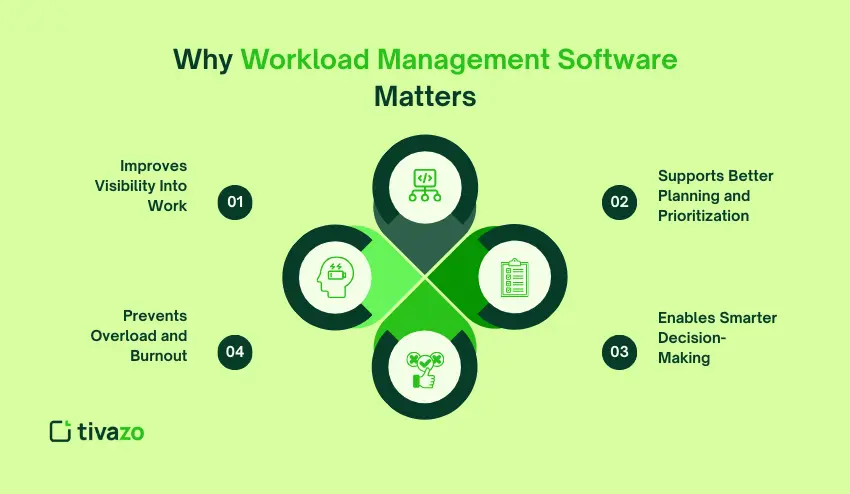
1. Improves Visibility Into Work
Among the greatest problems of work management, there is the lack of knowledge concerning who does what. Workloads are not measured but are usually assumed without being visible.
The workload management software gives a transparent picture of the tasks, deadline and ownership. This facilitates the identification of bottlenecks and a re-arrangement of work before it becomes late.
2. Prevents Overload and Burnout
In case of uneven workloads, there are individuals who become overstretched, whereas others are not fully utilized. This eventually causes stress, burnout, and poor performance.
The software allows work to be distributed more equally by displaying real-time workload distribution. This is in favor of work patterns and sustainable productivity.
3. Supports Better Planning and Prioritization
The lack of planning can lead to changes and hasty implementation at the last moment. This frustrates and decreases the quality of work.
The workload management software allows the prioritization and the meeting of deadlines. Users are able to plan in advance, change schedules with ease and concentrate on things that are important.
4. Enables Smarter Decision-Making
Guesswork tends to result in inefficiencies in decisions. In the absence of data, one cannot be sure of whether workloads are realistic or attainable.
Users are able to make informed decisions with workload data and reports. This contributes to enhanced forecasting, improved results, and dependable delivery.
Key Benefits for Teams and Individuals
One major benefit is clarity. All people know what to do, when, and why, and this minimizes the back and forth communication.
When workloads are also realistic, productivity is also enhanced. Individuals are able to concentrate on getting the task done rather than being in a hurry or multi-tasking due to the pressure of time.
Improved workload visibility helps to promote healthy work habits. In case the overload is apparent, it can be managed before it becomes stressful or burnout.
Lastly, the workload management software assists in improved decision-making. Capacity and performance data can assist users in planning the future work more accurately.
Types of Workload Management Software
Workload management software is not designed equally. Various tools can be used in different needs, team size and complexity. The knowledge of the key types assists in reducing the correct choice within a shorter period of time.
1. Task-Based Workload Tools
Task-based tools are concerned with single tasks and simple assignments. They are typically simple to install and fast to master.
These are suitable in simple tasks of an individual or small teams. They assist in following up on what should be done without introducing any unnecessary complexity.
2. Project-Centric Workload Platforms
Project-based platforms The platforms are tailored to work management on a timeline, milestones, and multicontributor basis. They are more structured compared to simple task tools.
These tools can be applied to work that is time-sensitive and where there is inter-role coordination. They offer more insight into progress and time allocation of work.
3. Enterprise and Advanced Workload Systems
Workload management software on the enterprise level is designed to be used in larger organizations and in complex operations. These systems are usually associated with automation, forecasting and sophisticated reporting.
They are best suited to a setting where the workloads have to be optimized at departmental or long-term levels. Although more powerful, they tend to be more set up and trained.
How to Choose the Right Workload Management Software
Selecting workload management software is not a question of the tool that has the best features. It is concerned with coming up with a solution that suits the way work is done.
The decision is easier because it is organized, and the risk of implementing a tool that is not used is minimized.
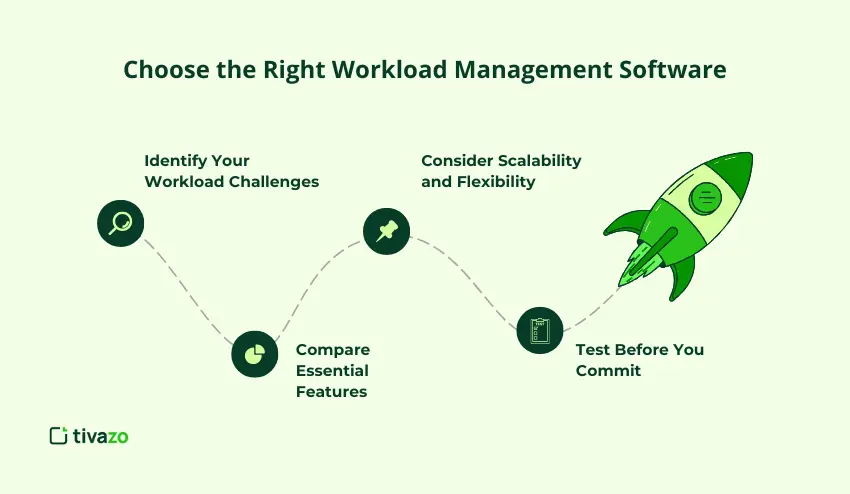
1. Identify Your Workload Challenges
Begin by knowing the areas of workload problems. Do people work too hard or is work not a priority?
Having an idea of the size of your team, the nature of the work to be done, and how you are going to deal with deadlines can help to determine what the software will need to deal with.
2. Compare Essential Features
Pay attention to the features which are directly solve your problems. Task tracking, scheduling and visual workload views tend to be more useful than sophisticated extras.
Ease of use is critical. In case the software is not user friendly, there will be low adoption and little benefit will be realized.
3. Consider Scalability and Flexibility
The requirements in workloads vary with time. The current tool must be able to sustain further development.
Find software that can support an additional number of users, projects or complexity without the need to switch entirely in the future.
4. Test Before You Commit
The majority of workload management software have free trial or demos. This time should be used to test actual workflows.
Engaging the individuals who will work with the tool on a daily basis will help in pointing out the problems at an early stage and enhance its uptake in the long run.
Common Mistakes When Using Workload Management Software
The most efficient workload management software cannot work when it is not used properly. Numerous problems are caused by mere mistakes and not the tool.
Understanding these common pitfalls helps users get real value from their software.
1. Overcomplicating Workflows
The common error is the inclusion of an excessive number of steps, fields or rules. This renders the system difficult to use and slows down the people.
Workload management is effective when workflow is straightforward and narrowed down to necessities. Begin with little and grow as the need arises.
2. Poor Onboarding and Training
Unless onboarded properly, users might fail to know how to use the software. This results in incoherent data and poor adoption.
The use of clear instructions and brief training allow the user to gain confidence and use the tool properly at the beginning.
3. Ignoring Workload Data
Other users monitor work and do not take any action about the data. This makes the software a passive task list.
Decisions should be made based on workload insights. Modify tasks, timeframes, and priorities, depending on the information provided by the data.
4. Treating It as a One-Time Setup
Workloads vary continuously. The software is considered a set and forget tool, which makes it less effective.
Checking and updating of workloads regularly make them correct and in balance with the actual state of affairs.
Conclusion
Workload management software is not a simple task tracker. It provides transparency, equality and regulation of work distribution and accomplishment. Through appropriate software, groups and individuals will be able to avoid overload, enhance productivity and make wiser decisions.
When you are thinking about how to do things better, begin by evaluating your existing work processes and finding points of weakness. Select a tool that is appropriate to your team, requirements, and expansion strategies and adopt it as a priority.