
By using time management goal examples, you may be able to work more productively, decrease stress, and make better use of each working hour. Regardless of your role, whether as an employee, student, manager, freelancer, business owner, or remote worker, clearer goals will allow you to prioritize the most important and accomplish the best.
Time is the best thing we all have, but the way you use it is the difference between where you end up. Whether you are a working professional, business owner, team leader, or student, you can achieve more with less time, which is why having effective time management goals will keep you organized, relieve stress, and accomplish more.
Here we will discuss the most effective examples of time management goal, the importance of these goals, how to formulate them, and how working with tools such as Tivazo will allow you to track time, quantify productivity, and optimize workflows to achieve the best results.
Quick Answer: What Are Time Management Goal?
Time management goal are specific targets to help you plan, prioritize, and manage your time more efficiently. Setting goals that are Specific, Measurable, Achievable, Relevant, and Time-bound (SMART) is a good way to keep time management goal attainable.
noon, having They range from getting the three main things done before noon, having fewer distractions in the day, working on hour tracking, and setting aside time for focus. Establishing time management objectives can lead to higher productivity, less stress, and increased personal and professional goals.
Key Takeaways
- Time management goals help you stay organized, productive, and focused on high-priority work.
- The most effective goals follow the SMART framework: Specific, Measurable, Achievable, Relevant, and Time-bound.
- Prioritizing important tasks, reducing distractions, and reviewing progress regularly lead to better long-term results.
- Time management goals should be tailored to your role, whether you’re an employee, manager, student, freelancer, business owner, or remote worker.
- Avoid common mistakes like multitasking, vague goals, poor prioritization, and skipping progress reviews.
- Using tools such as Tivazo can help you track your time, measure productivity, and continuously improve your workflow.
What Is Time Management?
Time management is a process of planning, organizing, and controlling your time use so that you can work smarter, rather than harder. It consists of prioritizing, setting clear goals, avoiding 5 min. distractions, and using tools that will aid you to remain focused and productive. Time management examples give you more time to do less, and you will find that your day has been planned, is controllable and stress free.
The reason why time management is even more significant nowadays is as follows:
- Lessens stress: When you put things in order, your mind will remain clear and calm.
- Enhances decision-making: You are well aware of what is worth your time and what you can afford to postpone.
- Increases productivity: You can accomplish more work in less time with less mental exhaustion.
- Establishes Work Life balance: Time management does not mean a deadline at the expense of personal life.
- Favors long-term development: When time is managed well and in a consistent manner, it would be easier to achieve ambitious objectives.
- Develops discipline: You practice discipline to remain committed, orderly, and consistent on a day-to-day basis.
This underpinning is a requirement before making effective time management goals that can cause actual change.
8 Ideal Qualities of Effective Time Management Goal
It’s never too late to set a time management goal, which is one of the best things you can do to help boost your productivity, lower your stress level, and make consistent progress toward your personal and professional goals. But making the decision to “manage your time better” isn’t enough. Goals should be specific, measurable, and attainable.
With the perfect attributes of time management objectives, every minute spent adds value to progress made and not just mere activity. Regardless of whether you are working on your own or on a team, having goals that are well structured can help you prioritize important tasks, stay away from distractions, and focus on activities that are going to have the greatest impact.
Here are the key attributes that all good goals for time management should include.
1. Specific
A good time management objective has a very clear idea of what you want to do. The broader objectives of ‘be more productive’ or ‘manage my time better’ are hard to measure, as they do not specify a clear outcome. Rather, set objectives that detail the specific areas that you want to develop.
For example:
- Complete all high-priority work before lunch.
- Respond to emails only three times each day.
- Spend two uninterrupted hours on deep work every morning.
Specific objectives remove uncertainty and make daily planning a lot simpler.
2. Measurable
Without measuring your progress, it’s hard to gauge whether or not you’re improving. Measurable goals allow you to know how you are doing and what needs to be changed.
Instead of saying, “Reduce distractions,” Make a measurable objective such as “Reduce social media time to 20 minutes while you are at work.” Time tracking software can be helpful in tracking progress over time, offering insights into how real hours are being spent.
You can look at the effectiveness of time usage, rather than assuming where it’s being used well and where it could be improved.
3. Achievable
Your goal must push you but still be attainable. It is easier to get frustrated and burned out with a goal that is too difficult, but setting a goal that can be accomplished will keep you going and improving over time.
For instance, if you are currently spending an average of three hours at work per day focused, then you shouldn’t expect to be at work for eight hours at once.
A sensible goal would be to add 30 minutes of focused work time each week until you achieve the desired level of productivity. Small steps will often make for long-term gains, rather than big changes that are hard to sustain.
4. Relevant
Every goal should contribute to your larger objectives.
Ask yourself:
- Will this goal improve my productivity?
- Will it help me complete projects faster?
- Will it improve team performance?
- Will it reduce unnecessary work?
If the answer is yes, then the objective is relevant. Organizations measure performance based on employee productivity, which aims to track them to see how they are spending their time and how effective they are in achieving organizational goals.
Setting goals for time management that are related to measurable outcomes makes your daily actions lead to success and not just more activity.
5. Time-Bound
All objectives must have a cut-off. Deadlines give people urgency, make them more accountable, and make fewer people procrastinate. Instead of saying, “Finish my project.” Be sure to set a time limit, like, By Thursday at 5 PM, complete the first draft.
It is important to have a clear timeframe in order to prioritize work efficiently and avoid postponing important work indefinitely.
6. Flexible
While planning is essential, unexpected meetings, urgent requests, and changing priorities are part and parcel of every workplace. Goals for time management need to be flexible enough to adjust as needed while keeping you focused on your ultimate goals.
If there’s an emergency call that comes up and throws your timeline way off, but it’s not the end of the world, then move your schedule to accommodate that and not give up your list of most important priorities.
Flexibility enables you to keep on being productive without feeling overwhelmed in the face of unanticipated events.
7. Prioritized
All tasks are not created equal. Successful professionals do tasks that are of high importance before the rest of the tasks.
One effective tip is to prioritize the three most significant tasks that you have for the day and get them done first before tackling routine administrative tasks.
Focusing on important work at the top of the list yields benefits in terms of productivity, decision fatigue, and meaningful progress toward goals each day.
8. Regularly Reviewed
Setting goals is the first step. Weekly progress checks provide feedback on progress, highlight any issues, and refine planning.
In your weekly review, you should ask yourself:
- What activities were the most time-consuming?
- What were some of the things that were distracting me from my work?
- What goals did you achieve?
- What do you think I should work on next week?
Periodic reviews make time management an ongoing process, not a one-off project.
Key Qualities of Effective Time Management Goals
| Quality | Why It Matters |
| Specific | Creates clear direction and focus. |
| Measurable | Makes progress easy to monitor. |
| Achievable | Encourages realistic and sustainable improvement. |
| Relevant | Aligns daily work with long-term objectives. |
| Time-Bound | Improves accountability and reduces procrastination. |
| Flexible | Allows adjustments when priorities change. |
| Prioritized | Ensures high-value work gets completed first. |
| Regularly Reviewed | Supports continuous learning and productivity improvement. |
The Reason to Set Time Management Goal
When you set time management goal, you have:
- Understanding of the real things that count.
- Structure in your workflow
- Better concentration with a reduced number of distractions.
- Daily increased productivity.
- Better work-life balance
- Reduced stress and burnout
- The capacity to work within deadlines with ease.
Once your time is handled in the right way, you will be unstoppable, both personally and professionally.
How to Create SMART Time Management Goal
Setting goals is a good first step, but how you set those goals will determine if you will achieve them. This is where the SMART framework is useful. SMART goals convert your general intentions into action plans that are Specific, Measurable, Achievable, Relevant, and Time-bound.
Instead of vague goals like “be more productive” or “manage time better,” SMART goals provide you with a clear direction and measurable milestones. They hold you accountable, help you measure your progress, and point out areas for improvement.
Whether you are managing your own workload, leading a team, or running a business, SMART goals for time management will help you become a more efficient worker and make your time more purposeful.
What Does SMART Stand For?
| SMART Element | Description | Example |
| Specific | Clearly defines what you want to achieve. | Complete all priority tasks before noon. |
| Measurable | Includes a way to track progress. | Reduce daily meeting time by 30 minutes. |
| Achievable | Sets realistic expectations. | Spend one additional hour on focused work each day. |
| Relevant | Supports your larger goals. | Improve project delivery by reducing distractions. |
| Time-bound | Includes a deadline or timeframe. | Complete the weekly report every Friday by 4 PM. |
Following the SMART framework removes uncertainty from your planning process and helps you focus on meaningful improvements instead of simply staying busy.
1. Complete High-Priority Tasks Before Noon
SMART Objective: Complete your top 3 priorities before 12:00 PM each workday for the next 30 days.
Why Does It Work: Most people have more energy and better concentration in the first few hours of the day. If you do the important work before checking email or going to meetings, you reduce distractions and build momentum for the rest of the day.
For Example: Rather than beginning your day with emails, spend the first two hours on strategic planning, client proposals, or project work that moves the needle toward your goals.
2. Reduce Daily Distractions
SMART Goals: For the next four weeks, cut non-work screen time by 45 minutes a day.
The reason it works: Constant interruptions make it difficult to concentrate. Reduce social media use, multitasking, and unnecessary notifications, and spend more time doing meaningful work.
By using time tracking software to log your deep work sessions, you can see when distractions occur and how they impact your daily productivity.
3. Improve Time Estimation Accuracy
SMART Objectives: Estimate the time needed for each major task for the coming month, and compare your estimates to the actual time.
How it works: Many professionals are too optimistic about how long it takes to do their work, and they miss deadlines and get stressed out.
By comparing estimated times to actual times, you create the ability to make more realistic schedules and plan better in the future.
4. Schedule Focus Time Every Day
SMART Objective: For the next 30 days, schedule 2 hours of deep work into your calendar on each weekday.
How It Works: Time blocking shields your prime work hours from meetings, notifications, and distractions. It creates protected time to do complex work that requires concentration.
For example, you might block out time from 9:00 to 11:00 each day to write reports, solve technical problems, or plan projects.
5. Track Your Working Hours Consistently
Make a daily note of your working hours for the next 30 days and evaluate your productivity at the end of each week.
Why it Works: You can’t improve what you can’t measure. By keeping track of your daily activities, you can identify time-wasting habits, repetitive tasks, and opportunities to work more efficiently.
Employee productivity metrics are often used by organizations to gauge performance and measure improvements in the workflow. When you take the same approach to your own work, it helps you make better decisions about how you spend your time.
6. Reduce Meeting Time
SMART Goal: For the next two months, cut the meeting time by 20% per week. Decline meetings that aren’t necessary, and use asynchronous communication when possible.
How It Works: Many meetings waste precious working hours without any real results. Shorter, more efficient meetings mean more time for focused work and faster decisions.
A shared progress update can save several hours a month instead of a one-hour status meeting and keep everyone in the loop.
7. Finish Projects Before Internal Deadlines
SMART Goal: Complete every project at least two days before the official deadline for the next three months.
Why It Works: Creating internal deadlines provides extra time for reviewing work, correcting errors, and handling unexpected issues. This reduces stress and improves the quality of your final output.
Examples of SMART Time Management Goal
| Goal | Specific | Measurable | Time-Bound |
| Complete priority work before noon | Yes | Yes | Daily |
| Reduce distractions by 45 minutes | Yes | Yes | 30 days |
| Track work hours every day | Yes | Yes | 30 days |
| Schedule two hours of deep work | yes | Yes | Daily |
| Reduce meetings by 20% | Yes | Yes | Two months |
| Finish projects two days early | Yes | Yes | Three months |
8 Smart Time Management Goal Examples
1. Do More Important Things Everyday
Write down the top three activities that have the greatest impact on your goals each day. An example is that rather than spending time on minor administrative duties in the morning, you spend your morning on client acquisition, report analysis, or strategy planning. You can ensure that you minimize time wastage on low-priority activities by identifying high-value activities. This will assist you to stay in focus on what really matters. With Tivazo, you will be able to see how much time you spend both on meaningful and distracting activities, and you will get feedback to prioritize your time better. Doing this on a daily basis will make you stick to it, stay productive and in line with your long-term goals.
2. Cut the number of Daily Distractions
A good place to begin is by figuring out what distracts you the most – social media, unneeded meetings, constant notifications, or office gossip. Establish limits like checking messages after specific times or muting alerts, or focus applications. In case you are working in teams, block deep-work hours during which no communication should take place except in case of an emergency. Time Track your concentrated time using Tivazo that displays the amount of time spent actively working in comparison to idle time or task switching. It not only helps in becoming more productive, but also teaches your mind to remain disciplined and alert.
3. Correct Direction for task Estimation
Most individuals under estimate or over estimate the length of tasks to be done. Begin to trace the real time you use on each activity with time-tracking. Create comparisons to compare your estimates and real data and adjust your planning. With time, you will learn to estimate jobs in a better way which will enable you to make realistic schedules and deadlines without any stress. This objective enhances the project management, allocation of resources and distribution of workload particularly in the team-based context.

4. Finish a Full Week of Planned Scheduling
Arrange the whole week ahead of time—meetings, working days, personal activities, and breaks. Have it all centralized with the calendar integration of Tivazo. This is aimed at sticking with at least 80 percent of your timetable. This will condition you to organize your time effectively and be consistent. With time spent on planning on a weekly basis, decision fatigue will reduce, and the work will be more predictable. By the end of your planned scheduling of a full week, you will have developed a sense of discipline, and it will lead to greater accountability and make sure you are continuously on course towards achieving your long-term objectives.
5. Repetitive Tasks Automation
Determine the activities that you are constantly engaged in: data entry, reporting, timesheet updates, follow-up messages, or reminders. Special software is set up to automatically monitor time, report on it, and give notifications, eliminating human effort. Repetitive work is automated, and you will save hours in a week, and you can work on the strategic or creative work.
As an example, Tivazo can create real-time insights as opposed to calculating the hours of productivity manually. Automation enhances productivity and reduces human mistakes and makes working more streamlined.
6. Enhance Deadline Discipline
You should be able to meet deadlines with consistency, therefore you have to train yourself to set internal deadlines which are earlier than the deadlines. When a project is required on Friday, place your internal deadline on Wednesday. This buffer will allow you to escape the last-minute rush, as well as to have enough time to proofread your work. In the long run, you develop a habit of performing tasks on time, and this increases your reliability and professional standing.
7. Continue with Daily Time Tracking 30 Days
Challenge yourself to follow your time over 30 days with the help of Tivazo. This offers some great information on what you are spending your time on, productive, break, meetings, and distractions. Using actual data, you can define trends and points of weakness. After having a clear vision of your behavior, optimize your workflow by removing low-value activities, enhancing concentration, or changing your timetable. It is a habit that will create accountability and awareness that will allow you to manage your day better.
8. Develop a Work-Life Balance Habit
Establish proper delineations of work and personal time. Breaks, exercises, self-improvement, and family time as you would bring up to a meeting. Tivazo can be used to ensure that you are not overworking by tracking the number of hours spent on tasks in total. Balancing will avoid burnout and enhance productivity in the long run. This objective will see to it that you are in a healthy state both physically and psychologically and still deliver at your best.
6 Time Management Goal Examples for Different Roles
How well you manage your time depends on what you are responsible for and where you work. A student preparing for exams will have a different priority than a business owner with several teams or a freelancer trying to meet client deadlines and maximize billable hours.
The best time management goals are those that align with your daily tasks and your future goals.
Here are some practical time management goals for different roles that can help boost productivity, reduce stress, and create a more balanced schedule:
1. Time Management Goals Examples for Employees
Employees are often multitasking throughout the day, going to meetings, meeting deadlines, and responding to ad hoc requests. It’s easy to get busy without clear goals and not make meaningful progress.
It is a reasonable aim for workers to achieve the three most important things by the end of each morning. This guarantees your most critical work is getting your full attention before your schedule is filled with emails, meetings, and other distractions.
2. Time Management Goals Examples for Managers
Managers are involved in balancing strategic planning, team communications, project management, and problem-solving throughout the day. With increased responsibilities, good time management is crucial for keeping the team productive.
A good objective is to minimize the number of meetings needed by replacing status reports with common dashboards or written progress reports. This frees up time for employee coaching, project planning, and tackling critical issues.
It is also important for managers to hold weekly planning sessions to assess workloads, redistribute work as needed, and eliminate any barriers that could hinder team performance.
Employee monitoring software can help organizations determine workload and productivity and help them plan for resources more effectively—without only relying on their human eye.
3. Time Management Goals Examples for Students
Students are invariably juggling classes, assignments, exams, extracurricular activities, and personal commitments. Time management will help you to reduce your stress and improve your academic performance.
A simple but effective goal is to create a weekly study schedule that allocates specific time for assignments, revision, and breaks. Breaking big assignments into smaller steps makes studying easier and helps avoid the need to cram at the last minute.
Students can boost productivity by doing their best work at their most alert times and by minimizing distractions such as social media while doing coursework.
4. Time Management Goals Examples for Freelancers
Freelancers are responsible for managing client projects, communicating with customers, handling administrative tasks, and marketing their services. Without specific goals, you could lose track of billable hours or spend a lot of time on low-value activities.
A good goal is to track every hour you spend on a project and compare estimated timelines with actual completion times. This assists with better pricing, scheduling, and planning for future projects.
Freelancers also benefit from time-tracking software, as it allows them to accurately track billable hours, determine trends in productivity, and generate improved invoices for clients.
Another good goal is to spend at least one hour a week doing business development activities like networking, portfolio updates, or finding new clients.
5. Time Management Goals Examples for Business Owners
Business owners tend to split their attention between operations, finance, customer relations, marketing, and team management. If priorities are not clear, the urgent can easily crowd out the strategic.
A good goal for time management is to set aside some time each week for uninterrupted high-level planning and business development. Owners also benefit from delegating routine administrative work, as it frees them up to focus on growth opportunities instead of daily operational tasks.
Understanding the reason to time tracking software can assist business owners in spotting inefficient processes, improving employee productivity, and making informed decisions with real-time data instead of guesses.
Another key objective is to automate tedious administrative processes such as reporting, reminders, and attendance tracking to reduce manual effort.
6. Time Management Goals Examples for Remote Workers
While remote work has its benefits with flexibility, it also poses its own set of challenges like distractions at home, communication delays, and a lack of boundaries between work and home.
A very good objective is to set regular working hours and keep to a regular daily schedule. You can also set up your own work station and have frequent breaks; this can help improve concentration and help avoid burnout.
With the future of remote work still uncertain, those who learn to manage their time will be better equipped to remain productive and effective when working in remote teams.
Another helpful objective is to conduct brief check-ins with team members and review priorities before focused work.
Comparing Time Management Goals Across Different Roles
| Role | Example Goal | Primary Benefit |
| Employee | Complete three priority tasks before noon | Improved daily productivity |
| manager | Reduce meetings by 20% | Better team efficiency |
| Student | Study two focused hours daily | Improved academic performance |
| Freelancer | Track all billable hours | Better project planning and invoicing |
| Business Owner | Reserve weekly strategy sessions | Stronger business growth |
| Remote Worker | Maintain consistent work hours | Better work-life balance and focus |
8 Common Time Management Mistakes to Avoid
If you’re doing things that are counterproductive to your best time management plan, your goal is likely to fall short. Although most people think they’re doing a good job of managing their time, common pitfalls cause them to miss deadlines, get stressed out, and produce substandard work.
You can’t fix what you don’t recognize. You can’t change any habits or make steady progress towards goals that you don’t recognize.
1. Setting Vague Goals
The worst that you can do is to make overly general objectives.
For instance, when you say, ‘I will be more productive,’ you don’t define what productivity is, or how you will know you have attained it. Rather, develop concrete objectives with definite targets and achievable timeframes.
It’s much easier to follow and measure a goal like “Complete three high-priority tasks before noon every weekday.
2. Neglecting to do important work
Focusing equally on all tasks can lead to spending too much time on low-value tasks while important tasks are left behind.
Prioritize your tasks and tackle the most critical ones first, then do the mundane ones, such as checking emails or unnecessary meetings.
Effective prioritization helps you make progress rather than just busy work.
3. Not estimating how long tasks take
Many people are fooled about the time needed to finish projects. This results in unrealistic deadlines and the risk of missed deadlines.
Time tasks that occur over and over until they are done accurately in the future. As practice progresses, you will become more accurate and less rushed.
4. Allowing Constant Distractions
Email, IM, notifications, or social media can interrupt you regularly, making it hard to focus.
Set aside time for focused sessions, turn off extraneous alerts, and group related tasks together to reduce context switching.
Concentrate on a few small changes and reap major productivity benefits.
5. Trying to Multitask
While it can be tempting to multitask, it often leads to a decrease in focus and errors. Frequently moving from one task to another makes it difficult for your brain to shift focus, and this increases the time it takes to accomplish work.
Rather, do one thing well at a time. Single-tasking helps increase productivity and quality of the work.
6. Ignoring Breaks
Excessive workload or lack of breaks can cause mental fatigue, a decrease in productivity, and less creativity.
Frequent breaks during the day to keep attention and vigor high. Using methods such as the Pomodoro Method or designated walking breaks to help with concentration and prevent burnout.
7. Not Reviewing Progress
Many people make goals but rarely go back and assess if they are moving towards the goal.
Take a weekly review to ask yourself:
- What results did I get?
- What’s been distracting me this week?
- What tasks did you find were longer than anticipated?
- What would you like to work on next week?
Frequent reviews provide a good opportunity to notice the patterns and refine your time management practices on an ongoing basis.
8. Deferring the decision of what to eat
Attempting to remember all the tasks puts you at risk of forgetting the important ones.
Rather, utilize calendars, digital planning directories, or task management software to arrange your functioning and stay away from mental clutter.
Having a good planning system means that you will be able to work on what to do, rather than just remember.
Common Time Management Mistakes at a Glance
| Mistake | Better Approach |
| Setting vague goals | Create SMART goals with clear outcomes |
| Poor prioritization | Focus on high-impact tasks first |
| Underestimating time | Track actual task durations |
| Constant distractions | Schedule dedicated focus time |
| Multitasking | Complete one task before starting another |
| Skipping breaks | Take regular short breaks |
| Never reviewing progress | Conduct weekly reviews |
| Relying on memory | Use a planner or productivity tool |
What Are the 5 P’s of Time Management?
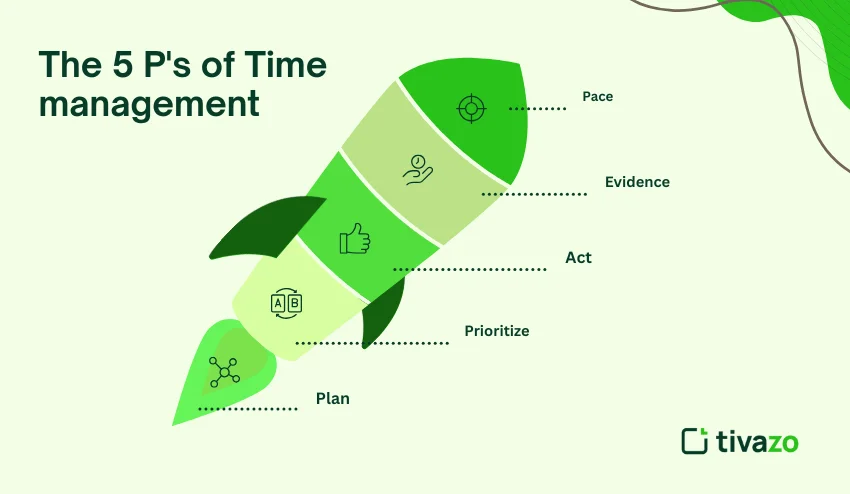
A standard formula of productivity is the 5 P’s:
| P’s | Meaning |
| Plan | Arrange the work in advance |
| Prioritize | Give priority to what is important |
| Act | Do not act in a procrastinating way |
| Evidence | Examine outcomes and enhance workflow |
| Pace | Work at a gradual sustainable pace |
These values will help you to avoid squandering time. Combined, they can assist you to keep organized and not waste time and energy as well as remaining productive in your daily routine. Learning the 5 Ps will make you conscious of how you use your time and create routines that can help you attain success in the long term.
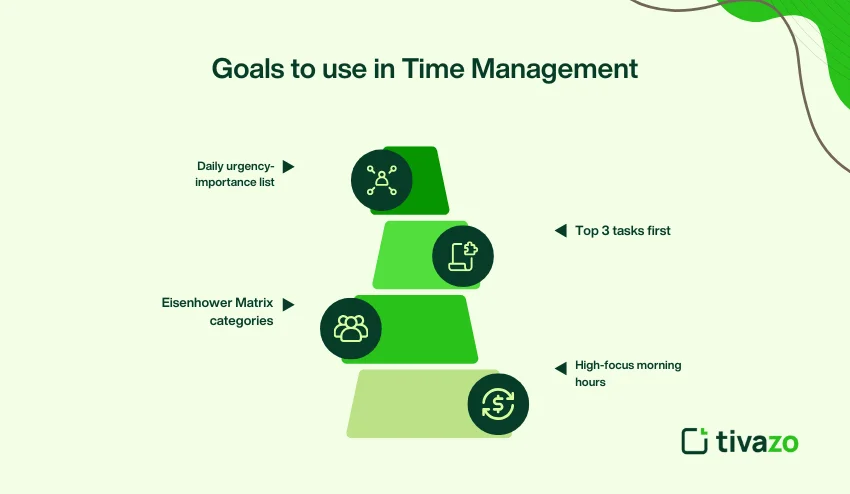
Examples of Goals to use in Time Management to be prioritized
- Prepare an urgency-importance list of tasks per day.
- Accomplish top 3 significant tasks first and then check email.
- Split tasks into 4 categories with the Eisenhower Matrix.
- Set up mornings in high work.
Assign time limits to every task so as not to have to switch between activities
Examples of Goal in Time Management to Accomplish Achievable Goals
- Establish SMART objectives of the weekly output at work.
- Splitting up big projects into small milestones.
- Establish achievable deadlines on the basis of performance.
- Measuring progress is driven, which measures improvements daily.
- Revise and modify goals on a weekly basis.
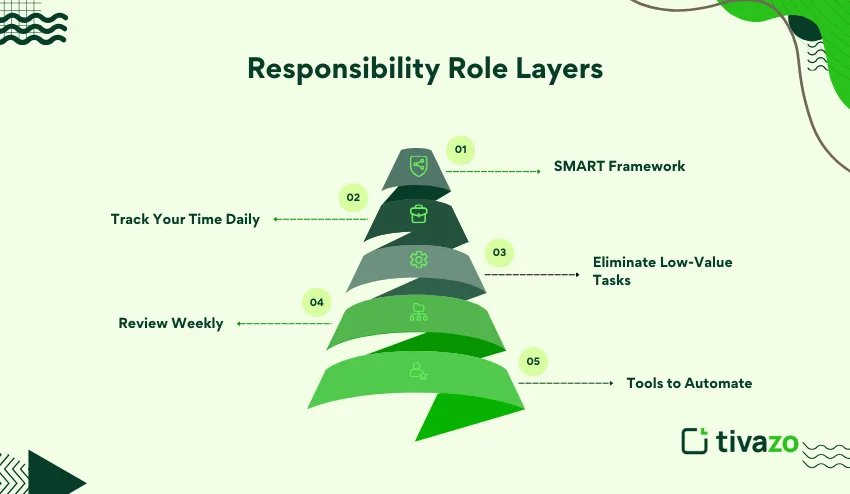
How To Set Time Management Goals (5 tips)
- Use the SMART Framework: Specific, Measurable, Achievable, Relevant, Time-bound goals help you to stay on track and stay responsible.
- Track Your Time Daily: You cannot measure what you do not measure, Tivazo makes this easy.
- Eliminate Low-Value Tasks: Eliminate non-growth, non-productive activities.
- Review Weekly :Measure weekly progress and improve your targets.
- Use Tools to Automate: Help save hours of work and improve productivity of the team in real time.
Time Management Goals Checklist
Before you begin setting new time management goals, use this checklist to make sure you’re creating goals that are practical, measurable, and aligned with your priorities.
Daily Checklist
- Identify your three highest-priority tasks.
- Plan your schedule before starting work.
- Block dedicated time for focused work.
- Minimize unnecessary notifications and distractions.
- Track how your working hours are spent.
- Take regular breaks to maintain productivity.
Weekly Checklist
- Review your completed goals.
- Identify tasks that consumed more time than expected.
- Adjust your priorities for the following week.
- Remove unnecessary meetings or low-value activities.
- Celebrate small improvements and completed milestones.
Monthly Checklist
- Evaluate your long-term goals.
- Measure improvements in productivity.
- Identify recurring time-wasting habits.
- Update your workflow based on lessons learned.
- Set new SMART goals for the coming month.
Using this checklist regularly helps you stay accountable, maintain consistent progress, and develop better time management habits over time.
Conclusion
Time management isn’t about filling up every minute of the day with work, it’s about making decisions that help you get something done. Clear, measurable goals, a focus on high-impact activities, and regular progress checks can boost productivity, decrease stress, and bring a healthier work-life balance.
Setting the right time management goals will give structure and direction to your daily activities, whether you are an employee, a manager, a student, a freelancer, a business owner, or a remote worker. Making small, regular improvements can have big long-term benefits and help to keep your focus on what’s really important.
Technology can also have an impact on promoting positive habits. With time tracking software, you can gain insight into how your time is being used, gain insights into trends in productivity, and make informed decisions that can lead to more efficient workflows. When your job becomes more demanding, it’s important to have some sort of positive measure of employee productivity that helps you keep the job on track for your personal job and life objectives.
Begin with one or two SMART time management goals, track them regularly, and adjust them as you go. By using the right strategies and tools, you can work more efficiently, get more done in less time, and develop habits that lead to sustainable success.