Have you ever heard yourself being assigned a task to do and then being blamed when something goes wrong? This workplace mixed-up situation makes the relevance of the knowledge of accountability and responsibility more significant than ever.
Although the terms are used interchangeably, the distinction between accountability and responsibility has an impact on leadership, ownership, and performance. The difference between accountability and responsibility aids the teams in not blaming, outlining, and enhancing outcomes.
Then there is the actual distinction between accountability vs responsibility? In simple terms, responsibility is concerned with getting the job done, whereas accountability is concerned with the possession of the result. Accountability vs responsibility in the workplace, in management and leadership, is what defines who does the job and who gets the blame for success or failure. The knowledge of this difference and the clear accountability vs responsibility illustrations make stronger teams and decision-making.
👉You May Also Like: 10 Proven Ways to Boost Employee Accountability Fast
What is Accountability?
Accountability means being answerable for the final result and taking ownership of what happens, whether it succeeds or fails.
In other words, Accountability is the obligation to own the final outcome of a task, decision, or result. It means being answerable for success or failure, regardless of who performed the work.
What is Responsibility?
Responsibility refers to the specific tasks or duties a person is assigned to complete. It focuses on performing the work and following instructions to meet expectations. In the accountability vs responsibility context, responsibility is about action and effort, while accountability belongs to the person who owns the final result.
📖Read More: What Are Responsibilities? 7 Key Insights to Master Them
Accountability vs Responsibility in the Workplace
The concept of accountability vs responsibility is vital in the workplace to ensure the efficiency of the team and their roles. Whereas responsibility is concerned with the accomplishment of assigned tasks, accountability makes sure that a person is held responsible for the end result. Being aware of the distinction between accountable and responsible roles assists leaders in delegating responsibilities properly, monitoring performance, and avoiding misunderstandings. Accountability vs responsibility in the workplace examples demonstrate that more than one person in the workplace can be responsible, yet the outcome of the work should be delivered by only one person, which would create a sense of ownership, trust, and enhance decision-making.
| Responsibility | Accountability |
| Assigned tasks or duties to complete | Owning the final outcome and results |
| Completing the work | Answerable for success or failure |
| Can involve multiple team members | Usually one person |
| Team members completing reports or tasks | Manager ensuring the project is delivered on time |
| Action and effort | Ownership and results |
| Ensures work is done | Promotes ownership, clarity, and trust |
Accountability vs Responsibility in Leadership
As a leader, it is necessary to know what accountability and responsibility mean to manage a team effectively. Leaders delegate duties to members of a team, and they are expected to accomplish everything effectively, yet they are expected to deliver the overall outcomes. Understanding the distinction between accountable and responsible positions can enable leaders to delegate work effectively without losing control over the results.
Responsibility in leadership refers to the duties or tasks that leaders give to the team members, like project execution, preparing reports, or communicating with clients. Accountability, on the other hand, is regarding the ownership of the success or failure of those tasks. Leaders play a role in the decisions, outcomes, and the work of their teams despite the presence of many individuals in charge of certain tasks.
📖You May Also Like: 5 Ps of Effective Leadership | Make Your Team Successful?
The development of a culture of ownership and trust can be achieved by defining the difference between accountability and responsibility in leadership clearly. The practice of this distinction by leaders promotes transparency, motivates employees to deliver and meet goals within the required time. The examples of accountability vs responsibility in leadership will allow the teams to learn about expectations, less confusion, and improve general effectiveness.
Accountability vs Responsibility Examples
Example 1: Project Management
- Responsibility: A team member is responsible for creating the project report, collecting data, and submitting it on time.
- Accountability: The project manager is accountable for the overall project’s success, ensuring the report is accurate, submitted on schedule, and meets client expectations.
Explanation: Multiple team members can handle parts of the work, but only the manager is answerable for the final outcome. This distinction between accountable vs responsible ensures clarity and prevents blame-shifting.
Example 2: Workplace Tasks
- Responsibility: An employee is responsible for sending weekly sales updates to the manager.
- Accountability: The sales manager is accountable for achieving sales targets and overall team performance.
Explanation: Responsibility is about doing the task correctly, while accountability is about owning the results. Understanding accountability vs responsibility in the workplace helps define clear roles and expectations.
Example 3: Event Planning
- Responsibility: A coordinator is responsible for booking the venue, arranging catering, and sending invitations.
- Accountability: The event director is accountable for the event’s success, ensuring everything runs smoothly and goals are met.
Explanation: While several people may be responsible for tasks, only one person is accountable for the final outcome, promoting ownership and better leadership.
How To Measure Accountability and Responsibility In The Workplace?
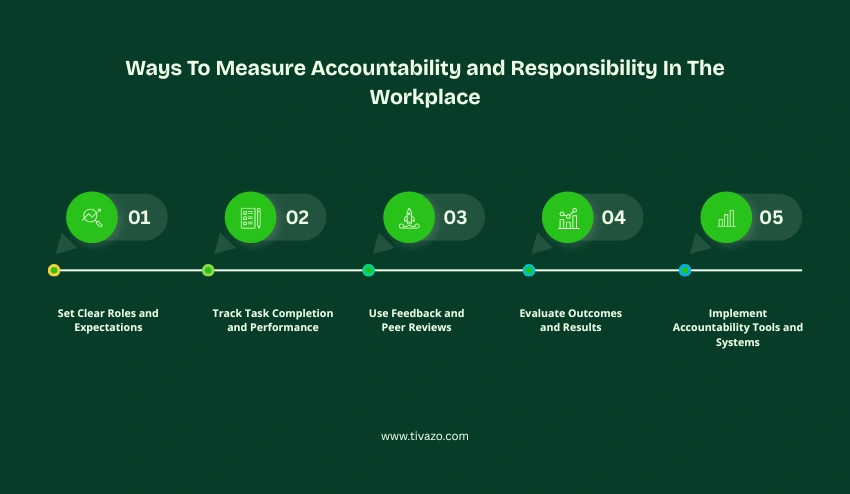
The accountability vs responsibility measurement at the workplace is one of the things that ensures that teams work effectively and the roles are not mixed up. It assists leaders in monitoring progress, locating gaps, and fostering ownership at all levels of the organization.
1. Set Clear Roles and Expectations
The initial step in the measurement of accountability vs responsibility in the workplace is the definition of roles. The employees clearly understand their duties and the person in charge, and this will minimize confusion and duplication of responsibilities.
Leaders are advised to state task expectations that are specific to deadlines, deliverables, and quality standards. It is possible to use tools such as responsibility charts or RACI matrices to understand who is responsible and accountable for each task.
The comparison of performance against these predetermined roles enables the managers to assess responsibility accomplishment as well as outcome accountability. It fosters an environment of ownership and clarity and enhances effectiveness in a team.
2. Track Task Completion and Performance
Responsibility is determined by how tasks are done and within the expected standard, and on time. It is easier to monitor the execution of tasks through project management software or a performance report to identify the person who is performing their duties.
The accountability is assessed with the help of the outcomes of the tasks. Leaders are expected to make sure that overall goals are achieved, even when employees are doing their job.
Frequent performance appraisal and feedback can be used to identify the difference between work responsibility and accountability of results to always improve and achieve the objectives of the organization.
3. Use Feedback and Peer Reviews
The insights on responsibility and accountability are given through feedback from colleagues, supervisors, and team members. Peer reviews point out the effectiveness of team members in performing the duties they are assigned and in making the group successful.
Responsibility is seen in the way people react to feedback, accept responsibility for the errors, and make changes. Leaders are able to evaluate the person who is always ready to take responsibility and own results in tough situations.
When the feedback is coupled with the performance metrics, organizations are able to build a balanced perspective of accountable vs responsible behavior to foster transparency and trust within the teams.
4. Evaluate Outcomes and Results
The ultimate results and the cumulative effect of work or projects are the main measures of accountability. The leaders should audit whether they have met their objectives and whether the results were satisfactory or not.
Responsibility is process-oriented and is concerned with doing things right and at the right time. Assessing the way work was done can be used to understand whether duties were managed properly.
The ability to measure both the completion and results of the tasks will make sure that teams know the difference between being responsible and accountable, which will help the leaders to enhance performance and acknowledge high performers.
5. Implement Accountability Tools and Systems
Accountability and responsibility are easy to measure using such tools as project management software, performance tracking applications, and task assignment systems. These tools give an insight into who does what and how to monitor the progress in real time.
Milestone reviews, progress reports, and outcome dashboards can be used as accountability systems. These make one accountable at all times, even in cases where tasks are handled by a number of individuals.
Accountability vs responsibility in the workplace can be constantly checked in the organization through the combination of technology and articulate policies, promoting the sense of ownership, efficiency, and improved cooperation.
The accountability vs responsibility measurement provides accountability and ownership and enhances performance within teams. Leaders can establish a culture of trust and efficiency by establishing expectations, monitoring activities, and assessing performance.
What Happens When Accountability Is Lacking?
The absence of accountability can also cause delays in tasks, unaddressed mistakes, and no one being accountable for the outcomes. This usually causes confusion, poor productivity, and a blame culture in the workplace.
The absence of accountability means that even the responsible employees can do their job, although the overall outcome will be worse since nobody will check that the goals are achieved and standards are kept. Groups are faced with a lack of roles, ineffective decision-making, and a lack of trust among teammates. In the long run, the absence of accountability may damage the morale of the employees, performance of the organization, and the credibility of the leaders, and thus, there is a need to create a clear accountability vs responsibility practice.

Conclusion
Learning how to distinguish between accountability vs responsibility is the key to achieving successful teams, leadership, and a productive work environment. Where responsibility is concerned with getting the tasks assigned done, accountability makes sure that one is held accountable for the end result. Defining accountable vs responsible roles will assist us to avoid confusion, minimize blame will be minimized and encourage ownership will be encouraged at all levels of an organization. Leaders can build trust, enhance performance, and ensure that all tasks and outcomes are addressed efficiently due to the application of clear definitions, practical examples of accountability and responsibility, and put in place systems to measure both.