The modern workplace is faced with a new challenge: too much work, too little understanding. Employees are overworked, deadlines are missed, and overall productivity is low. What’s the answer? Workload assessment.
If work is not allocated correctly, burnout occurs, and businesses suffer losses. Some team members are overworked, while others are not utilizing their time fully. It is a situation that affects morale and slows down a team.
Workload assessment provides a better understanding of what is going on in a team. It reveals who is doing what, how long it takes, and where the problems are. With a better understanding of what is going on in a team, managers can make better decisions, and teams can work better.
What Is Workload Assessment?
Workload assessment is a term that is used to refer to the evaluation of workload. In essence, it is a measure of workload, time, and employee potential.
To put it in a better perspective, workload assessment is like a checkup for a team’s productivity. You can learn a lot about your team’s workload by evaluating the tasks currently underway.
This is not just any normal checkup. It is a checkup that takes into account time, performance, and potential.
Workload Assessment vs Workforce Planning
Workload assessment and workforce planning are two terms that are often confused with one another.
Workforce planning is a process that guides an organization’s future hiring needs.
Workload assessment, on the other hand, is a checkup that is meant to ensure that a team is as efficient as it can be.
Why Workload Assessment Is Critical for Business Productivity
You may think that understanding your team’s workload is not essential. Well, let’s tell you why it is. It has become critical for business success. Business organizations that do not consider workload distribution will suffer dire consequences.
Analyzing your employees’ workload helps you identify problems you were unaware of. When you understand how work is distributed through your organization, you will be able to fix problems before they become out of control.
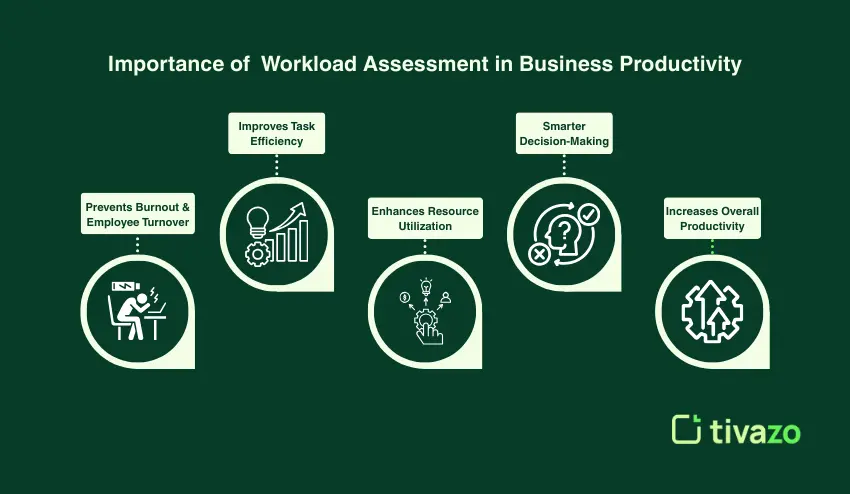
Prevents Burnout and Employee Turnover
Burnout is not just an issue for individuals; it affects businesses as well. When your employees are overworked, they do not just complain; they leave. Turnover leads to businesses losing money recruiting new talent. When you assess your employees’ workload, you will know who is likely to burn out.
By tracking how tasks are distributed through your organization, you will notice that some people are working longer hours than others.
Improves Task Efficiency
Some jobs need different amounts of work or varying skill sets. Workload evaluation helps you match the best person with the best job. This means seniors can focus on complex projects while juniors can focus on simple projects.
This will improve efficiency and reduce the time taken to finish projects. When you match the best person with the best job, you will realize that the person will be faster at the project. This means you will get more done without necessarily working longer hours.
Enhances Resource Utilization
Most teams have idle resources lying around. There are some team members whose skills are not being fully utilized. There are others who are not being assigned jobs despite the availability of time.
Workload monitoring tools will help you realize this, and then you can assign the jobs in a better way.
Supports Smarter Decision-Making
Intuition is not sufficient in managing teams. Therefore, you need to base your decisions on facts to ensure that you make the right decisions regarding your team’s workload, deadlines, and allocation of resources.
Knowing how long a task takes, how many projects require your team’s focus, and where delays happen is achievable with a workload analysis feature. Such a feature provides you with the facts you need to make informed decisions.
Therefore, you should consider a workload assessment feature to support your decision-making process.
Increases Overall Productivity
A team that operates with a proper workload is a productive team. A team that meets deadlines, provides quality results, and minimizes stress is a team that is in a positive productivity cycle.
Productivity is a key factor in a team, and it is achieved by ensuring that your team operates in a sustainable manner. A workload assessment feature is a tool that enables you to ensure your team operates in a sustainable manner.
Essential Components of a Good Workload Assessment
A good workload assessment needs multiple data points. You cannot use guesswork or assumptions. These are the essential components that you should consider.
- Task Identification: Identify all tasks and projects that your team is handling. These include regular tasks, one-off projects, and administrative tasks. Nothing should remain invisible.
- Time Tracking: Track actual time spent on tasks, not the time you think is required. You should know the actual time to conduct a good workload assessment.
- Resource Availability: You should know who is available and when. Consider holidays, meetings, training, and other activities that affect working hours.
- Performance Measurement: You should not just measure performance by tracking completion. You should also consider quality. Fast performance that needs constant revision is not efficient. You should measure accuracy, errors, and client satisfaction.
- Workload Distribution: You should identify who is handling tasks and look for patterns.
Step-by-Step Workload Assessment Process (Practical Guide)
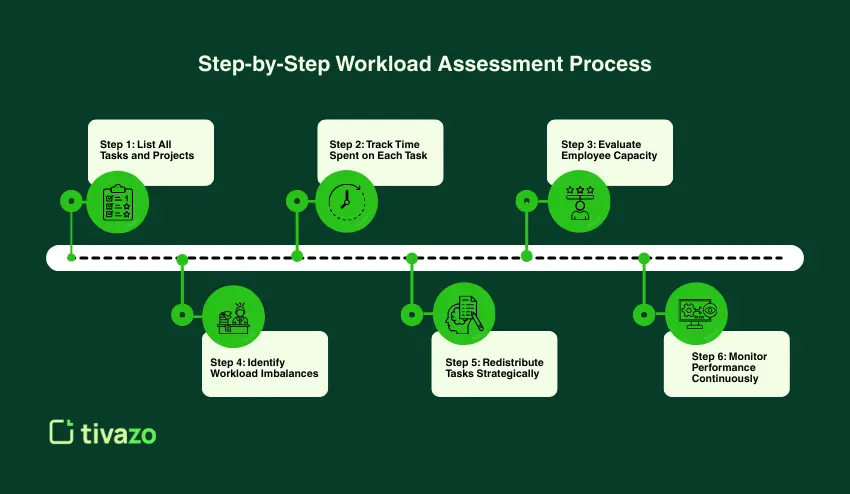
Are you prepared to do your workload assessment? The following is a sequential procedure that can enable you to get the right and practical results.
Step 1: List All Tasks and Projects
To begin with, it is necessary to make a thorough list. You need to collect information about all the team members concerning what they are doing. These are the tasks that should have the assigned projects alongside other tasks that are consuming their time.
Things that are little should not be overestimated. There is also time used in email management, meetings, and other activities. Everything would be recorded in one document or spreadsheet.
Step 2: Track Time Spent on Each Task
It is now time to gauge reality. Ask the members of the team to document their time commitment in every task at least two weeks. Time-tracking software should be used to document the correct data.
It is possible to record time manually, but not accurately. Team members can fail to keep a time record or can estimate their time instead of measuring it.
Step 3: Evaluate Employee Capacity
Determine the actual amount of productive time each employee has. Start with standard work hours and then remove meetings, breaks, and administrative time.
Employees have around 6 hours a day for productive work. Some jobs require more meetings than others.
Step 4: Identify Workload Imbalances
Compare the actual workload with the available capacity. Are some people always working beyond their capacity, and do others finish early with nothing left to do?
Also, consider skill level imbalances. Are high-skilled workers doing low-skilled work, and vice versa? This inefficiency will decrease productivity.
Step 5: Redistribute Tasks Strategically
Utilize the information gathered to redistribute the workload. You can redistribute the workload by transferring tasks from individuals with excessive workload to those with less workload.
Begin with small pilot projects. Implement new workload distribution for one week, then make permanent changes. Seek opinions from the employees concerned to improve the strategy used.
Step 6: Monitor Performance Continuously
The assessment of workload is not a one-off activity. It is essential to schedule periodic assessments to track changes and detect new imbalances. For most teams, reviewing the workload once a month is ideal.
Utilize productivity software for the assessment of workload. This will help you collect data easily and provide real-time insights into the performance of the team.
Real-World Workload Assessment Example
A marketing agency was experiencing reduced productivity and missed deadlines. Upon monitoring the time spent and assessing the workload, the agency found that two of their senior designers were handling 60% of the client workload, working over 50 hours per week, and that the junior staff had excess capacity.
In addition, the agency found that the administrative staff had 10 hours of work per employee per week.
The agency addressed the problem by reallocating the client workload, hiring a part-time administrative employee, and reviewing the workload on a weekly basis. After one month, the workload was balanced, and the agency was able to complete 25% more work than previously without any new hires.
This example illustrates the benefits of workload assessment by identifying the problems and providing the solution.
Common Challenges in Workload Assessment (And How to Fix Them)
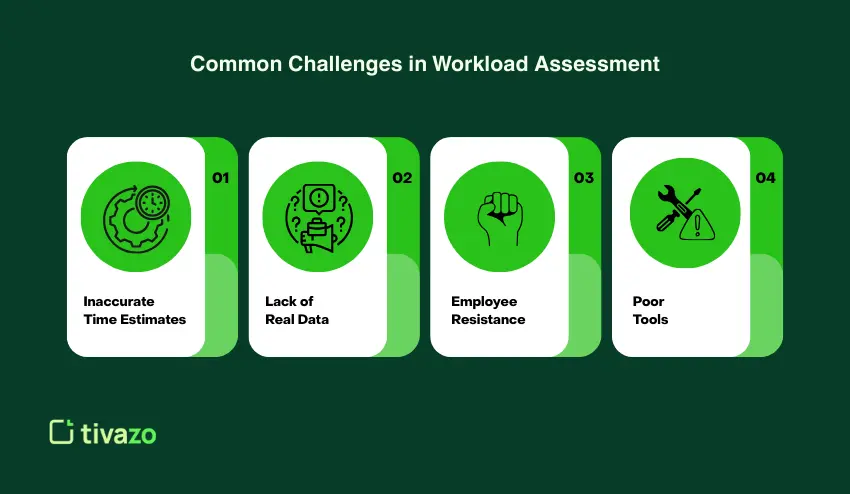
Even with good intentions, workload assessment may face challenges. Here are the common challenges and how they may be addressed.
Inaccurate Time Estimates
People are not good at estimating the time it takes to do tasks. They may end up underestimating the time taken for complicated tasks and overestimating the time taken for simple tasks.
Solution: Use actual time tracking data rather than relying on inaccurate estimates. Create a database of actual times taken for tasks.
Lack of Real Data
Some managers may not have actual data. Instead, they may be relying on assumptions. Some managers may assume they have actual data, but may not be collecting it.
Solution: Use time tracking tools that collect actual data. Make it a habit for it to become second nature.
Resistance from Employees
Employees may also perceive workload assessment as a form of micromanagement. Therefore, they may think that it will be used against them or that it will force them to increase their rate of work.
Solution: Explain to them that it is not meant to punish them but to ensure that there is a fair workload.
Poor Tools
Spreadsheets and manual tracking are tedious. Therefore, they are difficult and time-consuming. In most cases, teams end up abandoning the process altogether since it is too hard.
Solution: Invest in modern productivity software that can assist in automating data collection and reporting. Ideally, it should integrate all three functions.
Best Practices for Successful Workload Assessment
Tired of lackluster results from your workload assessment strategies? Well, you don’t have to be anymore! Simply follow these best practices that have worked for others.
Use Real-Time Data: There’s no point in using monthly reports to get a picture of your workloads only to realize that the figures are no longer current. Instead, use a tool that offers you real-time visibility of your workloads.
Involve Your Team: It makes a lot of sense to involve your team in your workload assessment strategies. They know where the problems are, and they may have a few ideas on how to fix them.
Review Regularly: It is essential to regularly review your workload assessment strategies. For fast-paced teams, it makes sense to do it on a weekly basis, while once a month may be more suitable for stable teams.
Use Automation and AI: There’s no point in using manual methods to do your workload assessment when you can use automation and AI to do the job for you.
Track Performance Trends: It is not enough to just track your workloads; you should also track your team’s performance trends over time to understand what’s going on.
How Productivity Tools Improve Workload Assessment
The current productivity tools make workload assessment easier by helping to gather data and provide real-time team performance. Rather than relying on assumptions, companies can now use these tools to track workload and make informed decisions in a timely manner.
The advantages of productivity tools in workload assessment:
- They assist in automating time tracking to gather workload data without relying on assumptions
- They provide real-time team workload to ensure timely decision-making
- They assist in identifying workload imbalances to avoid future problems
- They utilize team performance analytics to track productivity trends and any unusual activity
Workload Assessment for Different Industries
The concept of workload assessment is applicable in different industries with varying challenges. Below are how workload assessment can be applied in different industries.
Remote Teams
Remote teams face many challenges, especially in workload management. For instance, team leaders are unable to see which members are busy and which are available at any time, unlike in traditional teams, where you can see everyone in the office. However, workload assessment can help remote teams work more efficiently.
For instance, time tracking can be very effective in showing how many hours are being worked across different time zones. Remote teams can also benefit from asynchronous workload assessment.
Customer Service
Customer service teams face many challenges, especially in workload management. For instance, there are days with many tickets compared to other days with few tickets. However, workload assessment can help teams manage workloads efficiently during busy times and ensure no team member is overwhelmed with work during these times.
For instance, you can track the number of tickets each customer service employee is handling, as well as the rate at which they are responding to these tickets.
IT and Software Teams
The IT and software teams often underestimate the level of complexity in tasks. What may appear as a simple fix could end up taking days. With workload analysis and proper time management, teams can avoid overcommitting and meeting deadlines.
Development time, code review time, and testing cycles should be tracked and measured. With this data, teams can plan their sprint goals and work assignments appropriately.
Marketing Teams
Marketing activities are wide-ranging, and people in these teams have varying skill sets. With workload assessment, teams can ensure that people are working on appropriate projects.
Conclusion
Workload assessment is not just another management practice but has become an imperative for productive teams. The data you accumulate will not only highlight areas of inefficiency but also prevent burnout and optimize resources.
First and foremost, you should track time spent, list tasks to be completed, and then assess capacity. This investment will yield immediate returns as teams work more efficiently, employees are more relaxed, and more is accomplished without increasing resources.
Intelligent management of resources will fuel productivity growth. Do not wait for problems to reach a crisis point. Start your workload assessment today and build a stronger team.