One of the most critical and least understood aspects of payroll management involves overtime pay. Understanding how to compute overtime pay correctly is a key first step for any employer, HR professional, payroll manager, or business owner to ensure they remain compliant, properly manage labor expenses, and foster employee trust.
Payroll disputes, compliance fines, employee grievances, and legal repercussions are all possibilities if the overtime is calculated incorrectly.
It becomes even more difficult for businesses with hybrid or remote work teams that have work schedules across different time zones.
Employers today face a challenge of providing a dependable solution for keeping track of employee time, paying overtime correctly, and making sure payroll is accurate.
Overtime rules can vary depending on the type of workforce you have, from hourly workers to remote and field employees or shift-based staff.
In this complete payroll guide, you’ll learn:
- How employers calculate overtime pay
- FLSA overtime regulations and fundamentals of FLSA compliance.
- The overtime pay formula
- How bonuses and commissions affect overtime
- Some of the typical errors that employers may encounter in payroll.
- Why accurate time tracking is important.
- How Workforce Management Software Makes Overtime Payroll Easy to Handle
What Is Overtime Pay?
Overtime pay is the extra wages that employees are paid for working hours that are in excess of the standard work schedule.
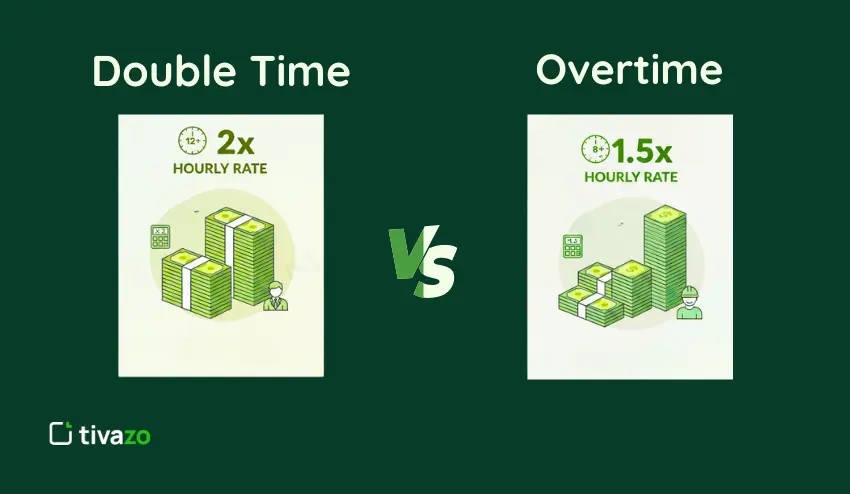
The Fair Labor Standards Act (FLSA) sets the minimum hourly rate to be paid for overtime in the United States at 1.5 times the regular rate of pay for any hours worked over 40 in a workweek. The Forbes overtime pay provides a helpful breakdown of how overtime calculations work for employers.
The most common overtime structure is called time-and-a-half pay.
For example:
- Regular hourly rate: $20/hour
- Overtime rate: $30/hour
- Overtime hours worked: 5
Total overtime pay:
- $30 × 5 = $150
With accurate overtime payroll calculation, employers can:
- Ensure compliance with labor laws.
- Avoid wage disputes
- Improve payroll transparency
- Control overtime costs
- Strengthen workforce trust
Manual timesheets and paperless payroll can often make overtime compliance difficult for businesses.
The need for integrated workforce solutions such as Tivazo time tracking, automated timesheets and reports has never been greater as many organizations search to streamline their payroll processes.
Understanding FLSA Overtime Rules
FLSA sets the federal overtime rules for employers in the United States.
The U.S. Department of Labor requires overtime pay for covered non-exempt employees who work more than 40 hours in a workweek.
Overtime laws may differ depending on the state, though. Several states also mandate overtime after a specific number of hours worked per day (daily overtime).
Key FLSA overtime principles include:
| Rule | Description |
| Standard Threshold | Overtime begins after 40 hours/week. |
| Overtime Rate | Minimum 1.5× regular pay |
| Eligible Workers | Non-exempt employees |
| Workweek Definition | Fixed recurring 7-day period |
| Recordkeeping | Employers must maintain accurate time records. |
Which Employees Qualify Best for Overtime?

Only some employees are eligible to work overtime. Employers’ calculation of overtime pay is dependent on understanding employee classification.
Exempt vs Non-Exempt Employees
The FLSA divides employees into two major categories:
1. Non-Exempt Employees
These employees are eligible for overtime pay.
For examples:
- Hourly workers
- Customer service staff
- Warehouse workers
- Technicians
- Administrative support staff
2. Exempt Employees
Generally, these employees do not qualify for overtime.
Common exempt roles are:
- Executives
- Certain administrative employees
- Some professional workers
- Highly compensated employees
One of the most frequent payroll overtime errors that employers make is the incorrect classification of employees.
Hourly vs Salaried Employees
Many employers believe that overtime is not paid on a salary basis. This is not necessarily correct.
Hourly Employees
Unless exempt, hourly workers generally must be paid overtime when they work more than 40 hours a week.
Salaried Employees
Even for salaried employees, overtime is possible in some instances, based on:
- Job duties
- Salary threshold
- State labor laws
- FLSA exemption status
The HR teams should complete regular employee classification reviews to ensure compliance.
How do Employers Calculate Overtime Pay?
When employers calculate overtime pay, they typically follow a structured payroll process.
Step 1: Determine Total Hours Worked
First, employers calculate the employee’s total hours worked during the workweek.
For example:
| Day | Hours Worked |
| Monday | 8 |
| Tuesday | 9 |
| Wednesday | 8 |
| Thursday | 10 |
| Friday | 9 |
Total Hours Worked = 44
Overtime Hours = 4
Accurate tracking is essential here. Businesses using manual spreadsheets often experience payroll discrepancies.
Tools like employee monitoring software by Tivazo help organizations maintain accurate attendance and work-hour records
Step 2: Calculate the Regular Rate of Pay
More than just an hourly wage bill, that regular rate includes benefits and other compensation.
It can also consist of:
- Non-discretionary bonuses
- Shift differentials
- Commissions
- Incentive pay
Standard Formula
Regular Rate = Total Weekly Pay / Total Weekly Hours.
Example:
- Weekly earnings: $880
- Hours worked: 44
- Regular Rate = $20/hour
Step 3: Apply the Overtime Pay Formula
The basic overtime pay formula is:
Regular Rate x 1.5 x Overtime Hours
extOvertimePay=extRegularRate*1.5*extOvertimeHours
Example:
- Regular rate: $20
- Overtime hours: 4
Calculation:
- $20 × 1.5 × 4 = $120
Total Weekly Pay:
- Regular pay: $800
- Overtime pay: $120
- Total: $920
This is the most typical method for calculating overtime pay that employers use
Step 4: Calculate Double-Time Pay (If Applicable)
States or company policies may call for double-time pay.
Double-time is typically observed when:
- Staff work more than the allowed daily hours.
- Employees work holidays
- Staff members work longer hours.
Double-Time Formula
- Regular Rate x 2 x Double-Time Hours
Example:
- Hourly rate: $25
- Double-time hours: 3
Calculation:
- $25 × 2 × 3 = $150
Employers with complex working patterns may find they need to track overtime across departments, which could be the case with workforce platforms such as Tivazo team management tools.
How Bonuses and Commissions Affect Overtime Pay?
Many employers don’t think about the effect of bonuses on overtime calculations. FLSA overtime rules could require adding non-discretionary bonuses and commissions to the employee’s regular rate of pay, according to the ADP overtime pay calculation guide.
Let’s take an example
Employee:
- Base earnings: $800
- Weekly bonus: $100
- Hours worked: 45
Total compensation = $900
Regular rate:
- $900 ÷ 45 = $20/hour
Overtime premium:
- $20 × 0.5 × 5 = $50 additional overtime premium
Without proper representation of bonuses, there can be payroll compliance risks.
Overtime Pay Calculation Examples
Understanding overtime becomes much easier when you look at real workplace examples.
Here are a few simple and practical scenarios that show how employers calculate overtime pay in everyday payroll situations.
Example 1: Hourly Employee Working Extra Hours
Let’s say Sarah works at a customer support company and earns $20 per hour. During a busy week, she works 46 hours instead of her usual 40.
Here’s how her employer would calculate overtime pay:
- Regular working hours: 40 hours
- Overtime hours: 6 hours
- Regular pay: 40 × $20 = $800
- Overtime rate: $20 × 1.5 = $30 per hour
- Overtime pay: 6 × $30 = $180
Total Weekly Pay
$800 + $180 = $980
This is the most common overtime pay formula employers use for hourly employees.
Example 2: Salaried Employee Eligible for Overtime
Many employers assume salaried workers never qualify for overtime, but that’s not always true.
Imagine David works as a non-exempt office coordinator with an annual salary of $52,000. One week, he works 50 hours due to a company project deadline.
To calculate overtime:
First, the employer converts his salary into an hourly rate.
- $52,000 ÷ 52 weeks = $1,000 per week
- $1,000 ÷ 40 hours = $25 per hour
Now calculate overtime:
- Overtime hours: 10
- Overtime rate: $25 × 1.5 = $37.50
- Overtime pay: 10 × $37.50 = $375
Total Weekly Pay
$1,000 + $375 = $1,375
This example shows why proper employee classification matters when employers calculate overtime pay.
Example 3: Remote Employee Overtime Calculation
Remote work has made overtime tracking more challenging for many businesses.
For example, Lisa works remotely as a marketing assistant and earns $22 per hour. During a product launch week, she works late several days and ends up logging 48 hours total.
Here’s the overtime calculation:
- Regular pay: 40 × $22 = $880
- Overtime hours: 8
- Overtime rate: $22 × 1.5 = $33
- Overtime pay: 8 × $33 = $264
Total Weekly Pay
$880 + $264 = $1,144
Without proper time tracking software, extra remote work hours like these can easily go unnoticed.
That’s why many businesses now use automated tracking tools to monitor overtime accurately and avoid payroll mistakes.
Example 4: Overtime with Bonuses Included
Bonuses can also affect overtime calculations.
Suppose an employee earns:
- Hourly rate: $18
- Weekly production bonus: $90
- Total hours worked: 45
The employer must include the bonus when determining the employee’s regular rate of pay.
Step-by-step:
- Regular earnings: 45 × $18 = $810
- Total earnings with bonus: $810 + $90 = $900
- Regular rate: $900 ÷ 45 = $20 per hour
Now calculate overtime:
- Overtime premium: $20 × 0.5 × 5 overtime hours = $50
Total Weekly Pay
$900 + $50 = $950
This is one of the overtime payroll calculations employers commonly overlook, especially when incentive bonuses are involved.
Example 5: Double-Time Pay Scenario
Some companies offer double-time pay for holidays or extremely long shifts.
For instance, Mike earns $25 per hour and works 3 hours on a company holiday that qualifies for double time.
Calculation:
- Double-time rate: $25 × 2 = $50 per hour
- Double-time pay: 3 × $50 = $150
Total Extra Holiday Pay
Mike earns $150 for those 3 hours worked.
5 Common Overtime Calculation Mistakes Employers Make
There are some common mistakes that employers make when calculating overtime. Even the pros can make overtime mistakes.
These are the most frequent errors that employers should steer clear of.
1. Misclassifying Employees
One of the biggest compliance threats is the mislabeling of workers as exempt.
This can result in:
- Back-pay claims
- Government penalties
- Legal disputes
2. Not using Bonuses in Regular Rate Calculations
Non-discretionary bonuses must often be included when calculating overtime. This can lead to underpayment risks if not dealt with.
3. Inaccurate Time Tracking
The manual time entry has issues like:
- Missed overtime hours
- Buddy punching
- Time theft
- Payroll inaccuracies
For businesses with teams spread out across the globe, the best employee tracking methods are essential to enhancing employee accountability.
4. Rounding Errors
Errors in time rounding can result in a build-up of payroll discrepancies.
Reliable digital timesheet systems should be used by employers rather than manual spreadsheets.
5. Not tracking remote work hours
Often, remote workers will work outside their hours without management oversight.
This results in the embedded overtime obligations.
An employer can track attendance accurately in real-time with a clock-in clock-out app.
Why Accurate Time Tracking Matters for Overtime Calculation
Accurate time tracking is the foundation of overtime payroll compliance. Without reliable attendance records, employers cannot correctly calculate employee overtime.
5 Benefits of Accurate Time Tracking
1. Payroll Accuracy
Precise tracking results in fewer payroll disagreements and payroll mistakes.
2. Compliance Protection
Accurate timekeeping documents ensure compliance with labour laws and audits for employers.
3. Workforce Transparency
Organizations that have clear payroll processes are trusted by employees.
4. Better Labor Cost Control
Managers are able to see overtime patterns and staffing inefficiency.
5. Remote Workforce Oversight
Hidden overtime is a problem that needs to be addressed with modern workforce monitoring tools for hybrid and remote teams.
Email, time tracking software, and payroll experts agree that companies that use time tracking automation greatly minimize payroll mistakes and administrative burden.
How Tivazo Helps Employers Track and Calculate Overtime?
Computing overtime payroll is a much easier task with modern workforce management software.
Tivazo automates overtime tracking, payroll reporting, and monitoring workforce productivity for employers.
1. Time Tracking
Tivazo automatically logs employee working hours on both office and remote and hybrid teams.
This helps employers:
- Prevent payroll disputes
- Improve overtime visibility
- Minimize manual tracking mistakes
Time Tracking Feature enables businesses to track attendance and overtime live.
2. Automated Timesheets
Paper time sheets can lead to payroll errors. The timesheets and reports feature of Tivazo will automatically process the employee’s work hours into payroll-ready reports.
Benefits are:
- Faster payroll processing
- Reduced administrative workload
- Better overtime compliance
- Employee Monitoring
It may be possible for remote teams to cause overtime issues without knowing.
3. Employee Monitoring
Software assists employers in monitoring the productivity, work patterns, and overtime trends.
4. Productivity Insights
Employers can identify:
- Depts that are producing excess overtime.
- Staffing shortages
- Inefficient scheduling patterns
Performance insights tools enable businesses to streamline their operations and reduce costs by optimizing their labor resources.
5. Overtime and Payroll Calculators
Tivazo also provides tools that simplify payroll calculations:
These are the tools that help employers accurately determine employee overtime pay and minimize payroll mistakes.
Mistakes to Avoid When Calculating Overtime Pay
Here are several payroll mistakes employers should actively avoid:
| Mistake | Risk |
| Misclassifying employees | Legal penalties |
| Using manual spreadsheets | Payroll inaccuracies |
| Ignoring state overtime laws | Compliance violations |
| Failing to track remote work | Hidden overtime costs |
| Incorrect bonus calculations | Wage underpayments |
| Poor recordkeeping | Audit complications |
Businesses that rely on outdated payroll systems often face avoidable payroll disputes and compliance challenges.
Best Practices for Managing Employee Overtime
Overtime management is not just about numbers on a payroll sheet.
1. Have a clear policy for overtime hours
Staff need to be well-informed about:
- Overtime approval procedures
- Work-hour expectations
- Time tracking requirements
2. Use Automated Time Tracking Software
Automated systems help to minimize manual payroll errors and increase accuracy.
3. Monitor Overtime Trends
Identify departments/teams that are consistently working overtime.
This helps identify:
- Staffing gaps
- Scheduling inefficiencies
- Burnout risks
4. Conduct overtime compliance training for Train Managers
Supervisors should understand:
- FLSA overtime rules
- Employee classification standards
- Payroll approval procedures
5. Audit Payroll Records Regularly
Regular payroll audits can help employers identify payroll mistakes before they become a legal issue.
Conclusion
It is important to know how to correctly compute overtime pay for all employers, payroll managers, HR people, and owners.
Overtime payroll calculations impact:
- Employee trust
- Labor law compliance
- Workforce productivity
- Payroll accuracy
- Operational costs
Overtime management becomes even more complicated as businesses transition to a hybrid or remote workforce.
The days of manual timesheets and spreadsheet payroll are behind us, and workforce visibility is a must.
Those that adopt a modern workflow management solution can minimize payroll errors, ensure adherence to regulations, and make the workplace more transparent.
With employee monitoring and reporting features, overtime calculators, and other tools such as Tivazo time tracking, payroll becomes easier and more effective for employers, while also keeping them compliant with overtime regulations.
For businesses looking to streamline their payroll operations and enhance payroll accuracy, try the Tivazo free trial to simplify overtime tracking and payroll management.