Hourly and salary are two common types of employee compensation, but they operate very differently. Hourly employees earn a wage based on the number of hours worked, while salaried employees receive a set amount during the year.
It’s a difference of more than just income. It can also change how overtime is handled, how predictable pay feels, what benefits are included, and how time is tracked. Understanding the difference between hourly and salary pay can help employees and employers make better decisions.
We will be discussing hourly vs salary pay, overtime regulations, benefits, and real-world salary comparisons. You’ll also discover how Tivazo tools, such as the hourly to salary converter, can make work hour tracking, payroll calculations, and employee productivity tracking a breeze.
If you are paid hourly, you are paid wages for each hour worked. Your income will vary depending on your schedule and the amount of overtime you work. Salary pay means you get paid a set amount each year, which usually gives you a more predictable income, but rules about overtime and benefits can differ depending on your role.
What is Hourly Pay?

Hourly pay is a form of compensation that pays workers according to the hours they work. The pay rate is determined by the employer, and the total amount of pay varies with the number of hours worked.
For Example
For instance, a worker who works 40 hours a week and makes $20 an hour will earn $800 before taxes.
Someone who works 40 hours a week and makes $30 an hour will earn $1,200 before taxes.
Timesheets, punch systems, or software are usually used to record the hours worked for hourly employees.
This is a model that is commonly used in businesses where schedules are constantly changing, as seen in the industry of tourism.
Some typical industries that pay hourly are:
- Retail
- Hospitality
- Construction
- Customer support
- Manufacturing
- Healthcare support roles
Most hours worked are overtime, according to labor laws. This means that after working beyond standard hours, employees will be paid more.
Many employers would rather pay someone on an hourly basis because it allows them to be flexible with them. You can hire employees on an as-needed basis, depending on the workload, seasonality, or need to hire personnel.
One of the benefits of being hourly paid as opposed to being salaried is that it is straightforward. Staff members are aware of their hourly pay earnings.
But sometimes earnings can go up and down. Increased hours may lead to higher weekly earnings, although this can be offset by lower hours during slow business times.
Numerous companies are now tracking their work hours and ensuring payroll accuracy through digital means. Time Tracking platforms, such as Time Tracking, enable companies to manage employee time effectively and decrease payroll mistakes.
What is Salary Pay?

A fixed compensation structure that pays employees a specific amount per year, without regard to hours worked, is known as salary pay.
Salaried workers have a set hourly vs salary instead of working on an hourly basis and are paid monthly, biweekly, or weekly.
For instance, if you work in a company that pays $60,000 a year, you are likely to get paid fairly throughout the year.
This type of compensation is typical in professional and managerial positions.
These are the industries that rely on salary pay:
- Technology
- Marketing
- Finance
- Human resources
- Management
- Corporate administration
Often, salaried employees can expect more stable earnings and better compensation packages. These packages can contain:
- Health insurance
- Paid vacation
- Retirement plans
- Bonuses
- Career development support
Part-time staff are paid by the hour, while salaried staff are paid a fixed amount of money for each week, month, or year that they work.
A lot of companies employ salary schemes to motivate long-term commitment and performance-driven development. Pay remains stable, too, which is another benefit for employers in terms of payroll.
For companies that maintain salaried staff, it is crucial to have the right tools to ensure better collaboration, scheduling, and productivity monitoring.
For companies with salaried employees, a tool such as Team Management can help with collaboration, scheduling, and productivity monitoring.
While salaried employment offers regular pay, work schedules are often worked longer than normal, with no extra pay.
Workers need to know the difference between an hourly and a salary system to assess the total value of a job rather than just the amount of money in their pockets.
Is it better to be paid hourly or a salary?
If a person desires overtime wages, flexibility, or part-time control, they should find a better hourly pay. The pay is strictly for hours worked: any overtime directly results in additional income. If hours are cut, however, income may vary.
Salaries are paid if you would like to receive a more predictable income every month. Typically, it involves perks such as bonuses, health insurance and paid leave. The downside is that additional hours don’t always translate into additional compensation, particularly for exempt positions.
In short: Overtime potential and flexibility versus stability and benefits. It is better to consider it according to the type of job, financial objectives, and lifestyle.
What is a $70,000 a year hourly rate?
Calculate how much your salary is per hour by using the standard 40 hours per week and 52 weeks per year (2,080 hours in total).
$70,000 ÷ 2,080 = $33.65 per hour (approx.)
Therefore, an annual income of $70,000 is approximately equal to $33.65/ hour before taxes and deductions.
How much is a $100,000 salary per hour?
With 2,080 hours of work per year:
$100,000 ÷ 2,080 = $48.08 per hour (approx.)
$100K would be roughly $48.08/hour in raw hours, before overtime rules and benefits, etc.
What is a $40,000 salary hourly?
$40,000 ÷ 2,080 = $19.23 per hour (approx.)
This is near the halfway mark for many occupations, on a full-time basis, depending on job and where you live.
Hourly vs Salary: Key Differences
When comparing hourly vs salary, stay tuned because there is more to it.
The two models differ in the rules of overtime, flexibility, benefits, and income stability.
| Feature | Hourly Pay | Salary Pay |
| Pay Structure | Paid based on hours worked | Fixed annual income |
| Overtime Rules | Usually eligible for overtime | Often exempt from overtime |
| Income Stability | Earnings may vary weekly. | Consistent paychecks |
| Schedule Flexibility | Shifts may change frequently. | Often, more stable schedules |
| Employee Benefits | Limited in some roles | Usually stronger benefits |
| Work Hour Tracking | Required | Sometimes less strict |
| Payroll Structure | Variable labor costs | Predictable payroll costs |
| Compensation Package | Focused on wages | Includes bonuses and benefits |
| Career Progression | Depends on the industry | Often tied to promotions |
| Productivity Tracking | Hour-focused | Performance-focused |
Need exact numbers? Use Tivazo’s Hourly to Salary Converter to calculate annual, monthly, biweekly, weekly, and daily pay instantly.
When considering salary versus hourly pay, workers should look at the entire compensation package, rather than just the base salary.
For instance, those who work more than 40 hours per week for an hourly wage might make more than a salaried employee.
Meanwhile, there could be better career prospects and benefits for employees in the salaried sector.
Another aspect that businesses consider when choosing between compensation structures is the labor cost structure.
Many companies prefer to hire hourly staff due to the fact that they have an unpredictable number of employees. Organizations that have a long-term strategic role generally opt for salaried employees.
Pros and Cons of Hourly Jobs
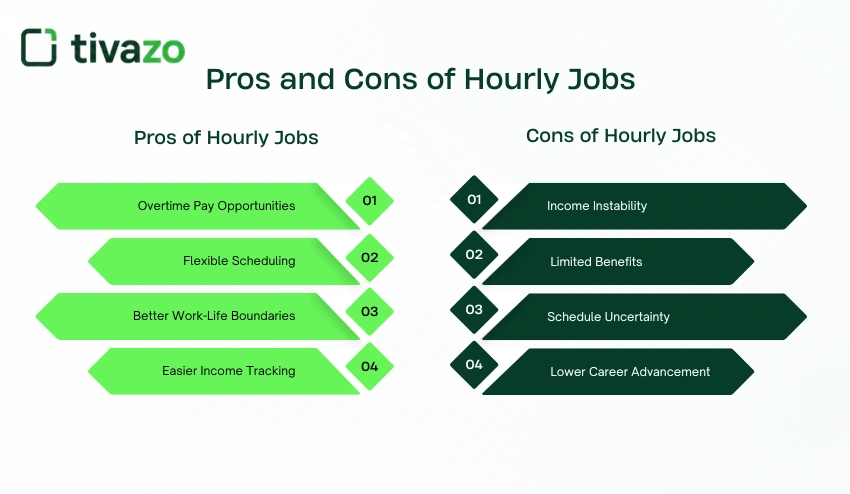
Overtime and flexibility come with hourly positions, but may lead to inconsistent earnings.
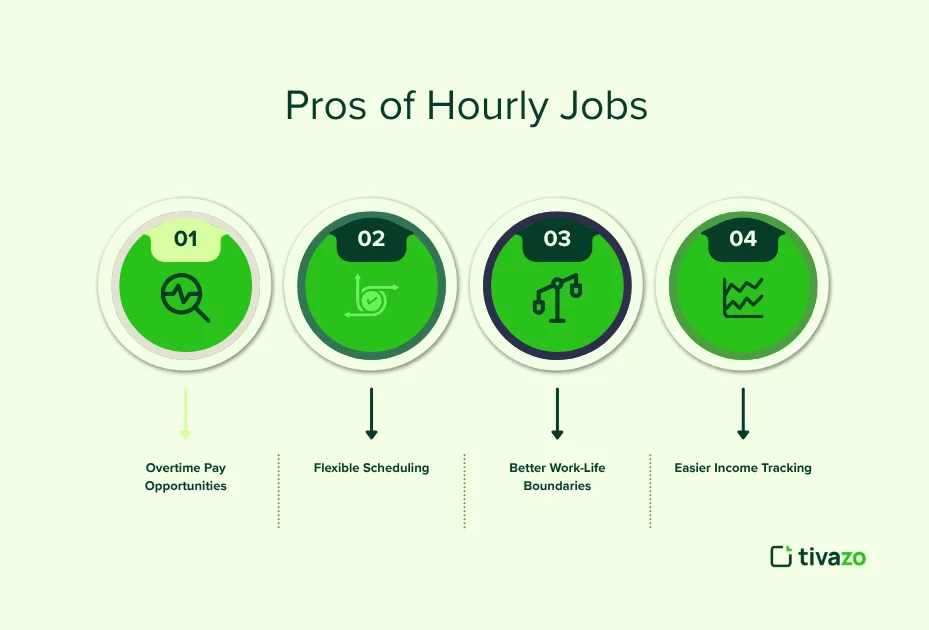
Pros of Hourly Jobs
1. Overtime Pay Opportunities
Among the biggest benefits of an hourly vs salary position is the possibility of working overtime.
An employee who works more than the standard 35 hours a week may receive an overtime wage of 1.5 times their standard hourly pay rate. This can really boost your monthly income.
2. Flexible Scheduling
There are a lot of jobs that offer flexibility for their work hours. The shifts, part-time jobs, or seasonal work may be flexible and determined by workers’ availability.
3. Better Work-Life Boundaries
Most hourly vs salary workers are typically only paid for the hours they are scheduled to work.
This helps to distinguish the activities of work from the activities of the private sphere, as unpaid work after working hours is less frequent.
4. Easier Income Tracking
Staff can easily work out their pay based on hours worked. With tools such as the Time Card Calculator, the weekly and monthly calculations of payroll are easier.
Cons of Hourly Jobs
1. Income Instability
Hours may vary from week to week based on staffing needs. Fewer shifts may come as a surprise and affect monthly earnings.
2. Limited Benefits
There are certain benefits that hourly employees don’t receive as much as salaried employees. Part-time staff will often have no health or retirement benefits.
3. Schedule Uncertainty
A shift-based job could be a night, weekend, or rotating shift. Spending time in long-term planning can be a challenge due to this unpredictability.
4. Lower Career Advancement
Some jobs that pay by the hour have a slower career trajectory. May be fewer opportunities for promotion and leadership than in corporate settings with salaries.
Attentiveness toward the working crew is essential for businesses with staff working on hourly vs salary schedules.
When it comes to workforce visibility and attentiveness, businesses that have staff on hourly schedules can use the Employee Monitoring tools.
Pros and cons of Salary Jobs
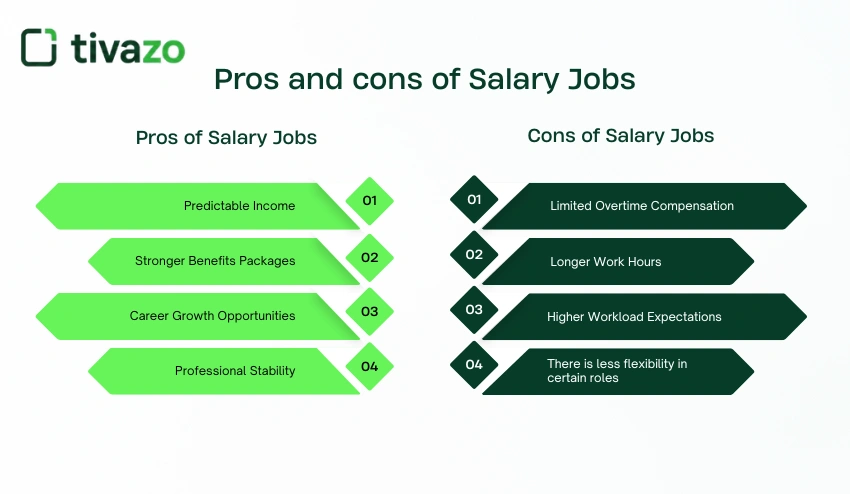
While salaries offer stability of income and employment prospects, they can also include extended periods of work without pay.
Pros of Salary Jobs
1. Predictable Income
Salaried staff are paid a fixed salary. This simplifies budgeting, financial planning, and taking out a loan.
2. Stronger Benefits Packages
A comprehensive compensation package often accompanies a salary position.
These can range from health insurance, retirement contributions, bonuses, and paid leave.
3. Career Growth Opportunities
Salaries are a common form of compensation in many management and leadership positions.
There are frequently more clear advancement opportunities and professional development opportunities for staff.
4. Professional Stability
Salaried positions can provide a degree of job security and career paths. In general, companies invest more in long-term employees who get paid a salary.
Using Performance Insights, organizations can measure productivity and performance trends to analyze team efficiency.
Cons of Salary Jobs
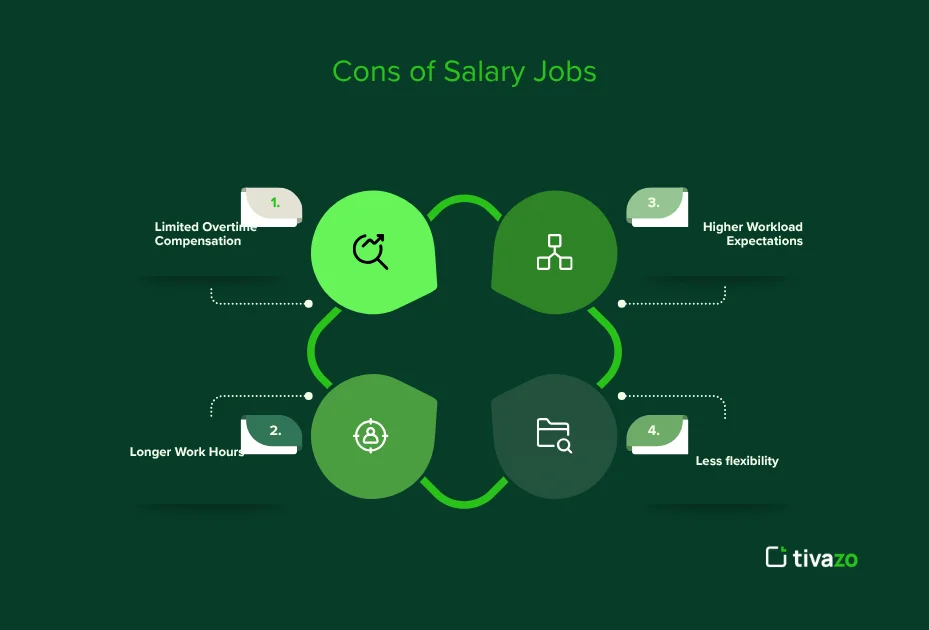
1. Limited Overtime Compensation
Extra overtime pay is not received by many paid employees. This can lead to lower hourly wages during peak times.
2. Longer Work Hours
There is a lot of overtime among managers and professionals. Late meetings and project deadlines are typical, as are after-hours communications.
3. Higher Workload Expectations
Employers can look at the results rather than the number of hours worked. This can sometimes add to the stress and workload due to the pressure.
4. There is less flexibility in certain roles
Some salary positions have regular office hours or are on-call. It can be more difficult to achieve a work-life balance during busy work hours.
There are advantages and disadvantages to working on an hourly or a salary basis, depending on the industry, management, and individual preference.
Overtime Differences
One of the biggest disparities in hourly versus salary compensation lies in overtime policies. Overtime rules can help employees make an accurate overtime estimate.
Hourly Overtime Rules
Labor regulations typically allow hourly employees to be compensated for overtime.
Many workers in the area get overtime compensation for working more than 40 hours per week.
The normal overtime rate is 1.5 times the regular hourly wage.
For example:
Normal hourly rate: $20
Overtime rate: $30
For an employee who has 10 hours of overtime each week, that extra pay can add up.
Businesses rely on automated work hour tracking systems to prevent payroll issues and overtime mistakes.
For employees, use the Overtime Calculator to accurately estimate Overtime earnings.
Real-World Salary Examples
| Hourly Rate | Weekly Income | Monthly Income | Yearly Income |
| $15/hour | $600 | $2,600 | $31,200 |
| $20/hour | $800 | $3,466 | $41,600 |
| $30/hour | $1,200 | $5,200 | $62,400 |
These examples show how hourly pay scales into annual income depending on working hours.
Hourly or salary – Which is better?
No one can tell you: Hourly vs. salary. It will be influenced by your lifestyle, financial objectives, and career stage.
Hourly pay might be preferable when:
- You want flexibility
- You need to earn more money
- You are employed part-time or as a freelancer
If you would like to earn a salary, consider it when:
- You want to be financially stable.
- You enjoy having your work schedule organized.
- You’re looking for a long-term career path.
- You’re after a long-term career trajectory.
Both systems have pros/cons based on individual preference.
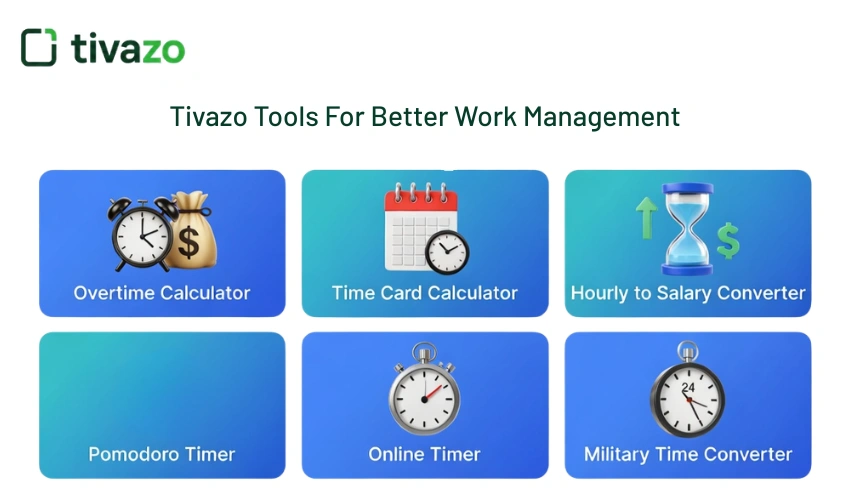
Tivazo Tools for Better Work Management
When you know your work hours and income, it’s easier to understand the concept of hourly vs salary.
Tivazo offers several tools to assist professionals and teams in managing time and productivity effectively:
- Make use of the Overtime Calculator to estimate extra earnings.
- Record work hours for the day using a Time Card Calculator
- Instantly convert wages to and from an hourly rate with the Hourly to Salary Converter.
- Take advantage of the Pomodoro Timer for better concentration and productivity!
- Explore the Online Timer to track tasks
- The Military Time Converter is used to schedule shifts based on military time.
These tools assist workers and businesses in comprehending the actual productivity and compensation trends.
Tivazo Workforce Management Features
Tivazo also offers advanced staff management capabilities, in addition to its tools:
- Time Tracking: Keep a proper record of workers’ time and enhance productivity analysis.
- Team Management: Track and report on teams easily.
- Employee Monitoring: Know the utilization of the work time in projects and tasks.
- Live Screenshots: Track work activity of remote or distributed work crews.
- Performance Insights: Review employee productivity and performance.
- Timesheets and Reports: Create precise reports of hours worked that can be used to calculate payroll.
These attributes make it easy for companies to compare the productivity of both hourly and salaried employees.
Conclusion
It’s vital to know the difference between hourly and salary pay before making savvy career choices. There are benefits to each pay system, depending on your financial requirements, lifestyle, and work objectives.
Hourly positions can be flexible and offer overtime earning opportunities; salary positions can be stable and long-term.
Use tools such as the Hourly Salary Calculator, Overtime Calculator, and Time Card Calculator to better understand your earnings and work patterns.
They enable you to estimate income precisely, record working time, and boost productivity.
Track hours, calculate salaries, and manage workforce productivity efficiently with Tivazo tools.