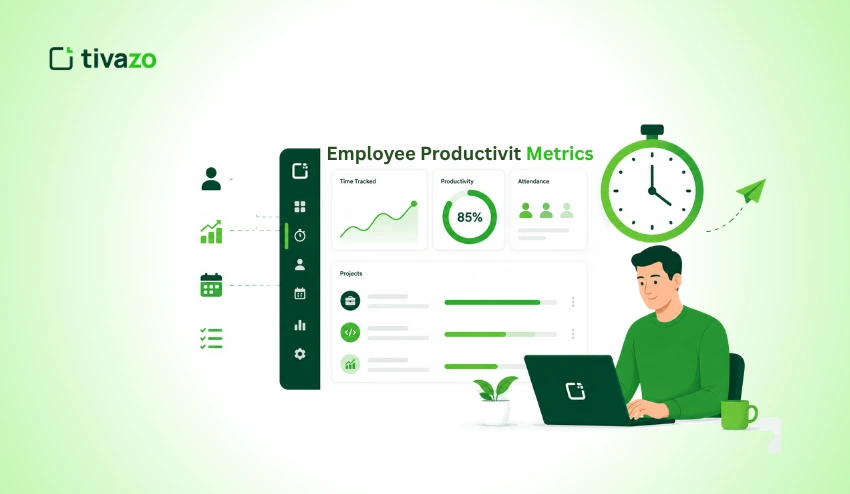
One of the top metrics used to measure business success is employee productivity metrics. With hybrid working, remote teams, flexible work options, and digital collaboration, just counting attendance or work hours is no longer sufficient.
Managers should have meaningful employee productivity metrics that show how efficient employees are, the quality of their product, and what their contribution to the business is.
The study by Gallup, McKinsey & Company, and Microsoft shows that companies that rely on data to inform workforce decisions tend to have better employee engagement, more efficient operations, and greater financial results. Good managers don’t work by guess and by golly; they know what they are seeing by looking at data.
Successful managers don’t keep assuming, they are measuring what is happening, and then they know how to work smarter instead of harder.
The objective of measuring productivity metrics is not to monitor all clicks or all minutes, however.
Productivity is a blend of efficiency, quality, teamwork, uniformity, and staff happiness. A team that does more, but does it badly, does not do anything.
Similarly, overworked staff might seem to be productive in the short term, but over time workers are more prone to burnout in the long run and therefore less productive.
For many companies, it’s not a question of whether they have data, it’s which metrics they should be tracking. Too many key performance indicators (KPIs) can lead to confusion, and too few can lead to unhealthy work practices.
The ideal organizational companies balance the measurement of outcomes and processes that lead to sustainable performance.
This guide covers all the information managers should know about employee productivity measures—what they are, why they are important, how to select the right ones, and which ones provide the most useful information.
You’ll also discover practical formulas, real-world examples, department-specific recommendations, productivity benchmarks, and best practices for creating an effective productivity dashboard.
From startups to small business growth, to large businesses, you can make informed and data-driven decisions to enhance employee performance, boost team productivity, and ensure long-term success.
Key Takeaways
- Employee productivity metrics measure how efficiently employees convert time, effort, and resources into valuable business outcomes.
- The best organizations track a balanced mix of productivity, quality, efficiency, and employee engagement metrics instead of relying on a single KPI.
- Every department should use role-specific KPIs, as the right metrics vary between sales, engineering, HR, customer support, and operations.
- Productivity should be measured by business outcomes, not simply hours worked or employee activity. Regularly reviewing productivity data helps improve workforce planning, resource allocation, operational efficiency, and employee development.
- Modern tools like Time Tracking, Employee Monitoring, Performance Insights, and Timesheets and Reports help automate productivity measurement and provide actionable workforce insights.
- Tracking the right productivity metrics enables managers to make data-driven decisions, improve team performance, and support long-term business growth.
Quick Answer
Employee productivity metrics are tools that measure employee efficiency in converting time, effort, and resources into valuable business outcomes. The best organisations take multiple productivity, quality, efficiency, and engagement metrics, not a single KPI.
Tools such as automatic time tracking and performance analytics empower businesses to make informed decisions, streamline operations, and foster a more productive work environment.
What is an Employee Productivity Metric?
Employee productivity metrics are quantitative indicators that allow businesses to assess employee output and effectiveness in meeting business goals.
These metrics offer objective information regarding the performance of each person, team, or organization, which allows managers to understand their strengths, pinpoint inefficiencies, and make informed decisions.
Instead of just relying on “gut feel” or periodic reviews, businesses track ongoing trends in employee productivity with the use of employee productivity KPIs.
These metrics help to determine if staff are creating effective products on schedule, making good use of time, and meeting goals.
Today’s digital workplace offers the capability to measure productivity using workforce analytics platforms that automatically pull data from time-tracking platforms, project management, communication, and collaboration tools.
With automatic time tracking, organizations can obtain more accurate productivity insights, minimize manual errors, and have real-time visibility into team productivity and how work is being done.
Employee Productivity Metrics Definition
Employee productivity metrics are quantitative and qualitative measures that assess the effectiveness of employees using time, skills, and resources to generate beneficial and meaningful results for businesses.
In simple terms:
Employee Productivity = Valuable Output / Resources used
The resource material could contain:
- Working hours
- Labor costs
- Employee effort
- Technology
- Materials
- Project budgets
The results vary by job and/or sector. For example:
- A salesperson may be measured by revenue generated.
- A software developer may be measured by completed features and code quality.
- A customer support representative may be evaluated using ticket resolution and customer satisfaction.
- A marketing specialist may be assessed by qualified leads or campaign performance.
There is no universal productivity measure, as every role creates value differently. Instead, organizations should select metrics that would be relevant for each person’s role and business goals.
Why Employee Productivity Metrics Matter?
Having no data to rely on, managers may use assumptions that don’t accurately represent performance. A worker can sometimes look like he is very busy, but actually accomplish very little; another may be less visible but more productive.
By measuring employee productivity metrics instead of making an educated guess, this guesswork can be avoided.
Effectively measuring productivity will enable organizations to:
- Identify high-performing employees and teams.
- Detect workflow bottlenecks early.
- Improve project planning and resource allocation.
- Reduce unnecessary overtime.
- Support fair performance evaluations.
- Increase operational efficiency.
- Improve customer satisfaction through consistent service quality.
- Make better hiring and staffing decisions.
- Build a culture focused on continuous improvement.
Rather than relying on productivity metrics to check the work of employees too often, effective companies leverage productivity as a tool for coaching and development, collaboration, and improved decision-making.
Employee Productivity Metrics vs. Employee Performance Metrics
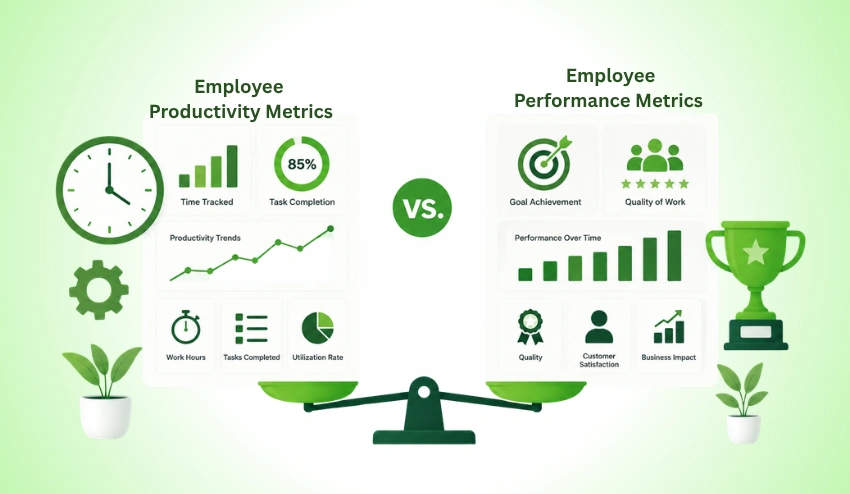
Although these terms are often used interchangeably, they measure different aspects of work.
| Employee Productivity Metrics | Employee Performance Metrics |
| Measure efficiency and output | Measure overall job effectiveness |
| Focus on quantity, speed, and resource usage | Focus on quality, behavior, competencies, and results |
| Usually data-driven and numerical | Often combine quantitative and qualitative evaluation |
| Help improve workflows | Help evaluate employee development and long-term success |
For example:
Customer support staff can handle 50 tickets a day, which is a high rate of productivity. But if the customers always provide a low satisfaction score, then the overall performance could still be improved.
On the other hand, an employee who resolves fewer tickets but has very high levels of customer satisfaction and accuracy could provide a better overall business value.
The best organizations integrate employee productivity measurement with other employee performance measures.
Analyzing employee performance time data enables managers to assess both the volume and quality, consistency, and overall contribution of employees.
Productivity vs. Activity: Understanding the Difference
The number one error that companies make is to take “activity” for “productivity.
Activity is the amount of work that an employee seems to do.
Examples include:
- Sending emails
- Attending meetings
- Logging hours
- Responding to messages
- Switching between applications
This can be interpreted as employees being productive, but it does not necessarily mean that they are adding value to the business.
Productivity, in contrast, is a measure of meaningful outcomes.
Examples include:
- On-time project completion.
- Closing sales
- Resolving customer issues
- Delivering high-quality code
- Generating accurate financial reports.
- Meeting strategic goals
Consider two employees:
- Employee A has a 10 hr daily work schedule and works on 5 tasks.
- Employee B does 7.5 hours of work and achieves 8 high-quality tasks.
Employee B is more productive, even though they work fewer hours, because they can create more value with fewer resources.
This is particularly critical for hybrid and remote teams. Successful organizations don’t just measure employee time online or attempt to track employee hours to see how long they’re on the job; they measure the impact of that work, whether in the form of a completed project, the quality of work, customer satisfaction, innovation, or business impact.
Employee Productivity Metrics Examples
Some of the most common employee productivity metrics are:
- Output per employee
- Revenue per employee
- Task completion rate
- Goal achievement rate
- Productivity per hour
- Employee utilization rate
- Project completion rate
- Quality score
- Error rate
- Customer Satisfaction Score (CSAT)
- Employee engagement score
- Focus time
- Active working time
- Collaboration efficiency
- Training completion rate
- Employee turnover related to productivity
These metrics give a different look at the workforce’s performance. It is not a single KPI, but a combination of employee productivity metrics that should be used to create a balanced perspective of efficiency, quality, teamwork, and long-term performance.
Why Measuring Employee Productivity Matter?
Monitoring employee productivity metrics is not just about assessing productivity, it’s about making better decisions, enhancing productivity, and building a workplace environment in which employees can thrive.
By consistently measuring the right metrics, managers can receive valuable insights into how the work is being done, pinpoint challenges and opportunities, and make better decisions about how teams can improve over time.
Instead of making assumptions or conducting periodic evaluations of employee performance, businesses can utilize real-time data to streamline processes, make informed resource decisions, and nurture employee growth.
This is particularly relevant given the recent changes in the work environment, including remote and hybrid work, which have made tracking work outcomes more relevant than tracking attendance.
The following are some of the most important reasons why it is important to measure employee productivity.
1. Supports Better Decision-Making
Productivity data can give managers facts and figures to replace guesswork. Employers can avoid making assumptions about employee performance and instead find out if there are any trends, reward those who are doing well, and deal with problems before they become big issues.
In this way, productivity indicators can show if there is a problem of workload, staffing, inefficient processes, or lack of resources for one team and not the other.
Measuring data allows managers to make better decisions and improve team performance and business outcomes.
2. Improves Workforce Planning
Effective workforce planning requires an understanding of employees’ time use and the amount of work they can manage.
Managers can use workload distribution and task completion data and capacity analysis to:
- Prevent employee burnout.
- Distribute workload evenly between teams.
- Predict future job requirements.
- Improve project planning.
- Improve resource utilisation.
By leveraging Timesheets and Report, managers can access past work history, pinpoint productivity patterns, and make informed hiring choices by taking into account their real performance and not guessing.
3. Optimizes Resource Allocation
All businesses are constrained by time, resources, and manpower. Productivity measurement assists managers to ensure that such resources are used efficiently.
For example, if staff are doing a substantial amount of repetitive administrative tasks, managers can automate these or restructure processes so that staff can spend more time on higher-value work.
Measurement of productivity can also be used to determine whether workers are not being used to their full capacity and overburdened teams can be balanced accordingly.
4. Drives Continuous Performance Improvement
Productivity metrics feed back to employees on a continuous basis rather than just at the end of the year.
Data can be used by managers to:
- Set realistic goals.
- Identify coaching opportunities.
- Recognize high performers.
- Remove workflow bottlenecks.
- Improve team collaboration.
What successful companies do is use productivity data to coach their employees, rather than as a micromanagement tool.
Solutions built to deliver Performance Insights will enable managers to see long-term productivity trends, compare team performance, and offer constructive feedback based on the objective data.
5. Supports Employee Development
Productivity indicators identify areas of learning and skill development.
For example:
- Employees with high error rates may benefit from additional training.
- Team members who consistently exceed expectations can mentor others.
- Employees struggling with workload management may need process improvements rather than increased supervision.
Managers can then use productivity information to develop targeted experiences based on regular feedback, which can boost employee performance and satisfaction.
6. Supports cost control of operations
Low productivity can result in increased labor expenses, excessive overtime, project delays, and poor use of resources.
Monitoring key workforce productivity metrics helps businesses:
- Reduce wasted time.
- Minimize project delays.
- Improve scheduling.
- Lower operational expenses.
- Improve the productivity of labour.
Organizations that regularly track productivity can more effectively spot inefficiencies early before they impact profitability.
7. Increases Business Profitability
The performance of a business is directly related to the productivity of its employees.
When workers do good quality work promptly:
- Projects finish faster.
- Customer service is improved.
- Revenue increases.
- Operating costs decrease.
- Profit margins improve.
The Organisation for Economic Co-operation and Development and the World Bank have confirmed that productivity growth is one of the most significant sources of economic performance and competitiveness of the organisation.
Improving productivity is often more valuable for businesses of any size than just working more.
8. Makes Hybrid and Remote Work More Effective
But it’s not about being in the same room when managing distributed teams, it’s about being able to see the result.
Organizations shouldn’t ask whether employees are online during the day, they should ask:
- Completed tasks
- Project progress
- Goal achievement
- Collaboration
- Work quality
- Customer outcomes
But modern Employee Monitoring solutions can help managers to discover and gain insight into work patterns and ensure transparency and accountability. Monitoring tools can be effective and helpful when applied with effective communication and employee buy-in, and they do not bring about micromanagement.
9. Improves Customer Satisfaction
The productivity of employees has a greater impact on customers than a lot of companies realize.
The most productive workers are likely to:
- Respond faster.
- Complete work on schedule.
- Produce fewer errors.
- Solve customer problems in a more efficient way.
- Ensure that services are of a consistent quality.
These enhancements result in greater customer satisfaction, deeper customer relationships, and higher customer retention.
Always keep the productivity metrics in line with the quality measures so that the increase in speed doesn’t compromise customer experience.
How to Choose the Right Productivity Metrics?
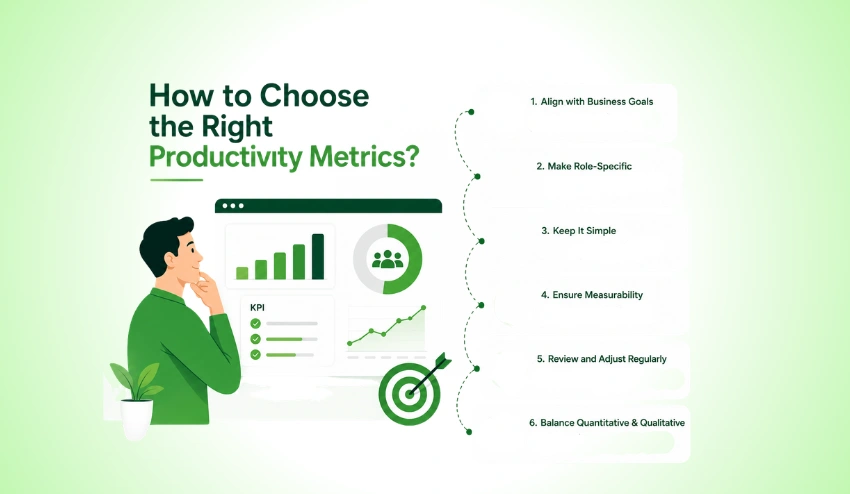
Not all metrics will be relevant to all organisations. Most effective employee productivity indicators are related to business goals, based on the roles employees have to play and drive long-term rather than short-term performance.
Six best practices for selecting appropriate measures of productivity.
1. Align Metrics with Business Goals
Every productivity metric should support a specific business objective.
For example:
| Business Goal | Recommended Metric |
| Increase revenue | Revenue per Employee |
| Improve efficiency | Productivity per Hour |
| Enhance customer experience | Customer Satisfaction Score |
| Reduce project delays | Deadline Compliance |
| Improve quality | Error Rate and Quality Score |
When metrics directly support organizational goals, they become more meaningful and actionable.
2. Match Metrics to Job Roles
Value is created in a variety of ways.
For example:
- Sales teams might concentrate on money generation.
- Completed features and code quality may be emphasized for software developers.
- Customer support teams can monitor the time it takes to resolve issues and customer satisfaction.
- HR teams can assess their hiring efficiency and employee retention.
Different departments may have different productivity measures, and this can create misleading results if they are used for all departments.
3. Avoid Vanity Metrics
Not all numbers that can be measured are indicative of actual productivity.
Some examples of vanity metrics are:
- Hours spent online
- The number of emails sent
- Meeting attendance
- Mouse movement
- Keyboard activity
These markers can reveal activity, but they don’t tend to capture the actual results of business.
Rather, concentrate on metrics that show real value creation.
4. Equities between Quality and quantity
Increased output is not always correlated with increased performance.
For example:
Overall productivity is low if they’ve been able to do double the amount of customer support tickets, but people are coming back to the same problem, which is not being solved.
The following three elements of a balanced productivity measurement system are combined:
- Output
- Efficiency
- Accuracy
- Customer satisfaction
- Goal achievement
This gives a more comprehensive view of employee performance.
5. Include Employee Well-Being
Healthy workers are essential for sustainable productivity.
If overtime, workloads, and declining engagement have been a recurring issue, then you will likely have a productivity challenge on your hands.
The following indicators should be used by managers:
- Overtime hours
- Workload balance
- Employee engagement
- Absenteeism
- Focus time
Employee wellness programs can mitigate the risk of employee burnout and maximize overall productivity.
6. Periodically review and revise metrics
Productivity measures need to be flexible if business priorities evolve with time.
Managers need to check their key performance indicators every three months or when:
- Business goals change.
- Teams expand.
- New technologies are implemented.
- Workflows are redesigned.
- Organizational priorities shift.
Routine reviews help to maintain the value of productivity measures and aid in decision-making.
25 Proven Employee Productivity Metrics Every Manager Should Track
The best employee productivity metrics don’t just track how busy employees are, they show how efficiently work is done, what value it creates, and where improvements are needed. Managers can get a balanced view of workforce productivity by tracking a mix of output, efficiency, and performance metrics.
Here are the seven key metrics all managers need to track.
1. Output per Employee
What it measures: The amount of work an employee produces in a given period of time. For example, the number of units produced, or sales made, or support tickets resolved.
Formula:
Output per Employee = Total Output ÷ Number of Employees
Why it matters: This metric allows managers to benchmark productivity across teams, identify top performers, and improve workforce planning. To get the best results, combine it with quality metrics instead of just measuring the output.
Best For: Manufacturing, Sales, Customer Service & Operations.
2. Revenue per Employee
What it measures: The average output of each worker, a measure of a business’s productivity.
Formula:
Output per Employee = Total Output ÷ Number of Employees
Why it matters: Revenue per employee is an important indicator of workforce productivity that can help guide business growth strategies, assess performance over time, and measure business efficiency.
Ideal for: SaaS, consulting, financial services, and tech companies.
3. Task Completion Rate
What it measures: The percentage of assigned tasks completed within a defined timeframe.
Formula:
Task Completion Rate = (Completed Tasks ÷ Assigned Tasks) × 100
Why it matters: A high completion rate indicates effective workload management and strong execution. However, managers should also evaluate the quality of completed work to gain a complete picture of productivity.
Best for: Marketing, HR, product management, and project teams.
4. Goal Achievement Rate
What it measures: The percentage of individual or team goals successfully achieved within a review period.
Formula:
Goal Achievement Rate = (Goals Achieved ÷ Total Goals) × 100
Why it matters: This metric connects employee efforts with business objectives, making it easier to evaluate progress, prioritize work, and improve accountability.
Best for: Sales teams, operations, leadership, and performance management.
5. Billable Utilization Rate
What it measures: The percentage of working hours employees spend on billable client work instead of internal or administrative tasks.
Formula:
Billable Utilization Rate = (Billable Hours ÷ Total Working Hours) × 100
Why it matters: Higher utilization generally improves profitability for service businesses. Organizations that need to calculate billable hours accurately can use automated time-tracking tools to reduce manual calculations and billing errors.
Best for: Consulting firms, agencies, legal services, IT providers, and freelancers.
6. Time to Complete Tasks
What it measures: The average time employees need to finish assigned tasks or projects.
Formula:
Average Task Time = Total Time Spent ÷ Number of Completed Tasks
Why it matters: Monitoring task duration helps managers identify workflow bottlenecks, estimate project timelines more accurately, and improve operational efficiency. Using time-tracking software provides reliable task duration data without relying on manual estimates.
Best for: Software development, design, operations, customer support, and content teams.
7. Attendance Rate
What it measures: The percentage of scheduled workdays an employee is present during a given period.
Formula:
Attendance Rate = (Days Present ÷ Scheduled Working Days) × 100
Why it matters: Consistent attendance supports smooth business operations and accurate workforce planning. Digital Timesheets and Report solutions help managers maintain attendance records, simplify payroll preparation, and identify attendance trends over time.
Best for: Healthcare, retail, manufacturing, hospitality, construction, and office-based teams.
8. Absenteeism Rate
What it measures: The percentage of scheduled workdays employees are absent, excluding approved leave where applicable.
Formula:
Absenteeism Rate = (Absent Days ÷ Total Scheduled Workdays) × 100
Why it matters: High absenteeism can reduce productivity, delay projects, and increase workload for other team members. Monitoring this metric helps managers identify attendance trends and address potential workplace issues early.
Best for: HR, healthcare, retail, manufacturing, and customer support.
9. Overtime Hours
What it measures: The amount of time employees work beyond their regular schedule.
Formula:
Overtime Hours = Total Hours Worked − Regular Working Hours
Why it matters: Occasional overtime is expected, but consistently high overtime may indicate poor workload planning or understaffing. Monitoring overtime helps reduce burnout and improve operational efficiency.
Best for: Operations, healthcare, manufacturing, logistics, and construction.
10. Employee Utilization Rate
What it measures: The percentage of available working time employees spend on productive or value-generating work.
Formula:
Employee Utilization = (Productive Hours ÷ Available Hours) × 100
Why it matters: This metric helps managers understand how effectively employee time is being used. Combining utilization data with Employee Monitoring provides better visibility into work patterns without focusing solely on activity.
Best for: Consulting, agencies, IT services, and professional service businesses.
11. Productivity per Hour
What it measures: The amount of output employees produce for every hour worked.
Formula:
Productivity per Hour = Total Output ÷ Total Hours Worked
Why it matters: This metric shows how efficiently employees use their working time. Businesses that track employee hours accurately can identify productivity trends, improve scheduling, and optimize resource allocation.
Best for: Manufacturing, retail, logistics, customer support, and field services.
12. Schedule Adherence
What it measures: How closely employees follow their assigned work schedules.
Formula:
Schedule Adherence = (Time Worked as Scheduled ÷ Scheduled Time) × 100
Why it matters: Strong schedule adherence improves customer service, workforce planning, and operational efficiency. It becomes even more effective when paired with employee shift scheduling software to manage shifts and reduce scheduling conflicts.
Best for: Call centers, healthcare, retail, hospitality, and customer support.
13. Project Completion Rate
What it measures: The percentage of projects completed successfully within the planned timeframe.
Formula:
Project Completion Rate = (Completed Projects ÷ Total Projects) × 100
Why it matters: This KPI measures team productivity, planning effectiveness, and project execution. Consistently tracking project completion helps managers identify delivery risks and improve future project planning.
Best for: Project management, software development, construction, engineering, and marketing teams.
14. Deadline Compliance
What it measures: The percentage of tasks or projects completed on or before their deadlines.
Formula:
Deadline Compliance = (Tasks Completed on Time ÷ Total Tasks) × 100
Why it matters: Consistently meeting deadlines improves customer satisfaction, strengthens project planning, and increases overall team reliability.
Best for: Project management, marketing, engineering, and operations.
15. Quality Score
What it measures: The quality of work based on predefined standards such as accuracy, customer feedback, or internal reviews.
Formula:
Quality Score = (Quality Points Earned ÷ Maximum Quality Points) × 100
Why it matters: Measuring quality alongside output ensures employees deliver valuable work instead of simply completing more tasks.
Best for: Customer support, manufacturing, software development, and content teams.
16. Error Rate
What it measures: The percentage of mistakes made during a specific period.
Formula:
Error Rate = (Total Errors ÷ Total Work Completed) × 100
Why it matters: A lower error rate improves productivity, reduces costs, and increases customer satisfaction.
Best for: Finance, healthcare, manufacturing, customer support, and engineering.
17. Rework Rate
What it measures: The percentage of completed work that must be corrected or repeated.
Formula:
Rework Rate = (Reworked Tasks ÷ Total Completed Tasks) × 100
Why it matters: High rework rates often indicate quality issues, unclear requirements, or process inefficiencies.
Best for: Construction, software development, manufacturing, and design teams. Organizations using Time Tracking for Construction can also identify delays caused by excessive rework.
18. Customer Satisfaction Score (CSAT)
What it measures: Customer satisfaction after receiving a product or service.
Formula:
CSAT = (Satisfied Responses ÷ Total Responses) × 100
Why it matters: Productive employees don’t just work faster—they also deliver positive customer experiences.
Best for: Customer support, retail, hospitality, and service businesses.
19. Employee Engagement
What it measures: Employees’ commitment, motivation, and connection to their work.
Formula:
Engagement Score = Average Survey Score
Why it matters: Engaged employees are generally more productive, collaborative, and likely to stay with the organization.
Best for: Every industry and department.
20. Focus Time
What it measures: The amount of uninterrupted time employees spend on meaningful work.
Formula:
Focus Time = Total Uninterrupted Productive Hours
Why it matters: Longer focus sessions often lead to higher-quality work and better efficiency. Development teams using time tracking for software developers can better understand how uninterrupted work improves project delivery.
Best for: Engineering, design, writing, research, and product teams.
21. Idle Time
What it measures: Time when employees are logged in but not actively working.
Formula:
Idle Time = Logged-in Time − Active Working Time
Why it matters: Occasional idle time is normal, but consistently high idle time may indicate workflow issues or resource gaps. Managers should understand employee monitoring vs micromanagement and use this metric to improve processes—not to monitor employees excessively.
Best for: Remote, hybrid, and office-based teams.
22. Active Time
What it measures: The amount of time employees spend actively performing productive work.
Formula:
Active Time = Productive Working Hours
Why it matters: Active time provides better productivity insights than simply measuring attendance. A transparent time tracking system employees trust encourages accountability while respecting employee privacy.
Best for: Remote teams, agencies, customer support, and professional services.
23. Collaboration Efficiency
What it measures: How effectively teams communicate and complete work together.
Formula:
Collaboration Efficiency = Team Goals Achieved ÷ Collaborative Projects
Why it matters: Strong collaboration reduces delays, improves knowledge sharing, and increases overall team productivity.
Best for: Cross-functional teams, product development, and project management.
24. Training Completion Rate
What it measures: The percentage of employees who complete required learning programs.
Formula:
Training Completion Rate = (Completed Training ÷ Assigned Employees) × 100
Why it matters: Well-trained employees adapt faster, make fewer mistakes, and contribute more effectively to business goals.
Best for: HR, compliance, healthcare, finance, and enterprise organizations.
25. Employee Turnover Related to Productivity
What it measures: The impact employee turnover has on productivity and business performance.
Formula:
Turnover Rate = (Employees Who Left ÷ Average Number of Employees) × 100
Why it matters: High turnover disrupts productivity, increases hiring costs, and reduces organizational knowledge. Professional service firms, including those using time tracking software for law firms, often monitor this metric alongside utilization and client productivity.
Best for: HR, professional services, consulting, and legal organizations.
Employee Productivity Metrics by Department
The business units each play their own part in business success, so not all KPIs can be used in all business units.
When it comes to measuring employee productivity, it is better to use role-specific metrics as they will give a more accurate picture and aid in better decision-making.
| Department | Most Relevant Productivity Metrics |
| Sales | Revenue per Employee, Goal Achievement Rate, Customer Satisfaction Score |
| Marketing | Task Completion Rate, Campaign ROI, Project Completion Rate |
| Customer Support | Ticket Resolution Time, CSAT, First Response Time, Quality Score |
| HR | Training Completion Rate, Employee Engagement, Employee Turnover |
| Engineering | Project Completion Rate, Error Rate, Code Quality, Productivity per Hour. Teams can also benefit from time tracking for software developers to improve project estimation and workload management. |
| Finance | Revenue per Employee, Error Rate, Deadline Compliance |
| Operations | Output per Employee, Productivity per Hour, Utilization Rate |
| Construction | Output per Employee, Schedule Adherence, Overtime Hours. Businesses can improve project visibility with Time Tracking for Construction solutions. |
| Remote Teams | Active Time, Focus Time, Goal Achievement Rate, Collaboration Efficiency |
6 Common Mistakes Managers Make

The best employee productivity metrics can yield false results if they’re not used properly. These are some of the common pitfalls to avoid:
1. Tracking Only Hours Worked
Working longer hours doesn’t always mean employees are more productive. Pay attention to results rather than seat time at a desk.
2. Measuring Activity Instead of Results
Email volume, mouse movement, and so forth are not necessarily indicators of meaningful work. Focus on business outcomes and not activity.
3. Ignoring Work Quality
High output is meaningless if it produces errors and/or customer complaints. Always have quality and quantity in balance.
4. Utilizing way too many KPIs
Deciding which metrics to track is hard enough, let alone reporting them. Target fewer, but relevant, KPIs that tie to business objectives.
5. Micromanaging Employees
Productivity tools must foster trust, not surveillance. The difference between employee monitoring and micromanagement is important for organisations to get right to build a transparent and supportive working environment.
6. Failing to Review Metrics Regularly
Productivity data should be continually analysed to develop trends and make decisions.
Best Practices for Measuring Employee Productivity
By following the successful practices, businesses will be able to get meaningful insights from their productivity data.
- Use automatic time tracking to reduce manual errors and improve reporting accuracy.
- Combine productivity, quality, and engagement metrics for a balanced evaluation.
- Share productivity dashboards with employees to encourage transparency.
- Set realistic benchmarks based on roles and business objectives.
- Review KPIs monthly or quarterly and adjust them as business needs change.
- Communicate clearly about why productivity data is collected to build employee trust.
How Tivazo Can Assess Employee Productivity?
Data that’s gathered automatically is much easier to measure productivity than data that’s gathered manually.
Tivazo provides businesses with tools for tracking important metrics for employee productivity, including:
- Accurately record working hours with Time Tracking.
- Employee Monitoring for insights into work habits and transparency for accountability.
- Performance Insights to measure and identify areas to improve productivity.
- Time Sheets and Reports for payroll-ready reports and workforce analytics.
- Team Management to plan, allocate work, and track team progress.
- Live Screenshots to optionally update remote and distributed teams visually.
These all contribute to managers taking data-informed decisions, increasing efficiency, and aiding staff performance with minimal management time.
Conclusion
Determining employee productivity isn’t just about monitoring how many minutes your employees spend on the job, it’s about measuring how well people convert their time and effort into valuable business outcomes.
This tells organizations they can make informed decisions, optimize team performance, and foster sustainable growth by integrating a variety of productivity, quality, efficiency, and engagement metrics.
From improving resources to creating a more productive workplace, consistently checking the right metrics is essential, no matter if you’re operating an office, hybrid team, or remote team.
Ready to Improve Employee Productivity?
With Time Tracking, Employee Monitoring, Performance Insights and detailed Timesheets & Report, Tivazo makes it easy to measure, analyze and optimize workforce performance.
Begin to automate productivity tracking, create actionable reports, and make smart management decisions using real-time data with Tivazo.