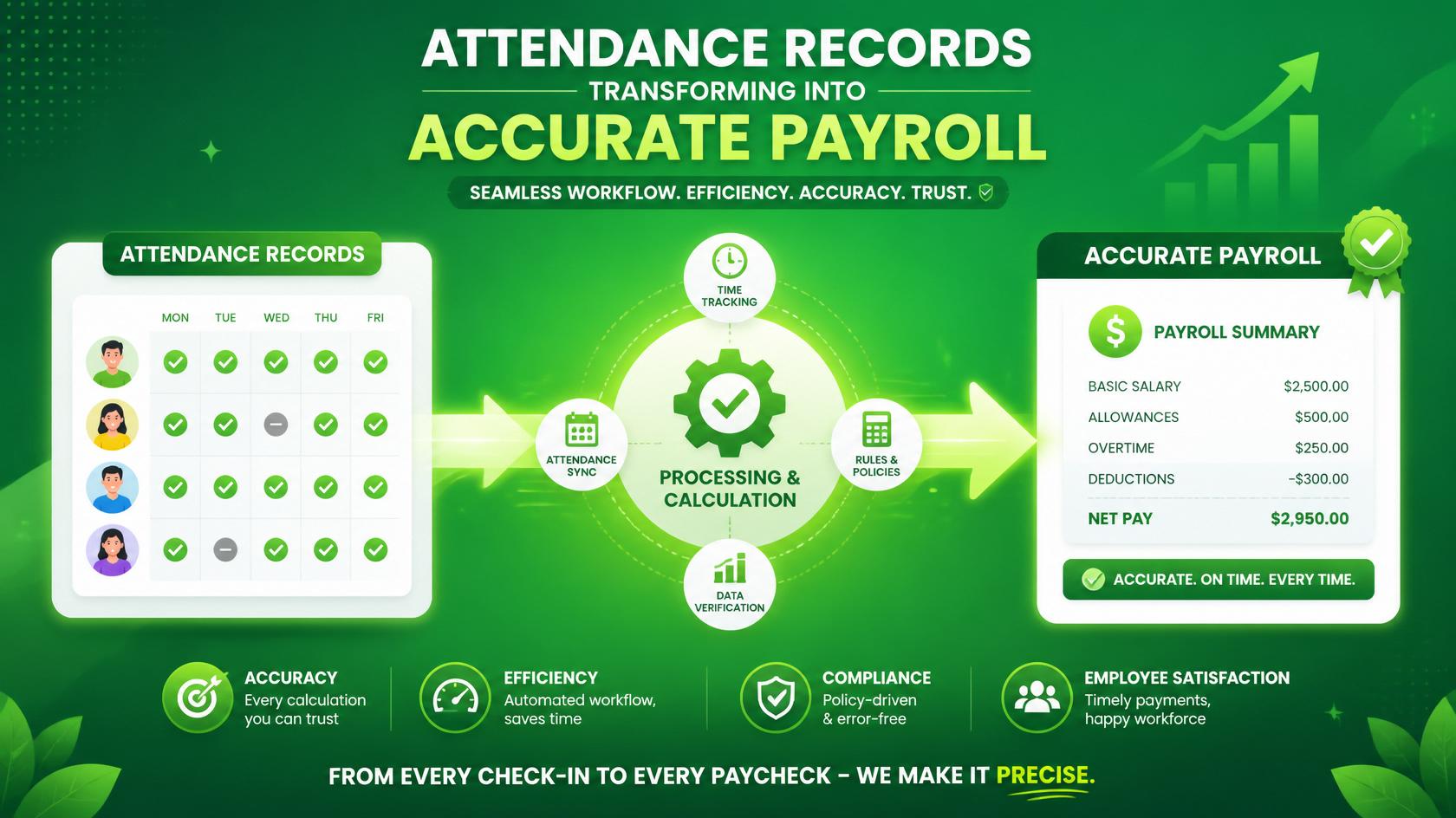
Time theft is one of the issues that has come to the fore as a problem that businesses with remote teams are facing more and more.
Although remote work provides flexibility and access to talent, there are also difficulties in visibility, accountability, and tracking of hours of work. If you don’t have proper systems in place, you could find yourself paying for hours that were not actually earned.
Time theft occurs when staff are paid for time not spent on work during their working time. It can be purposeful on one occasion or due to the lack of clear expectations and tracking systems on another. This can be more difficult to identify in remote areas.
Many businesses experience the impact in subtle ways, such as loss of productivity, missed deadlines, missed communication, or payroll inaccuracies.
It’s easy to accumulate small problems when teams are scattered in multiple locations and have varying schedules and time zones.
Over time, that goes unrecorded; incorrect attendance logs and inadequate remote worker management can cause an added financial burden.
Meanwhile, enterprises do not wish to foster an ethos of mistrust. Employees appreciate having the freedom to do their own work, and managers should learn how to hold employees accountable without being micromanagers. There, modern tracking and productivity solutions come in.
Employee time tracking tools such as:
Enhance insights into work time, attendance, productivity, and overtime management while enabling flexible working environments and remote working. If these systems are used correctly, they can keep teams accountable, productive, and aligned.
What Is Time Theft?
Time theft occurs when employees are paid for time that they were not working. It can occur in an office or work-from-home setting, but it can be easier to be sneaky when working remotely, as the manager isn’t around to physically check in on daily work.
Not all time theft is intentional. Deliberate actions by some employees, or poor time management or unclear policies by others, can lead to inaccurate time records.
Intentional Time Theft
Conscious time theft refers to the intentional misrepresentation of work activity and/or logged hours. For example:
- Buddy punching
- Logging false work time
- Time not logged is not overtime.
- Excessive breaks, not reporting them
- Performing personal activities while working during paid work hours
For instance, if the employee logs in, he or she could spend the first hour watching videos or doing errands. An employee could have another employee remain logged in to work systems overnight without doing any work for that employee.
Unintentional Time Theft
A lot of the time, theft is not due to dishonesty. Some issues occur due to a lack of structure or guidance from employees.
For example:
- Failing to sign out on time
- Poor overtime logging habits and other time-off-work issues.
- Some uncertainty about break policies.
- Handling of multiple tasks for personal and work-related needs.
- Manual attendance reporting is inaccurate.
These minor discrepancies can cause big headaches on payroll in the long run, especially in a remote team.
Here are some examples of time theft in remote teams. Let’s take a look at some examples of time theft in remote teams.
1. Buddy Punching
Buddy Punching does occur even in the most remote of locations. Attendance can be logged by one staff member for another, either by sharing their credentials or using a communication system.
2. Active Hours
A few employees move around with mouse movers or are not working online. This results in false activity records and productivity reporting.
3. Excessive Breaks
Short breaks are good and needed. But if they’re not talking to colleagues for extended periods of paid time, there’s wasted time.
4. Personal Activities while on the Job
Also, employees can work substantial portions of their time on social media, household chores, personal phone calls, or work projects for which they are not clocked in.
5. Incorrect Overtime Logging
In some cases, employees might exaggerate their overtime hours, particularly if the company does not have an automated system for tracking overtime.
6. Business impact of time theft
Payroll isn’t the only cost of time theft. It can lead to:
- Lower productivity
- Delayed projects
- Increased labor expenses
- Team frustration
- Client dissatisfaction
- Highly motivated staff who burn out.
If other employees use flex without consequences, morale can be lower. As time goes on, accountability issues erode team culture and operational efficiency.
Time Theft: What is it and why does it occur in Remote Teams?
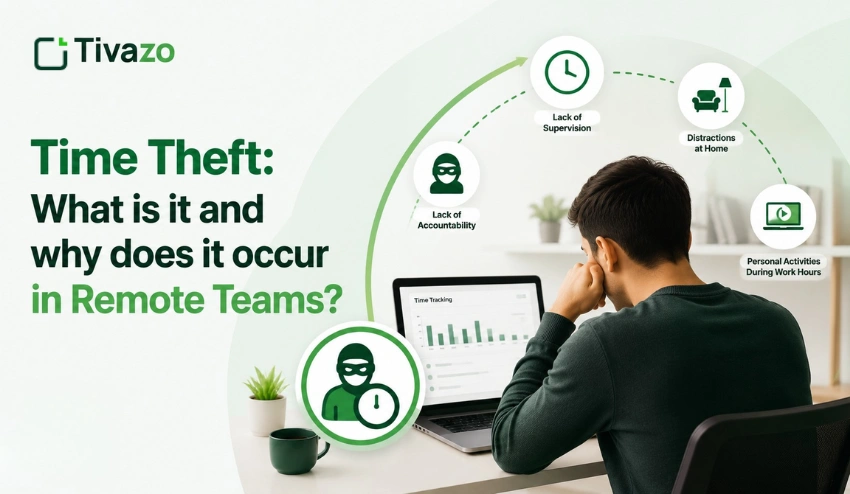
Poor systems are the real culprit in most cases of poor productivity among remote employees. If businesses know what’s causing the issue of time theft, they can work to minimize it.
1. Lack of Supervision
Working from home takes away the direct visibility in the workplace. Managers do not have time to be able to observe workflows, attendance, or engagement throughout the day.
Some staff members may become less time-efficient without being able to see.
Of course, companies should not be constantly keeping an eye on their workers. But teams must have systems written in place for accountability and work hour tracking.
2. Poor Accountability Systems
A lot of companies transitioned to remote working without establishing accountability systems.
There are instances when employees don’t know:
- Expected work hours
- Productivity standards
- Overtime approval processes
- Response time expectations
- Reporting procedures
As accountability systems are weak, inconsistencies escalate rapidly.
3. Burnout
Burnout is a huge but under-recognized factor in time theft. People who are feeling overwhelmed or mentally exhausted can not communicate their struggles but become disengaged with work. They can remain logged on at extremely low production levels.
Sustainable workloads and realistic expectations are healthy for employee time management.
4. Weak Communication
Communication problems result in misunderstandings about priorities, deadlines, and responsibility.
As a remote worker, you might finish your work late if you don’t know what it should look like or what is expected of you. Sometimes, workers completely refuse to communicate, and they pretend to be busy.
Effective communication systems enhance accountability and teamwork.
5. No Productivity Measurement
Managers have no way of knowing where the productivity loss is occurring if there are no measurable outputs.
Having only online status tracking can lead to overlooking deeper problems with real-world work.
The use of tools such as productivity monitoring software can provide companies with better insights into activity trends, workload distribution, and productivity.
6. Outdated Attendance Methods
Manual spreadsheets and old attendance systems are extremely susceptible to inaccuracies and tampering.
Today’s remote workers require automated systems that deliver:
- Real-time attendance records
- Correctly tracking work hours.
- Overtime visibility
- Shift monitoring
- Reporting dashboards
This is the reason why many businesses are choosing to employ attendance tracking software for distributed teams.
7. Flexible Schedules Without Boundaries
Flexibility is good, but too much flexibility will lead to accountability issues. Employees may:
- Work inconsistent schedules
- Delay tasks
- Overreport hours
- Blend social and work hours
When working remotely, setting boundaries can help to keep you productive, but feel free to work.
7 Signs Your Remote Team May Have a Time Theft Problem
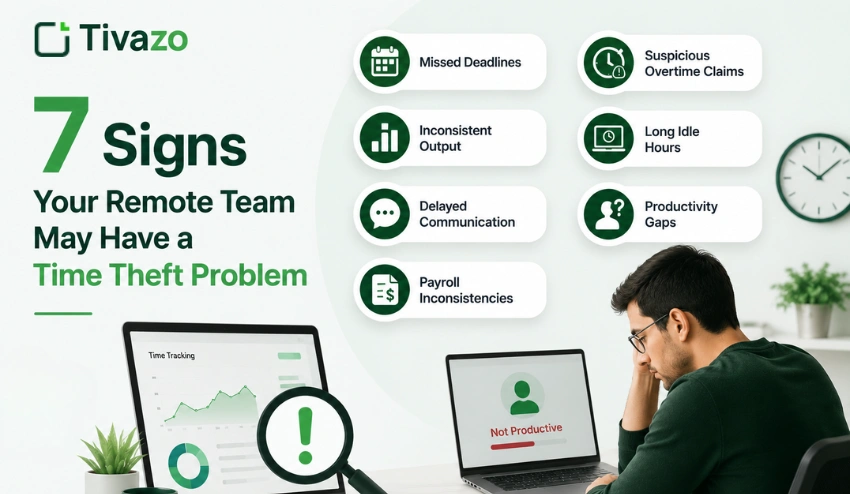
Time theft isn’t always easy to spot. Indirect signs are sometimes the first signs that businesses may notice.
1. Missed Deadlines
If they are continually delayed while working properly, it could be a sign of poor productivity or bad time reporting.
If staffing is getting in full-day work, but projects are still lagging, consider analyzing workflow efficiency.
2. Inconsistent Output
There are some employees who are only reporting the same amount of time as their high-performing colleagues but aren’t actually generating as much output.
Accountability issues are usually signaled by significant productivity gaps.
3. Suspicious Overtime Claims
Overtime that occurs without a corresponding project advancement could be due to overtime abuse.
Businesses need to take an honest look at their overtime patterns and utilize an overtime calculator to analyze them. To enhance payroll accuracy and detect unusual payroll reporting patterns.
4. Long Idle Hours
Extended periods of employees being logged on with little activity can be a sign of fake active hours or disengagement.
When employees are logged on for extended periods of time with little activity, this can signal either fake active hours or disengagement. The key to activity monitoring is to look at patterns, not individual incidents.
5. Delayed Communication
When responses are delayed, meetings are missed, or there are unknown reasons, it may indicate a lack of engagement during active working hours.
6. Productivity Gaps
Teams may be busy but not productive, which could indicate hidden productivity loss.
Managers should compare logged hours to what they are getting done.
7. Payroll Inconsistencies
Often, irregularities in payroll indicate tracking issues.
Examples include:
- Repeated overtime corrections
- Missing attendance data
- Unusual variation in hours worked.
- Overly manual payroll changes
These errors are greatly minimized with automated work hour tracking. But first, there’s the cost of time theft.
The Real Cost of Time Theft

Many businesses don’t realize that time theft inflicts financial and operating losses.
1. Payroll Losses
It’s easy to see how small errors can add up to a high cost over the course of a year. For example:
- Students will be provided with 30 minutes of unpaid time each day.
- Across 20 employees
- Over several months
This can lead to thousands of dollars of payroll lost.
2. Lower Productivity
Time theft has a negative impact on overall efficiency and delays critical work.
3. Team Resentment
Good workers can get irked when other people are allowed to take advantage of flexible work arrangements without any repercussions.
4. Delayed Projects
Productivity problems can stall product launches, campaigns, and client projects if they’re not tracked.
5. Client Dissatisfaction
Employers are required to provide uniform service to clients, no matter where employees work.
6. Burnout for Honest Employees
Reliable employees tend to take on more when others do less.
7. Overtime Abuse
Some employees may falsely record overtime hours as they wish to do so.
These issues can be minimized by utilizing the timecard calculator by businesses. To enhance the accuracy of payroll and overtime.
12 Ways to Reduce Time Theft in Remote Teams?
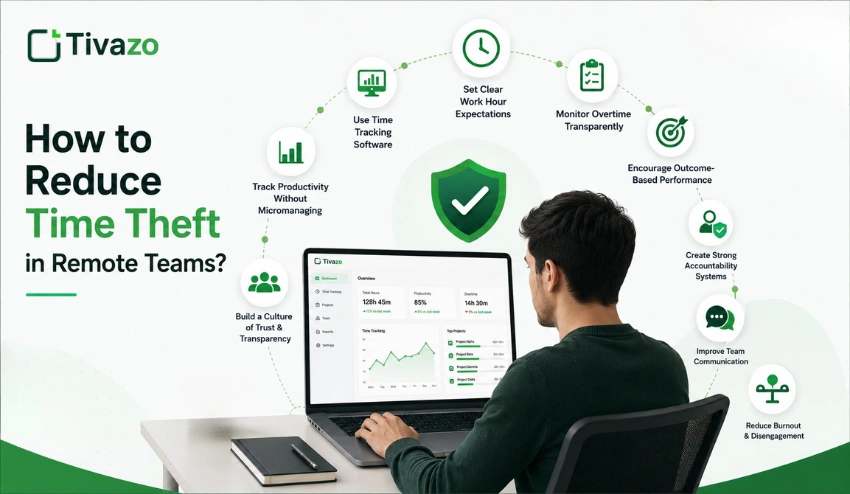
Reducing time theft requires balanced systems that improve accountability while maintaining employee trust.
1. Set Clear Work Hour Expectations
Clear guidelines need to be given to employees on:
- Work schedules
- Break policies
- Overtime approval
- Availability expectations
- Attendance reporting
For instance, companies might mandate that workers be on call during their normal work hours but flexible during other times of the day. Clear policies eliminate confusion and accountability.
2. Use Employee Time Tracking Software
Automated tracking systems provide greater visibility of attendance, work hours, and overtime. Tivazo enables Businesses to keep track of:
- Work hour tracking
- Attendance patterns
- Productivity trends
- Overtime visibility
- Employee activity
Some of the key features that companies look for in the best time tracking software include accurate reporting, payroll integration, and remote employee monitoring.
Different industries have unique workflows as well. Often, time tracking software for law firms requires accurate billable hour reporting and client-oriented time tracking.
3. Track Productivity Without Micromanaging
Productivity tracking shouldn’t be intrusive. Rather than just looking at each click and each screenshot, companies should look at:
- Deliverables
- Workflow consistency
- Deadline completion
- Quality of work
An example of this is if a remote designer consistently delivers strong results and is different from others, they should not be monitored unnecessarily.
4. Monitor Overtime Transparently
Staff need to be made aware that:
- How overtime is approved
- How overtime is calculated
- How overtime affects payroll
Transparent systems reduce disputes and improve fairness.
Businesses managing hourly workers can also use the hourly salary calculator for payroll planning and labor cost estimation.
5. Encourage Outcome-Based Performance
When businesses are not continually monitoring them, remote teams perform better.
There are lots of companies out there that track the time of software developers and value the outcomes that they produce when they’re engaged in a sprint instead of constantly keeping an eye on them.
An outcome-based system enhances accountability and flexibility.
6. Create Accountability Systems
Simple accountability systems can make remote teams more aligned. Examples include:
- Daily check-ins
- Weekly reports
- Task management boards
- Progress tracking
- Team meetings
The systems enhance visibility but are not overseen.
7. Use Automated Attendance Tracking
- Reduce manual errors
- Track schedules accurately
- Improve payroll accuracy
- Recognize unusual attendance patterns
Tivazo offers attendance visibility to enable managers to better track remote staff. Some global teams also use a military time converter to standardize schedules across different regions.
8. Improve Team Communication
Effective communication enhances accountability and productivity. As a remote team, you should set up:
- Response expectations
- Meeting schedules
- Collaboration channels
- Escalation procedures
Clear communication eliminates misunderstandings and a lack of engagement.
9. Minimize Burnout and Disengagement
When workers are overworked, they tend to get distracted during working hours. Healthy work habits should be encouraged in businesses through:
- Flexible scheduling
- Reasonable workloads
- Mental health support
- Regular breaks
A lot of remote employees utilize a pomodoro timer to help improve concentration and productivity during the day.
For teams that are conducting a structured work session, there may be an online timer that can help to develop time sense.
11. Train Managers to Detect Time Theft
Employers should be aware of the ways that their managers detect time theft professionally and fairly. The emphasis of training should be placed on:
- Attendance analysis
- Productivity trends
- Overtime inconsistencies
- Communication issues
- Employee engagement
Aggression is less successful in enhancing accountability than good leadership.
12. Build a Culture of Trust and Transparency
For any remote workforce management to be successful, there has to be trust in it.
Businesses should explain:
- The purpose of tracking systems.
- When and how employee data is used.
- What are the expectations for accountability?
Employees need to understand that tracking systems are not a form of punishment but rather promote fairness and productivity.
Tivazo can help with this balance by providing productivity insights, attendance tracking, and employee visibility remotely.
5 Best Tools to Prevent Time Theft
Implementing the right productivity monitoring equipment can enhance companies’ accountability and payroll accuracy.
1. Tivazo
Tivazo solutions for managing remote teams include:
- Time tracking
- Employee monitoring
- Attendance tracking
- Productivity insights
- Overtime visibility
- Remote workforce management
It offers businesses greater visibility of employee productivity and work hour tracking.
2. Hubstaff
For teams working remotely, Hubstaff provides distinct activity tracking, reporting, and productivity monitoring.
3. Time Doctor
Time Doctor is mainly used to monitor employee productivity and track their remote work.
4. Clockify
Clockify’s work hour tracking and attendance management capabilities are flexible.
5. Toggl Track
Toggl Track offers lightweight tracking tools that enable businesses to keep track of project time and productivity.
For businesses looking to find more resources for remote tracking and productivity, they can also check out the best time tracking software.
How Does Tivazo Help Reduce Time Theft?
Tivazo enhances remote accountability through automation of productivity and attendance management in business.
1. Automated Tracking
Automated tracking ensures work hours are accurate and helps minimize manual reporting mistakes.
2. Productivity Monitoring
Managers can check the productivity trend without having to over-monitor.
3. Attendance Visibility
An attendance tracking feature to identify unusual attendance and scheduling patterns.
4. Remote Accountability
Tivazo enhances accountability with a single point of view on work activity and attendance.
5. Overtime Transparency
Overtime tracking is more precise, and payroll inaccuracies are minimized.
6. Payroll Support
For remote teams, it’s essential to have accurate work hour records to streamline the payroll process.
7. Manager Reporting
Detailed reports enable managers to find out about productivity gaps and overtime issues.
8. Employee Productivity Insights
Better visibility of work habits can also help employees enhance their productivity and time management.
7 Common Mistakes Companies Make When Fighting Time Theft
In their attempts to prevent time theft, many companies end up with larger issues.
- Micromanagement: Constantly monitoring every detail decreases morale and trust between employee and employer.
- Unclear monitoring: It’s imperative to keep employees informed about what is being monitored and why.
- Screenshots: While screenshots are helpful, they rarely offer true insights into productivity.
- Overlooking burnout: Burnout often results in a decrease in productivity.
- Undefined overtime rules: Ambiguous overtime policies create payroll disputes and accounting errors.
- Poor communication: Lack of communication breeds a lack of accountability.
- Using obsolete systems: A modern business cannot run on outdated spreadsheets or attendance records; a reliable system of tracking is needed.
Conclusion
Without good systems, time theft can slowly eat into your productivity and drive up costs while simultaneously lowering accountability across your remote team.
This often manifests as missed deadlines, unnecessary overtime, and hidden reductions in productivity.
Excessive monitoring is not the answer, however. The keys to managing a remote workforce productively are setting realistic expectations, clear communication, proper tracking methods, and healthy accountability.
Businesses that prioritize improved time tracking, productivity tracking, overtime tracking, and employee accountability foster a stronger and more productive remote team.
Tivazo helps reduce time theft by enabling efficient time tracking, productivity monitoring, attendance visibility, and a host of other remote workforce management tools built for today’s distributed teams.
A robust system helps build better accountability in a business without sacrificing employee trust or autonomy.