Tracking employee time goes beyond merely registering when staff members clock in and out. The goal is to enable businesses to understand how working hours are allocated, to boost productivity, to facilitate prompt and accurate payroll, and to enhance project management processes.
Whether your workforce is located in the office, operates remotely, or adheres to a hybrid structure, time tracking furnishes invaluable data that enables management to make sound decisions and ensures workers are compensated properly for their contributions.
This comprehensive guide delves into the intricacies of employee time tracking, exploring its importance, outlining best practices for tracking, discussing common hurdles, and demonstrating how a modern solution such as Tivazo can streamline this entire procedure.

Quick Answer Box
Employee time tracking is essentially the method used to record a company’s employees’ working time. It’s all about increasing payroll accuracy, monitoring productivity levels, better managing projects and ensuring the organization is in line with any labor regulations. Businesses can keep a record manually, or they can employ employee time tracking software like Tivazo to automate the entire process.
Why Employee Time Tracking Matters
Employee time tracking empowers organizations to precisely grasp how work hours are dispersed across various departments and specific projects. Instead of relying on educated guesses or handwritten records, businesses can obtain real-time, precise data that fosters better decision-making.
By employing employee time tracking, employers have the capacity to:
Why Employee Time Tracking is Crucial. Employee time tracking empowers organizations to precisely grasp how work hours are dispersed across various departments and specific projects. Instead of relying on educated guesses or handwritten records, businesses can obtain real-time, precise data that fosters better decision-making. By employing employee time tracking, employers have the capacity to:
- Handle payroll with unwavering confidence.
- Refine project planning and estimations.
- Quantify employee productivity.
- Reduce administrative workload.
- Pinpoint bottlenecks within workflows.
- Elevate accountability.
- Optimize the allocation of resources.
When deployed with transparency and honesty, employee time tracking creates significant advantages for both employers and employees by fostering a more organized and efficient working environment.
Expanding Benefit
Benefits Of Employee Time Tracking
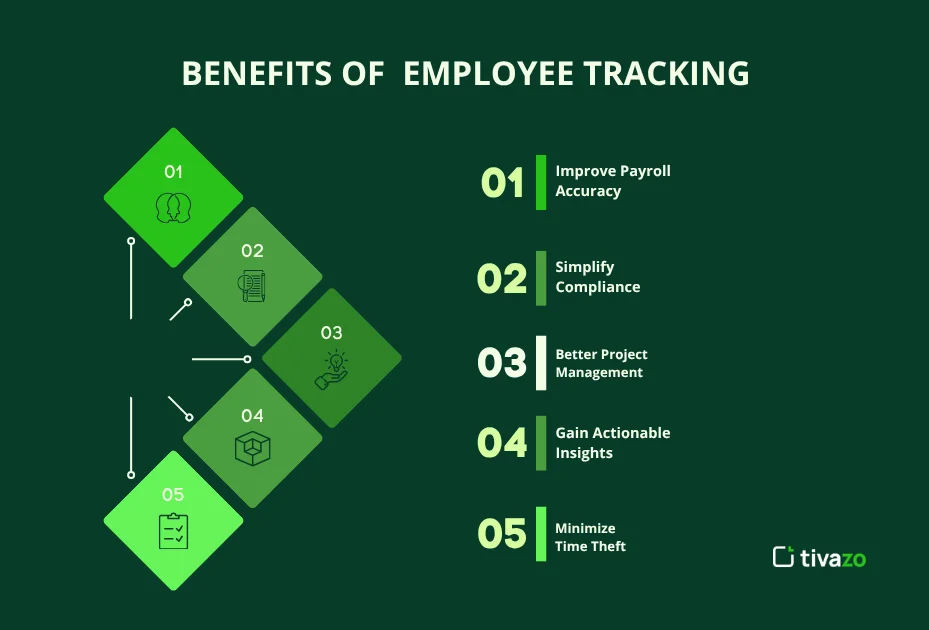
1. Improve Payroll Accuracy
Employees become more mindful of where they are directing their work hours, cultivating improved attention spans and time management skills.
2. Better Project Management
Managers can keep up to date with progress on current projects, forecast upcoming resource demands, and allocate staff resources with greater proficiency.
3. Simplify Compliance
When time tracking is accurate, a company can remain in compliance with all current and upcoming labor regulations, overtime policies, and workplace attendance standards.
4. Minimize Time Theft
An automatic time tracking solution drastically reduces instances of buddy punching, falsified timesheets, and unapproved overtime.
5. Gain Actionable Insights
Get the detailed insights you need to gain visibility into trends, worker activity, and efficiency opportunities.
Employee Time Tracking Methods
| Method | Accuracy | Best For | Drawbacks |
| Paper Timesheets | Low | Small Businesses | Easy to lose, manual errors |
| Excel Spreadsheets | Medium | Small teams | Time-consuming updates |
| Punch Clocks | Medium | Office environments | Limited reporting |
| Employee Time Tracking Software | High | Most Businesses | Requires initial setup |
| AI-Powered Time Tracking | Very high | Remote & hybrid teams | Depends on software features |
Challenges of Tracking Employee Time
Although the value proposition of tracking employee time seems clear-cut, your organization might run into several complications with implementation. Some of the most common employee time tracking challenges include:
- Forgetting to clock in or out
- Manual entry errors;
- Privacy concerns among employees;
- Difficulty with remote workers across different time zones
- The integration with existing payroll systems.
- Utilize Automated Software to Overcome Issues
The good news: many of these employee time tracking challenges are quite simple to overcome through the use of the right software. Furthermore, to be as successful as possible, make sure you openly communicate to your employees that it is not about micromanagement but about overall company organization, efficiency, and fairness.
Best Practice for Employee Time Tracking

For any employee time tracking method, to obtain the fullest benefits, it should be as effective as possible. With these best practice guidelines at hand, you’ll have the optimal system at your disposal. Some of the main guidelines to follow include:
- Maintain clear communication about time tracking;
- Use an automated employee time tracking solution;
- track project hours as well as attendance;
- Frequently review all tracking reports;
- Ensure privacy is protected;
- Train employees how to use the time tracking software;
- Don’t use data to micromanage.
Common Time Tracking Pitfalls to Avoid
For many companies, it feels like employee time tracking is simply a tedious HR process, but nothing too important or impactful beyond payroll-specific work. Poor employee time tracking can have a serious negative impact; however, the following common mistakes prevent it from yielding the positive results it should deliver.
- Don’t Rely Purely on Timesheets;
- Avoid tracking too much detail;
- Discard performance reports;
- Fail to check for overtime trends;
- Ignore integrating your time tracking system with your payroll software;
- Don’t use antiquated systems;
- Fail to implement clear time tracking policies.
Payroll Errors: Of all the concealed repercussions of failing to track employee time accurately, one of the simplest but most typical is payroll errors. In the case where employees use traditional methods like filing paper time sheets, then the payroll is normally off-revised. This can lead to underestimation, which makes the employees feel like they are being underpaid, and this is not good for morale, or overestimation, which negatively affects the financial health of the business. It also generates legal risks or lawsuits and damages the reputation of an organization, besides generating whistleblower complaints. Hence, the use of efficient tools to track employee time can help exclude such mistakes and reward employees with correct and timely pay.
Time Theft: The other major disadvantage associated with the failure to track employee time is time theft. Lump defines time theft as when employees waste company time engaging in personal business. Within its text, it describes them as taking extended breaks, excessive personal phone calls, or even cheating on records. The lack of structures within organizations to monitor employee time means that it is hard to find such problems. It is equally disappointing to know that businesses have a significant negative impact in terms of productivity and, by implication, money. This is because effective solutions for tracking employee time can reduce time theft, due to proper accountability in workplaces.

Employee Health: Employee time could also not be tracked, negatively impacting their health. If a nurse has no fixed working schedule or if overtime is allowed without supervision, it can cause sleepless nights, stress, and probable chronic health complications. If employees are forced to work long hours because there is not adequate tracking of time, then the health of the workers will deteriorate. This minimizes production while enhancing the truancy rates. Monitoring the time employees spend in the workplace assists organizations in developing schedules that give the workers adequate time off so that they have a quality work-life balance.
Employee Turnover: Another hidden cost that organizations face due to a failure to track employee time is the cost of employee replacement. Many employees quit owing to concerns about their working conditions, such as shifts, unfair promotions or demotions, or shift breaks due to time measurements. Replacing an employee can cost anywhere between 50% and 200% of the employee’s annual wage, depending on the employee’s position. These issues are addressed since tracking the time that the employees spend on their work offers organizations a standard and just way of handling the schedules and the amount of work employees are assigned to do. This fosters a healthy working culture and reduces employee turnover.
Employee Job Satisfaction: Intriguingly, even though tracking an employee’s time is an essential aspect, it is the most sensitive one. Inaccurate tracking of employees through the implemented software negatively affects job satisfaction. This is not good news for any organization because if employees sense that they are being overly managed or not trusted at all, they will also develop high-stress levels and lose loyalty to the employer.
To prevent this, the usage of time-tracking systems with good interfaces and easy-to-read time entries should be implemented. They should be oriented to the increase in efficiency and effectiveness, and be free from excessive performance control. Time tracking is also beneficial in another way in that it strengthens the company’s human resources and increases overall job satisfaction.
Data-Driven Decision Making: There are core categories of data that get lost in organizations due to poor tracking of time for employees. While meetings and tasks’ timing are not recorded and controlled, businesses cannot understand and improve meeting knowledge and task performance. Timely tracking helps in understanding how time is utilized, and this assists organizations in realizing wastage, planning and redesigning time, and enhancing project durations. It emerges that the optimization of activity records enables organizations to undertake data-driven decisions.
How Tivazo Simplifies Employee Time Tracking
Modern businesses need more than basic timesheets. Tivazo combines intelligent time tracking with productivity insights to help organizations manage their workforce efficiently.
With Tivazo, businesses can:
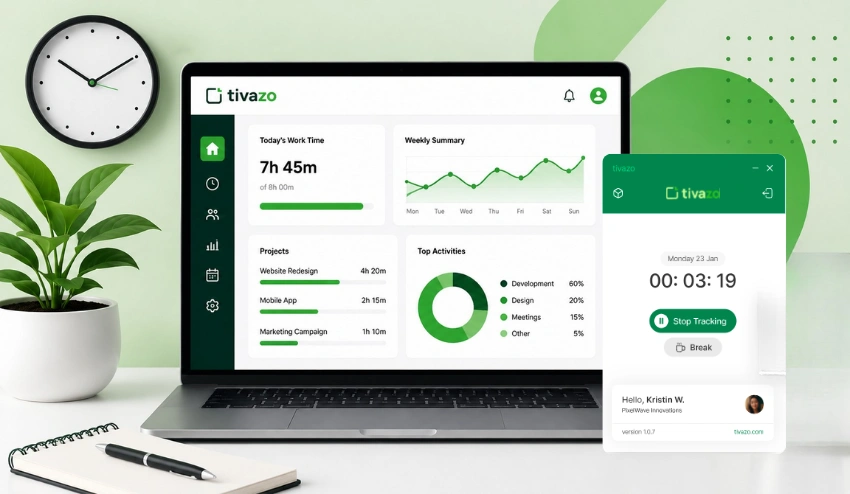
- Automatically track employee working hours
- Monitor attendance in real time
- Generate payroll-ready reports
- Analyze productivity trends
- Manage remote and hybrid teams
- Improve project time allocation
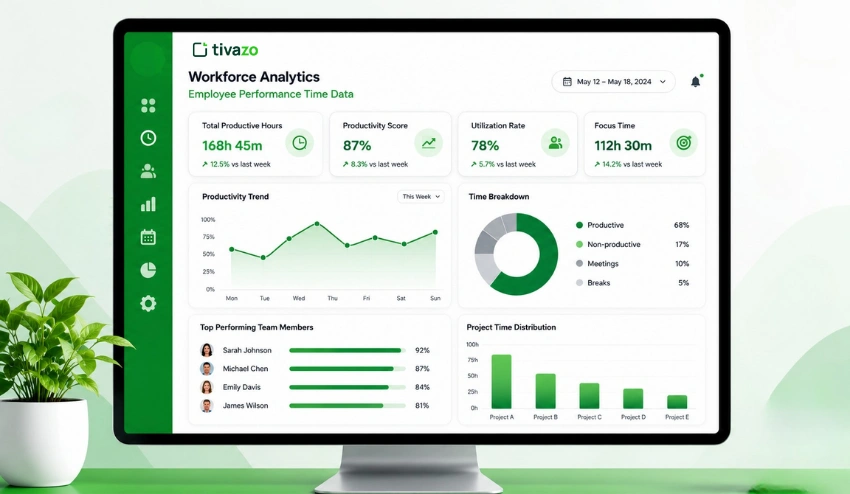
- Access detailed dashboards for smarter decision-making
Instead of spending hours managing spreadsheets, teams can focus on meaningful work while Tivazo handles time tracking automatically.
Conclusion
Top the hours spent managing spreadsheets and allow your teams to focus on truly impactful work while Tivazo does the work for you. Employee time tracking has evolved and has become an integral part of the workforce. Accurate working hour tracking optimizes payroll, drives better results from your team, strengthens project execution, and encourages data-driven business decisions.
It doesn’t matter the scale of your business – a remote team or a local crew – if you are looking to optimize team performance, streamline processes, and obtain valuable business insights, then look no further.
Start using Tivazo to help your organization manage work time, attendance, and boost overall workforce efficiency with an all-in-one, intuitive solution.