
Time. You cannot keep it. You cannot extend it. You can just spend it. Have you ever felt that your day was over before your work was done? You are not alone. Being a person who has worked on several projects, with several clients and deadlines, I can definitely say: the ability to manage your time is the most useful habit you can develop. Learning the importance of time management is a must.
What is time management? It is the act of planning and regulating the amount of time to be spent on certain things. It is not only about doing more. It is all about less stress, better focus, and more time on what really matters.
And here is how you do it. This guide is going to show you 7 effective time management strategies with real-life examples and practical tips that you can apply immediately.
Key Takeaways
- Time management is planning, prioritising, and arranging your time to accomplish your goals more efficiently.
- Time management is crucial. It makes us more productive, less stressed, and creates a healthier work-life balance.
- Some of the most well-known approaches are the Pomodoro Technique, Time Blocking, the Eisenhower Matrix, and the Pareto Principle.
- Keep a journal of your time – this helps you to see which tasks are taking up much of your time, and also things you’re spending a lot of time on may not be worth it.
- Time management excellence doesn’t happen overnight. It takes developing good time management practices over time.
What Is Time Management?
Time management refers to the planning, organizing, and controlling of time that you use to accomplish certain objectives. It is a matter of conscious decisions rather than responding to what appears in your day.
You only get 24 hours in a day. Time management assists you in determining how to utilize those hours in order to not always be playing catch-up or trying to juggle too many things at one time.
This is not about doing more. It is about doing what is important, at the right time, and having space to rest, concentrate, and be balanced.
How Does Time Management Work?
Time management is not just making a to-do list. It is a continuous cycle of planning, prioritising, completing, and reviewing your work, thereby helping you to optimise your available time. Time management allows you to concentrate on work that is actually important, rather than on the shouts of the immediate.
A simple time management workflow includes:
1. Set Clear Goals
Set one or several goals. Come up with your objectives for the moment, week, or even longer term. It’s important to have some goals in mind so that you can prioritize the allocation of your time.
2. Prioritize Your Tasks
Not all activities are equally important. Prioritize activities with a framework such as the Eisenhower Matrix to distinguish between the urgent and the important and develop a focus on higher-value tasks.
3. Schedule Your Time
Schedule particular blocks of time for the most important things rather than a generic to-do list. It is easier to follow through when you set time apart for certain tasks.
4. Stay Focused
Get rid of interruptions, don’t multitask, and assign continuous time blocks to focused work. Focus on one thing at a time for efficient work and superior outcomes.
On a daily or weekly basis, look back on everything, see what you’re wasting time on, and modify your schedule to keep improving.
Time Management Is Not:
- Doing everything at the same time
- Packing your calendar to the second
- Operating on caffeine and eleventh-hour stress
Rather, effective time management appears as follows:
- Doing what is important rather than what is urgent
- Division of big objectives into small and achievable ones
- Saving your time against distractions and useless work
As a freelancer, student, manager, or entrepreneur, the way you handle your time is the way you work, the way you feel, and the way you get ahead.
The 4 Ps of Time Management
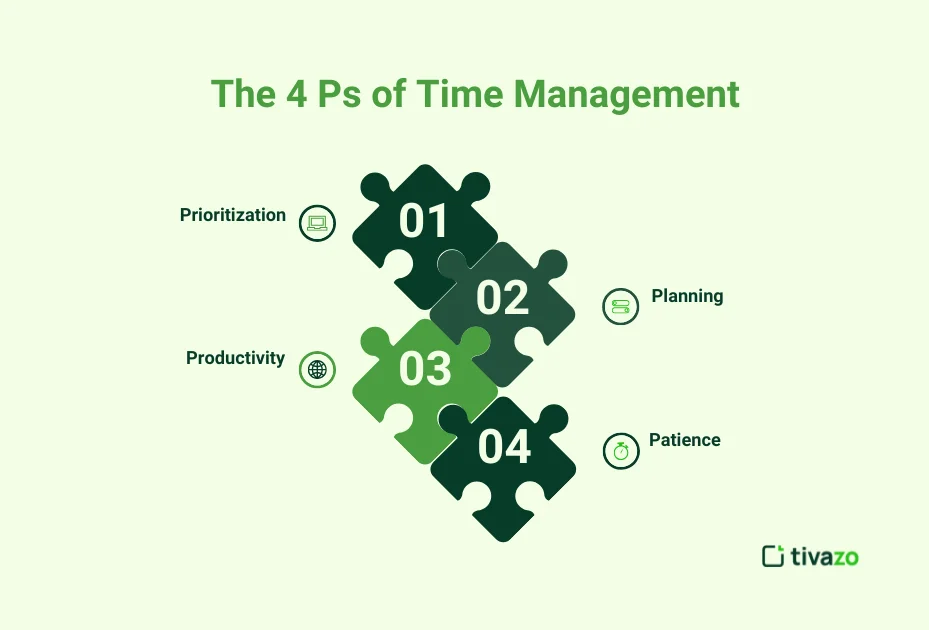
Being good at time management is not only about ticking the boxes. It is about developing a sticky mindset. This is where the 4 Ps of time management come in, a workable system that keeps you on course day in and day out.
1. Prioritization
You do not always have to do what is on your to-do list. Smart time managers know what time management is by understanding what’s worth doing. Study to know what is most important.
Ask yourself:
- What tasks have the biggest impact?
- What’s urgent vs. what’s just noise?
Rank tasks according to importance and urgency using such time management techniques as the Eisenhower Matrix or ABCD method.
2. Planning
When you are aware of your priorities, plan your day or week.
Good planning includes:
- Setting daily goals
- Blocking time for focused work
- Leaving space for breaks and unexpected tasks
This can be made easy and repeatable with the help of such tools as digital calendars or daily planners.
3. Productivity
This is where execution happens. Productivity is doing more with less effort, less time, and less stress.
To boost your productivity:
- Get rid of distractions (phone alerts, loud environments)
- Use the Pomodoro Technique or time blocking
- Keep a record of the time tasks really take as compared to the time you estimated they would take
4. Patience
Time management is not a quick fix, but a habit. Not every day will go according to schedule, and that is okay.
Give yourself time to develop consistency.
- Don’t expect perfection
- Reflect weekly on what worked and what didn’t
- Adjust and try again
This final “P” helps you commit to the long game of what time management is all about: building control, not chaos.
Importance of Time Management
Before we get into the how-to, it is important to take a step back and see why time management is something we should master. It is not only about fitting more in your schedule or doing everything on your list. It is about how you manage your time so that you feel more in control, less overwhelmed, and on the whole more fulfilled.
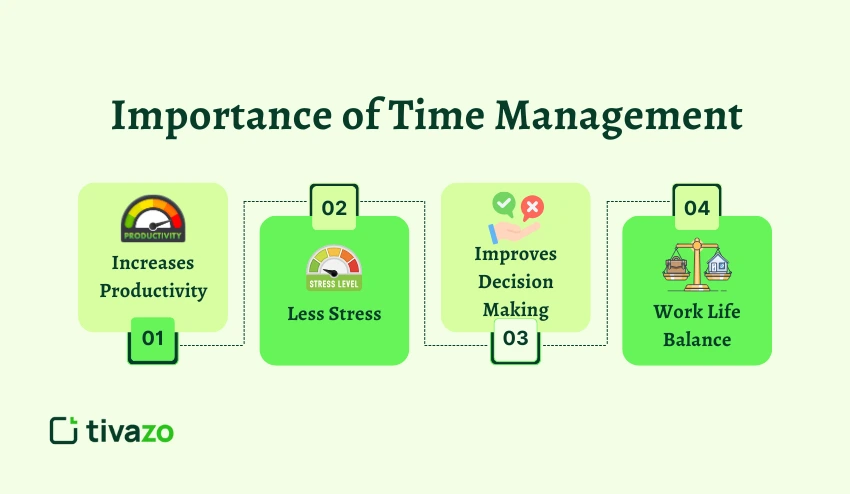
Some of the greatest importance of time management are the following:
- Less stress: Planning your day will help you to avoid the feeling that you are always in a rush or behind schedule. Such clarity of mind automatically reduces anxiety and keeps you calm even when some unforeseen difficulties emerge.
- Increases productivity: Time management techniques can assist you in focusing on high-impact activities rather than busywork. You are not responding to what is happening, but rather you are working on what is important.
- Enhances work-life balance: With an organized and effective work, you will be less tempted to allow it to spill into your evenings or weekends. That frees up some time to rest, pursue hobbies, and spend quality time with the ones you love, and improve your work-life balance.
- Enhances decision-making: You will make better decisions and feel more confident in them because you will not have to make last-minute decisions and rush to make decisions in panic mode.
After all, time management is not about being busy; it is about being intentional. It is deciding how to spend your time according to your goals, values, and energy, not what is urgent or in front of you. The more you can manage your time, the more freedom you will, in fact, generate.
For more details on the importance of time management, read 8 Essential Tips on the Importance of Time Management
Time Management Statistics in 2026
In the era of digital, remote, and AI-centric workplaces, proper time management has become more critical than ever.
But research indicates that many workers are spending their working time in an inefficient manner, resulting in reduced productivity, missed deadlines, and increased stress. These statistics only serve to underscore the importance of good time management for one and for business.
Here are some noteworthy time management statistics:
- Almost 82% of people do not have a formal time management system, instead relying on mental notes or a simple to-do list.
- People who multitask can make up to 40% less work because they are constantly switching between tasks, which makes it harder to concentrate and makes people more prone to errors.
- Employees are less than half as productive as they could be because they are spending nearly 60% of their workday on work coordination activities like meetings, emails, and messaging.
- Organized time management fosters employee engagement and project completion rates, which are key areas of improvement for businesses.
- AI-powered productivity tools have become a staple in today’s work environment, aiding professionals in their tasks of automating schedules, prioritizing work, and managing workloads more efficiently.
These are statistics that prove the effectiveness of time management is not about working harder, it is about making smarter decisions and improving productivity while decreasing stress.
Why Time Management Is Important at Work?
You understand now the importance of it, so now we can get into the actual strategies that will make you take control of your time starting today.
Managing time is very important in the workplace. Regular employees who learn and apply good time management skills are less likely to have their projects run late. Good time management skills will reduce the amount of stress for employees and will improve their communication skills.
Effective time management allows organizations to increase collaboration, enhance productivity, eliminate extra hours, and enable managers to better manage resources, ultimately benefiting the entire organization. When managing remote or hybrid teams, utilizing time management together with time tracking can provide a better view of workloads and avoid burnout.
Signs You Have Poor Time Management
Many people struggle with time management without realizing it. If you regularly experience any of the following situations, it may be time to improve your daily habits.
- Frequently missing deadlines
- Feeling busy without making meaningful progress
- Constantly multitasking
- Working overtime regularly
- Procrastinating important tasks
- Forgetting appointments or commitments
- Feeling overwhelmed by your workload
- Frequently switching between tasks without finishing them
Recognizing these patterns is the first step toward developing healthier and more productive routines.
Why Most People Fail at Time Management?
Many people feel that they don’t seem to have any motivation or discipline in managing their time. However, poor time management is typically not a result of laziness, but instead of bad habits.
Here are some of the most common reasons why people don’t use their time effectively:
No Clear Priorities
If you’re not sure what tasks are the most important, you can waste a lot of time on things that aren’t going to help you accomplish something worthwhile.
Avoid underestimating how long tasks take
When people make estimates of how long work will take, many are unrealistic, resulting in inaccurate schedules and deadlines.
Constant Interruptions
Focused work is invariably interrupted by emails, phone notifications, meetings, and instant messages, all of which decrease overall productivity.
Doing too much at once
An overly full calendar, burnout, and poor work performance follow the “yes” response to many requests.
Lack of Planning
When you don’t have a plan each day, it is easier to get distracted and become reactive rather than proactive.
Never Reviewing Progress
It’s hard to improve productivity in the future if you don’t review past work and find out what makes you waste time.
Luckily, these obstacles can be overcome by making good habits and using effective time management techniques that will help you prioritize, plan, and focus.
Biggest Time Wasters That Kill Productivity
Not all hours of the day are productive. People waste many hours each week on something that’s not really worth their time. One of the first steps towards productivity improvement is to identify those time wasters.
The following items are some of the largest productivity killers:
Constant Email Checking
Emails are read and responded to all day long, causing distractions and making it hard to get important things done.
Unnecessary Meetings
Spending time on meetings without a clear objective can waste a lot of productive time and yield little return.
Multitasking
Multitasking may seem like working, but shifting to and from tasks makes work of lower quality and more fatiguing.
Social Media Distractions
When using social media, you can easily get caught up in browsing for extended periods, which can derail you from your actual work.
Poor Planning
People often spend more time “thinking about what to do” than actually getting work done if there is no sorted-out plan.
Perfectionism
Attempting to do everything right can make the work take longer and be less productive.
Frequent Interruptions
Interruptions from the phone, messages, and the office require switching out of deep work. Out-of-the-blue emails, texts, and interruptions on the job make it more difficult to get back to deep work.
Identifying and reducing these distractions can help you focus more time on productive tasks that will help you achieve your personal and professional objectives.
7 Proven Time Management Techniques to Reduce Stress & Boost Productivity
Technique 1: Set Priorities using the Eisenhower Matrix
Not every task is equal. Some turn the dial. Others are simply urgent. The Eisenhower Matrix will assist you in organizing your everyday duties into four quadrants:
- Important and urgent- Do it now.
- Not urgent but important- Schedule.
- Important but not urgent- Delegate.
- Not urgent or important- eliminate.
The approach among the time management techniques compels you to prioritize in the long term rather than the clamor of the moment. I would use this weekly in planning my calendar.
Technique 2: Time Blocking Your Calendar
Time blocking was one of the largest game-changers in my routine. Rather than maintaining an open-ended to-do list, reserve blocks of time on your calendar to do particular work.
Here’s how:
- Block deep work (no meetings, no emails).
- Insert buffer time between meetings.
- Add in breaks, emails, and administration.
Allotting time to each task will make you more likely to complete tasks without distraction.
Technique 3: Use the 80/20 Rule (Pareto Principle)
The Pareto Principle says that 80 percent of the results come from 20 percent of the work. Find out what 20 percent of your work produces the greatest value. Stay longer there.
As an example, you are a freelancer and 80 percent of your income is generated by 2 clients, so focus on them. This assists in reducing the time on low-impact activities.
Continue to review your activities every week in order to match your time with what is really important.
Technique 4: Limit Multitasking

Multitasking is productive. However, according to science, this is not the case. Switching tasks, in fact, decreases productivity by as much as 40 percent and causes mental fatigue.
Instead, attempt to batch like tasks:
- Respond to emails on scheduled times.
- Afternoon group calls.
- Do creative work at a sitting.
By remaining concentrated on a single task, results of higher quality are achieved, and stress is reduced.
Technique 5: Plan Tomorrow, Tonight
A very effective habit is to plan your day the previous night. It takes away the morning decision fatigue and gives a sense of direction.
Before bed, ask:
- What are my top 3 priorities tomorrow?
- Do I have any meetings to prepare for?
- What blocks can I reserve for deep work?
Doing this helps you start your day strong and prevents wasting time figuring out where to begin.
Technique 6: Apply the Two-Minute Rule

This rule is simple and popularized by David Allen:
If a task takes less than 2 minutes, do it immediately.
This helps prevent small to-dos from piling up and cluttering your to-do list. I apply this when reading mails or sorting files. It keeps my task lean and actionable.
For bigger tasks, break them down into 2-minute starting points. Getting started is often the hardest part.
Technique 7: Audit and Improve Weekly
Effective time management is not a one-time thing, but it changes as your objectives, duties, and everyday problems change. What will work this week may not work next week. That is why a weekly review can be a game-changer.
Ask yourself:
- What did I spend most time on?
- Did I achieve what I planned?
- What was productive, what was a waste?
The practice helps you find out what is and is not working. Track your time to have a clear idea of how you are really spending your time. Even short-term tracking will expose inefficiencies and indicate where you can do better.
Understanding how you use your time reinforces the importance of time management. You start to see patterns, you start to see distractions, and you make better choices on how to organize your day. Using proper time management techniques will help you get the benefits of time management.
Real-Life Example of Time Management
To reboot your imagination, consider a marketing manager juggling multiple campaigns, client meetings, and deadlines to deliver reports.
Before working on their time management, they continually jumped from one email to another, from one meeting to another, from email to project work, back to emails again, etc. Without even realizing it, the deadline date would arrive; long hours would be worked; pressure would mount!
Since blocking my time, categorizing my duties with the Eisenhower Matrix, and revisiting my calendar every week, I was able to finish the critical work much earlier in the day, eliminate some non-value-added meetings, and have an extra 4 hours per week to work on my “thinking time”.
For me, this example is a reminder that good time management is about working smarter- not longer!
How Time Tracking Improves Time Management
Unaware of where their time actually goes, most people struggle here. Time tracking gives you the concrete numbers to compare your actual time working to the time you thought you were working. You’re able to see exactly where your time is being spent, allowing you to see where the distractions are happening.
By tracking your time consistently, you can:
- Click on one of your activities and see how much time you have automatically tracked there.
- Enhanced project planning and time estimates.
- Minimize unneeded extra hours.
- Create greater accountability for individual and team performance.
- Create more realistic Daily schedules.
- Strive to enhance the balance between work and leisure.
- By using a time tracking tool such as Tivazo, you can identify work trends and positively develop your time management skills.
Benefits of Time Management
Knowing the importance of time management goes beyond just being organized. It has a direct impact on the way you feel, the way you work, and the way you live. By being in control of your time, you open the door to several key benefits:
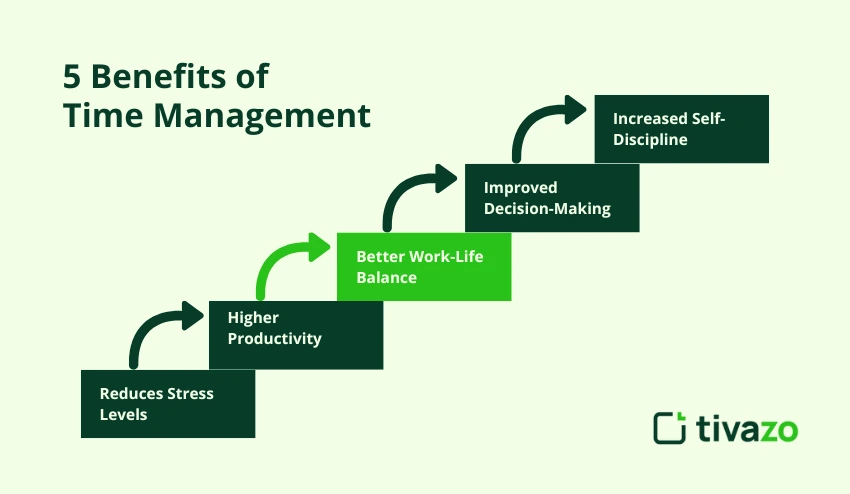
- Reduces Stress Levels
When you have a plan for the day and what you are supposed to do, there is less mayhem. Less rush at the last minute implies less anxiety. - Higher Productivity
You get more done in less time. Clear priorities help you focus on high-impact tasks rather than just staying busy. - Better Work-Life Balance
You can allocate time to personal and professional objectives with proper planning- without one dominating the other. - Improved Decision-Making
With time buffers, you can make considered decisions as opposed to taking pressured decisions. - Increased Self-Discipline
The framework of good time management creates stronger daily habits and routines, which accumulate over time.
- All the benefits of time management lead to a more intentional, balanced, and effective life. Let’s now explore how to achieve that with actionable techniques.
Common Time Management Myths
There are many ideas out there about how to be more productive that don’t actually work. Once you are aware of these myths, you can work to create more effective habits.
Myth 1: Being Busy Means You’re Productive
Too many activities can lead to a lack of substantive progress. The measure of productivity is not hours worked, but results.
Myth 2: Multitasking Saves Time
Studies have repeatedly demonstrated that multitasking leads to decreased attention, greater errors, and slower overall performance.
Myth 3: Successful People Never Procrastinate
Highly successful individuals procrastinate at times. They are different in that they have structured systems to quickly get back on track when they lose focus.
Myth 4: Working Longer Hours Produces Better Results
Long working hours can cause fatigue, loss of creativity, and substandard work. It is much more effective to have focused effort over a sustained period.
Myth 5: Time Management Is Only for Busy Professionals
Enhancing time management skills is beneficial to students, freelancers, entrepreneurs, managers, and anyone who has responsibilities.
Once you know what these misconceptions are, you can concentrate on techniques that result in real productivity gains rather than merely keeping you occupied.
A Simple Daily Time Management Routine
It’s not difficult system to develop good time management habits. A small routine of the day can be of great help in enhancing productivity and de-stressing.
Morning
In the morning, look back at the goals that you set and figure out the 3 most important things that you have to do. Set aside specific periods of time to focus on work without interruptions, such as checking emails or going to meetings.
Afternoon
Prioritize what is most important and schedule time blocks for similar activities like email, phone calls, and administrative tasks. Break up the day for short periods of time to keep fresh and not burn out.
Evening
Revisit what you did during the day before you go home. Update task list, tidy up work, and make plans for future tasks.
Just a few minutes of planning ahead equals a clear and focused start to the next day. Productivity becomes a habit when you follow a routine.
How AI Is Transforming Time Management
Artificial intelligence has begun to impact how people and businesses utilize their time. AI tools can take over the mundane aspects of managing tasks and can analyze productivity trends.
AI can help by:
- Automatically scheduling meetings
- Prioritizing tasks based on deadlines
- Sending intelligent reminders
- Summarizing meeting notes
- Identifying productivity trends
- Improving time tracking accuracy
Of course, an AI-powered system like this can work even better when coupled with time tracking technology and workflows that track how time is spent in modern-day realization.
Best Tools for Better Time Management
Habits can do the logistics of time management, but if you’ve got the proper planning tools, it makes things easier and consistent.
- Popular productivity tools include:
- Digital calendars for scheduling
- Project planning software tools and programs to organize work projects.
- Dedicated to Pomodoro timers, to work uninterrupted.
- Note-taking applications for capturing ideas
- Time-tracking applications such as Tivazo monitor productivity and finding in road for making it
The smartest implementations are those that would be easily integrated into your working habits. Most importantly, the program should promote a daily routine.
Common Mistakes in Time Management
Even with the best intentions, many people fall into subtle habits that sabotage their productivity. Recognizing these traps is crucial if you want to master the importance of time management and experience its full potential.
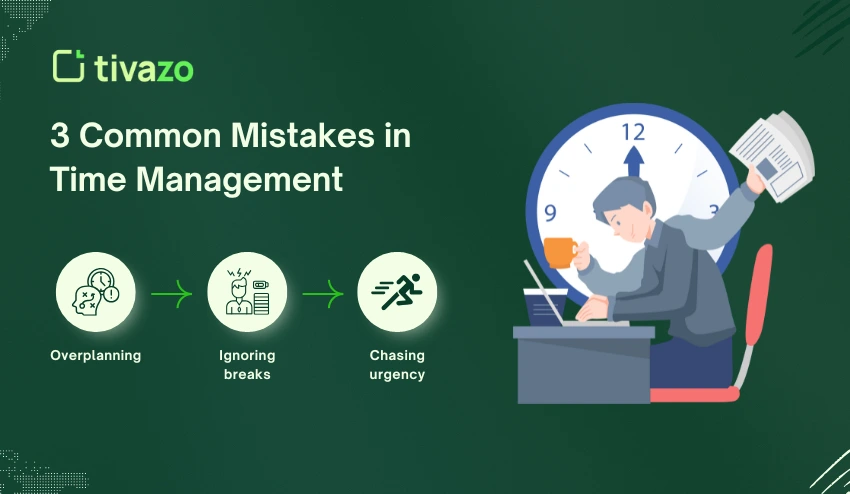
- Overplanning: Packing your day with activities from morning to night might appear to be effective, but it usually fails. Life is uncertain-meetings overrun, work drags, and surprises come. These factors might cause stress and anxiety. Leaving buffer time to transition, interruptions, and thinking is one of the best time management techniques. It is not an option to be flexible; it is a necessity.
- Ignoring breaks: Some people think that taking no breaks helps to increase productivity, yet it causes mental exhaustion and an inability to concentrate. Sustainable energy is one of the major advantages of time management. Effective short breaks will make you recharge and feel alert throughout the day.
- Chasing urgency: It is tempting to get lost in answering every notification or request that appears. However, not all that screams is important. One of the most effective time management techniques is learning how to differentiate between the urgent and the really important. Do work that will help you achieve your long-term objectives rather than responding to every fire drill.
Recognizing these patterns is the first step to improving how you handle your time.
Time Management Checklist
Before ending your workday, use this quick checklist to ensure you’re managing your time effectively.
- Set clear daily goals
- Prioritize high-impact tasks
- Schedule focused work sessions
- Minimize distractions
- Avoid unnecessary multitasking
- Take regular breaks
- Track how your time is spent
- Review your progress
- Plan tomorrow before finishing work
Conclusion
What is time management really? It’s a collection of small daily choices. And like any skill, it improves with practice.
Start with one technique this week. Maybe you begin planning your day the night before. Or block 2 hours each morning for focused work.
Whichever path you take, remember this: your calendar reflects your values. Use these management strategies to make it count.