
$30 an hour is how much a year after taxes? This is one of the most common questions job seekers and hourly workers ask when evaluating a new position.
While a $30 hourly wage sounds attractive, your actual take-home pay depends on taxes, deductions, overtime, and the number of hours you work throughout the year.
Overall, a full-time employee with an hourly wage of $30 will make approximately $62,400 in annual wages before taxes.
The net income, or take-home pay, after taxes is typically $45,000 to $52,000 per year, depending on state, deductions, and individual tax status.
This is why it is important to calculate hourly wages. The best way to know your income is to use a tool like the Hourly to Salary Converter to convert your hourly pay to your monthly and annual earnings, based on your work schedule.
Quick Answer: $30 an Hour Salary Breakdown
If you’re here just for the numbers, here’s a simple breakdown of what $30 an hour looks like in 2026:
| Breakdown | Estimated Income |
| Hourly wage | $30 |
| Weekly income (40 hrs) | $1,200 |
| Monthly income | $5,200 |
| Yearly income (before tax) | $62,400 |
| Estimated after-tax income | $45,000 – $52,000 |
How Much Is $30 an Hour Per Year After Taxes?

The first step in figuring out how much $30 an hour equals is knowing the standard number of hours worked in a year.
The 40-hour work week is the standard for most full-time US jobs. That means:
- 40 hours × 52 weeks = 2,080 working hours per year
According to the U.S. Bureau of Labor Statistics, full-time wage structures are commonly based on 2,080 annual working hours.
Then multiply by $30:
- 2,080 × $30 = $62,400 per year
This is your total income before any deductions (such as taxes or insurance).
But not everyone works exactly 40 hours per week. Others work irregular hours, part-time, or longer hours.
An hourly-to-salary converter, such as the one offered at Tivazo, is valuable because it calculates the income based on actual working hours, not based on assumptions.
$30 an Hour Per Paycheck
When considering a job offer, many individuals do not consider the annual salary. Rather, they desire to see how much cash they will really discover in their check.
If you make $30 an hour and work a 40-hour workweek, your pre-tax income would be:
| Pay Period | Gross Earnings |
| Hourly | $30 |
| Daily (8 hours) | $240 |
| Weekly | $1,200 |
| Biweekly | $2,400 |
| Semi-Monthly | $2,600 |
| Monthly | $5,200 |
| Yearly | $62,400 |
Your actual earnings will be reduced by federal taxes, Social Security, Medicare, health insurance, and state income taxes.
If you have a set of work hours, use the Tivazo Hourly to Salary Calculator for a more accurate estimate.
$30 an Hour After Taxes: What You Actually Keep?
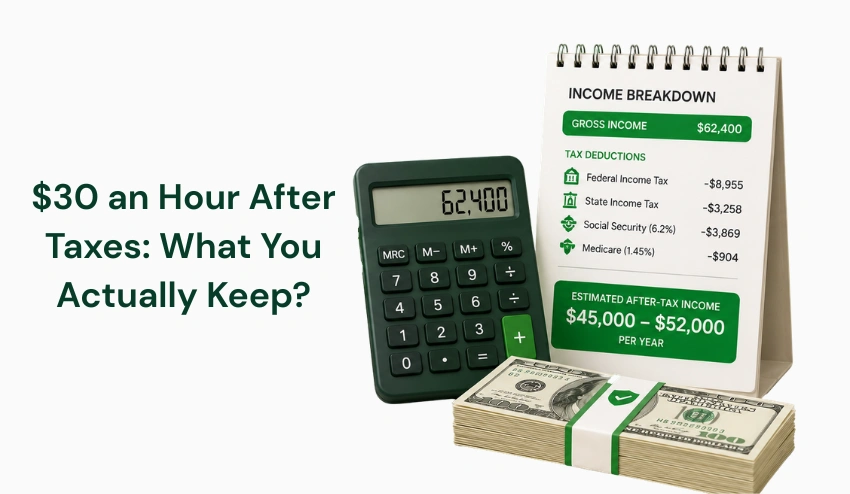
It’s easy to see on paper that you are paid $30/hour, but it really isn’t until taxes and deductions are subtracted out.
The gross annual income equals about $62,400, but the income that you can spend is dependent on what is withheld from that income before you actually see it in your bank account.
The United States has several deductions that take a cut out of your paycheck. These are generally federal income tax, state income tax (also known as state withholding tax), Social Security, and Medicare.
When combined, these deductions can have a significant impact on your total income, particularly if the tax rate varies from state to state.
Federal income tax is a tax system that is determined by the IRS (Internal Revenue Service) and is applied to your income at various tax brackets based on your income and filing status.
Due to such deductions, a full-time employee working 40 hours a week working for $30 an hour will make only a little more than what the $30 suggests. For most, the estimated after-tax income is in the range of:
- In lower-tax states: around $48,000 to $52,000 per year
- In higher-tax states: around $43,000 to $48,000 per year
In real life, this difference can seem like a lot. It’s not uncommon for two people to be making the same $30 an hour but then having vastly different lives due to their geographic location and the amount deducted from their pay.
$30 an Hour Is How Much a Year After Taxes by State?
Taxes can significantly affect your take-home pay.
Although exact amounts vary based on filing status, deductions, and local tax laws, the following estimates provide a general idea of annual take-home income.
| State | Estimated Take-Home Pay |
| Texas | $49,000 – $52,000 |
| Florida | $49,000 – $52,000 |
| Washington | $49,000 – $52,000 |
| California | $44,000 – $48,000 |
| New York | $43,000 – $47,000 |
States without state income tax generally allow workers to keep a larger portion of their earnings.
Your actual take-home pay may vary depending on tax credits, retirement contributions, healthcare deductions, and filing status.
Monthly, Weekly, and Biweekly Income Breakdown
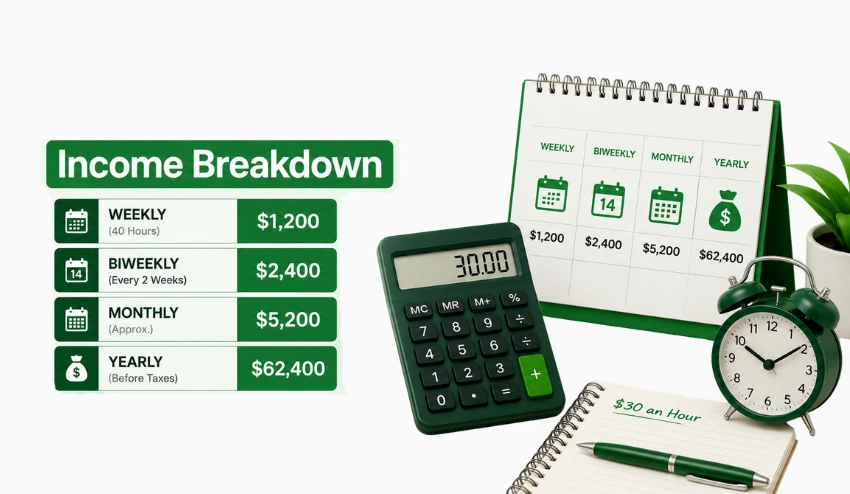
A great way to simplify budgeting is to divide the salary into a smaller time period. With an average wage of $30 per hour, those are the typical earnings.
- Weekly: $1,200
- Biweekly: $2,400
- Monthly: about $5,200
- Yearly: $62,400 (before taxes)
This division can be particularly useful for tenants, freelancers, and people who work on an hourly basis, as they want to budget for each month.
When you work on an irregular schedule or have shift work, it can be hard to see exactly what your earnings are. If so, you can use the Tivazo Time Card Calculator and accurately monitor actual working time.
Sample Monthly Budget on a $30 an Hour Salary
Understanding real-world spending can help determine whether this income level fits your lifestyle.
Example monthly budget based on an estimated after-tax income of $4,000:
| Expense Category | Monthly Cost |
| Housing | $1,300 |
| Utilities | $200 |
| Groceries | $500 |
| Transportation | $300 |
| Health Insurance | $250 |
| Entertainment | $250 |
| Savings | $500 |
| Miscellaneous | $700 |
Is $30 an Hour a Good Salary in 2026?
The salary of $30 an hour may seem ideal in some areas but not others, depending on factors such as location, lifestyle, and household size.
$30 an hour is a decent middle-class salary in many places in the United States. It pays a lot more than the minimum wage and is more than most entry-level jobs.
Its value, however, varies according to the living place.
- In high-priced cities such as New York or San Francisco, it can seem restrictive.
- In lower-cost states or rural areas, it provides a comfortable life.
- In mid-cost cities, it’s capable of maintaining a stable yet budgeted lifestyle.
A single person’s basic needs are met at $30 an hour. It might call for extra earnings from a family, particularly in high-cost regions.
Is it Possible to Make a Living on $30/Hour?
It will largely depend on where you live, how much you have to pay for housing, and family size.
For a single adult living in a moderate-cost area, a $30 hourly wage can often cover:
- Rent or mortgage repayment
- Utilities
- Groceries
- Transportation
- Health insurance
- Entertainment
- Savings contributions
If there are more people in the family, there might be a need to earn more (especially in areas where the cost of living is higher).
Jobs That Pay Around $30 an Hour
There are numerous professions that lie within this salary range, particularly for those who have experience or expertise.
Common jobs include:
Medical assistants, dental hygienists, and other jobs in the healthcare field are typically in this range.
Other trades, such as electricians, plumbers, and HVAC technicians, often make $30/hour or more based on their experience.
IT support technicians, junior developers, and administrative staff in the tech or office environment can also make nearly this amount of money.
Freelance writers, designers, and digital marketers can achieve this or even surpass it based on what their clients are in need of and how much they are working on.
Why Accurate Hour Tracking Matters?

The biggest error that workers can make is assuming their hourly wage equals their actual earnings.
In fact, your income is based on:
- Actual hours worked
- Incorporates break times (paid or unpaid)
- Missed shifts
- Overtime hours
The difference can be substantial if there are even minor discrepancies.
That’s where a tool such as the Tivazo Time Card Calculator can be helpful. It aids in making sure that your hours are tracked accurately to ensure your hours are correct with your pay, particularly if you work hourly or by shift.
How Overtime Changes Your Yearly Income
Overtime can significantly boost your overall pay rate to $30 per hour.
For most jobs, overtime is paid at 1.5 times the regular rate. That means:
- $30 × 1.5 = $45 per overtime hour
Overtime can add up if it is just a little here and a little there. For instance, if you were able to get an additional 10 hours of overtime each week, your salary would increase by over $20,000 annually.
This is one reason that many employees use the Free Overtime Calculator to determine how additional hours affect their annual earnings.
How Much Overtime Can Increase a $30 an Hour Salary
Overtime can significantly boost annual earnings.
Most non-exempt employees in the United States receive overtime pay at 1.5 times their regular hourly rate after working more than 40 hours in a workweek.
For someone earning $30 per hour:
Regular pay: $30/hour
Overtime pay: $45/hour
The table below shows how additional overtime hours can impact annual earnings.
| Overtime Hours Per Week | Additional Annual Income |
| 5 Hours | $11,700 |
| 10 Hours | $23,400 |
| 15 Hours | $35,100 |
Even a small amount of weekly overtime can add thousands of dollars to yearly income.
Workers can estimate additional earnings using the Tivazo Overtime Calculator.
Why Do People Use Tivazo Salary Tools?
The concept of income isn’t limited to mere number multiplication. It’s the understanding of how work hours, taxes, and overtime all work together.
Tivazo tools assist workers to
- Calculate annual earnings from hourly wages easily and quickly
- Record actual working time properly
- Understand overtime earnings
- Avoid payroll confusion
Rather than taking an educated guess, you’ll see a realistic picture of your finances.
Conclusion
In short, $62,400 a year is equivalent to $30 an hour before taxes, and $45,000 to $52,000 a year after taxes, depending on your location and deductions.
Generally, it is regarded as a stable, decent income in the United States, particularly in the middle-cost zones.
But as you work more hours, overtime, and the tax rates are applied, you will earn more, so it is important to use a reliable tax calculator.
To accurately determine how much money you earn per year, per month, and per hour, you can use the Tivazo Hourly Salary Calculator to convert your hourly rate into your yearly and monthly earnings, all in a flash.
If you’re interested, check out our similar article on $20 an hour is how much a year.