If you’re wondering, “$20 an hour is how much a year?”, you’re not alone. This is one of the most searched salary questions in 2026 as more jobs shift to hourly pay structures.
At $20 per hour, your income may look simple at first, but once you break it down into yearly salary, monthly income, taxes, and real living costs, the picture becomes much more important for budgeting and job decisions.
In this guide, you’ll learn exactly how much $20 an hour is per year, per month, and after taxes, plus whether it’s a good salary in 2026 and what types of jobs pay this rate.
Quick Answer
If you earn $20 an hour, your estimated annual salary is $41,600 before taxes, assuming you work 40 hours per week for 52 weeks a year. That equals approximately $3,466 per month, $1,600 biweekly, $800 per week, and $160 per day. If you work part-time or overtime or take unpaid leave, your total annual earnings will vary.
Key Takeaways
- $20 an hour equals approximately $41,600 per year before taxes for a full-time employee.
- Your estimated monthly gross income is about $3,466.A full-time schedule pays approximately $800 per week.
- A biweekly paycheck is around $1,600 before deductions.
- An 8-hour workday earns approximately $160.
- Your take-home pay depends on taxes, benefits, retirement contributions, and other payroll deductions.
- Overtime can increase your annual income if you’re eligible for overtime pay.
- Cost of living greatly affects how far a $20 hourly wage will go.
- Comparing hourly wages with annual salaries can help you evaluate job offers more effectively.
- Use Tivazo Hourly Salary Calculator to estimate yearly, monthly, weekly, and daily earnings based on your work schedule.
$20 an Hour Is How Much a Year? Full Breakdown
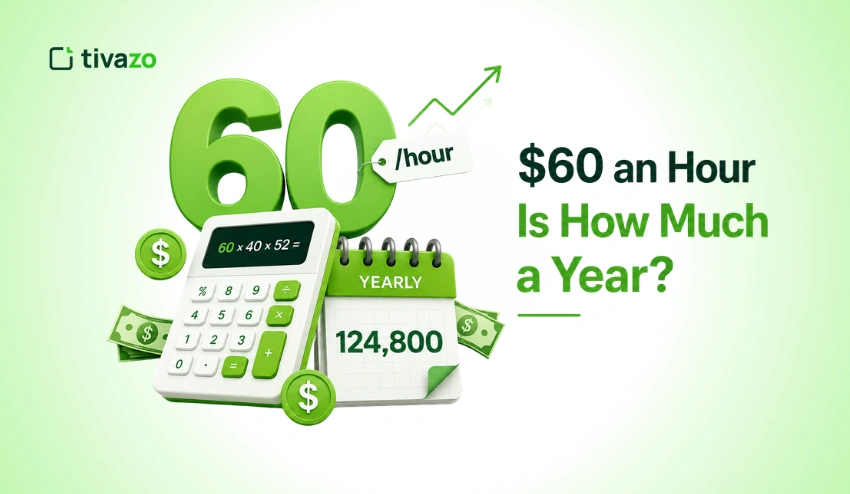
$20 an hour is $41,600 per year before taxes (40 hours/week, 52 weeks/year).
20×40×52=41600

First, let’s begin with the basics of the calculation.
A full-time job is typically
- 40 hours per week
- 52 weeks per year
So:
- $20 × 40 hours × 52 weeks = $41,600 per year
Quick Summary:
Hourly: $20
Yearly salary: $41,600
This is the income before taxes and deductions. A number frequently referenced when comparing job offers or applying an hourly wage to a yearly wage calculator for pay structure comparisons.
But there are factors like taxes, benefits, overtime, and where you’re working that will certainly impact your real earnings, so we will continue to examine those.
$20/hr Annual Salary Explained
If you have been working at a $20/hr rate, it is estimated that your yearly income is $41,600 before taxes (assuming 40 hours per week for 52 weeks per year).
This simple calculation should tell you that:
Here is the formula for calculating annual salary:
$20 × 40 × 52 = $41,600
This is your total annual income, before taxes, retirement contributions, health insurance, and other payroll deductions. If you change your plans throughout the year, so will your annual earnings. Use Tivazo calculate annual salary tool for a quicker estimate according to your actual hours worked.
Annual Salary Breakdown
| Hours Worked Per Week | Weekly Income | Annual Salary |
| 20 Hours | $400 | $20,800 |
| 30 Hours | $600 | $31,200 |
| 35 Hours | $700 | $36,400 |
| 40 Hours | $800 | $41,600 |
| 50 Hours | $1,000 | $52,000 |
$20 an Hour Monthly Salary Breakdown
Many people search for “$20 an hour monthly income” because monthly earnings are much more useful for budgeting than yearly income alone.
If you work a standard full-time schedule of 40 hours per week, earning $20 an hour equals an average gross monthly income of approximately $3,466 before taxes.
Breaking your salary into monthly amounts makes it easier to:
- Plan monthly bills
- Estimate rent affordability
- Build an emergency fund
- Set savings goals
- Compare job offers
Monthly Salary Breakdown
| Pay Period | Gross Income |
| Hourly | $20 |
| Daily (8 Hours) | $160 |
| Weekly | $800 |
| Biweekly | $1,600 |
| Monthly | $3,466 |
| Quarterly | $10,400 |
| Annual | $41,600 |
If you are an Hourly employee, you can use a tool such as an hourly to salary converter to quickly see how various situations of overtime or other schedule changes may impact your compensation.
Note: Monthly income is calculated by dividing the annual salary by 12 months. Actual paychecks may vary depending on your employer’s payroll schedule.
What Is the Gross Monthly Income at $20 an Hour?
If you’re wondering about the gross monthly income for $20 an hour, the answer is straightforward.
A full-time employee earning $20 per hour makes approximately $3,466 per month before taxes and deductions.
Gross monthly income includes all earnings before deductions, such as:
- Federal income tax
- State income tax (where applicable)
- Social Security
- Medicare
- Retirement contributions
- Health insurance premiums
Your net monthly income, or take-home pay, will usually be lower after these deductions are applied.
Understanding the difference between gross and net income helps you create a more accurate budget and compare job offers realistically.
Gross Income vs. Net Income
When discussing salary, it’s important to know whether you’re looking at gross income or net income.
| Gross Income | Net Income |
| Before taxes and deductions | After taxes and deductions |
| Used in salary offers | Amount deposited into your bank account |
| Higher amount | Lower amount |
If a person works for $20 per hour, his/her gross annual income is $41,600; actual net income depends on taxes, deductions and employee benefits.
To learn more about wage calculations, deductions, and payroll, look at our Employee Payroll Management Guide.
$20 an Hour After Taxes: Real Take-Home Pay
Gross income is not your take-home pay. After taxes, most workers keep about 75–80% of their earnings.
Common deductions include:
- Federal income tax
- State tax (as applicable)
- Social Security
- Medicare
- Estimated take-home pay:
The share of gross income retained by workers is approximately 75-80 percent.
So:
- Yearly after tax: $31,000 – $33,000
- Monthly after tax: $2,600 – $2,750
- Weekly after tax: $600 – $650
That’s why it’s important to know how much $20 per hour after taxes will be before planning a budget.
Companies may also use technology, such as time tracking and automatic time tracking for employee work hours for remote work or organized teams, to maintain precision in payroll and steer clear of payroll mistakes.
Estimated Take-Home Pay
Although every taxpayer’s situation is different, employees earning $20 an hour often take home around 75% to 80% of their gross income after common payroll deductions.
Estimated take-home pay may be approximately
| Pay Period | Estimated Net Income |
| Weekly | $600–$650 |
| Monthly | $2,600–$2,750 |
| Annual | $31,000–$33,000 |
Is $20 an Hour a Good Salary in 2026? (Realistic View)

Whether $20/hour is good depends on your location and lifestyle.
General breakdown:
- Entry-level employees: fair initial salary
- Skilled professionals: typically not average
- Low-cost areas: fairly comfortable
- High-cost cities: low finances.
The U.S. Bureau of Labor Statistics reports that the wage benchmarks vary widely depending on the job and location, particularly with the ever-rising cost of living in cities across the country.
Key insight:
While $20 an hour may be near the entry-to-mid-range of many occupations, it is possible that it may not keep up with the expenses of housing and living in 2026. To better understand employment structures, see hourly vs salary.
In 2026, $20/hour is generally entry-to-mid-level income.
Jobs That Pay $20 an Hour in 2026 (Best Options)
Here are the most common industries where $20/hour jobs are available:
1. Customer service roles
- Call center representative
- Help desk support
2. Administrative roles
- Office assistant
- Data entry clerk
- Receptionist
3. Retail & hospitality
- Shift supervisor
- Experienced sales associate
4. Logistics & warehouse jobs
- Warehouse associate
- Delivery driver
5. Healthcare support roles
- Medical assistant
- Pharmacy technician (entry-level)
Many of these jobs require structured scheduling systems and workforce applications like the best clock-in clock-out apps for employees and employee monitoring.
Can You Afford a Comfortable Living on $20 per Hour?
Spending habits and location are important in determining how comfortable you can live on $20 an hour.
Comfortable conditions:
- Rent or shared housing that is affordable.
- No major debt
- Stable full-time hours
- Controlled lifestyle expenses
Difficult conditions:
- High-cost housing markets
- Those who depend on the member or his family.
- High transportation or loan limitations
Any inefficiencies, no matter how small, in scheduling or payroll can affect earnings; that’s why companies rely on systems such as a transparent time tracking system that employees trust.
Monthly Budget Example on a $20/Hour Salary
Monthly income after tax: $2,600 – $2,750
Sample budget:
- Rent: $1,000
- Utilities: $150
- Food: $400
- Transportation: $250
- Insurance: $200
- Phone/Internet: $100
- Miscellaneous: $300
- Savings: $300
This means there’s not much room for maneuver, and there’s a strong need for discipline in budgeting.
Employers benefit from tools such as reducing time theft in remote teams, which can guarantee that they make accurate payroll and pay fairly.
$20 an Hour vs Other Salary Levels
| Hourly Rate | Yearly Salary |
| $15/hour | $31,200 |
| $20/hour | $41,600 |
| $25/hour | $52,000 |
| $30/hour | $62,400 |
Even a $5/hour increase adds over $10,000 per year.
Career Growth: How to Increase Your Hourly Wage in 2026?
To move beyond $20/hour, focus on skill development and job positioning.

Ways to increase income:
- Earn certifications (IT, healthcare, trades)
- Move into supervisory roles
- Develop technical skills (Excel, CRM tools)
- Apply for higher-demand industries
- Improve communication and leadership skills
According to Harvard Business Research, one of the drivers of long-term wage growth is skill development and internal mobility.
Some companies use performance insights, timesheets and report tactics to assess workers for promotion and salary increases.
Salary Calculation Tools for Accurate Income Estimates
While it’s good to do it by hand, it can be easy to mess up, particularly when working overtime, shifting shifts, or setting your tax assumptions.
That’s why job seekers and employees who have to use a digital tool have a much more accurate and clear financial picture.
For instance, the hourly to salary calculator can help you to calculate the hourly salary of $20 per hour and get the yearly, monthly, and weekly income without manually making calculations.
This can be helpful if you’re weighing several job offers or if you want to make sure you’re making an affordable job offer.
If overtime hours or shift differentials are in the schedule, a free overtime calculator becomes a must-have. Just a couple of hours each week could help you make a lot more money in a month, and miscalculations can cause you to create an unrealistic budget.
The time card calculator allows for hourly payroll validation and verification of hours worked in a time card or time clock environment.
It can be particularly beneficial for workers in customer service, logistics, and retail jobs who are paid by the hour and have irregular work hours.
For 24-hour clock military time records, which are often used in healthcare, security, and transportation, a military time converter can help prevent misinterpretations and reporting errors.
In addition to individual calculations, employers are increasingly turning to structured solutions, such as time tracking, to ensure payroll accuracy, minimize disagreements, and enhance wage transparency.
This is not only good for businesses but for their employees as well, because the employees will only get paid for their hours worked.
If you’re comparing multiple job offers, looking at different hourly wages can help you understand how small pay increases affect your annual income.
You may also find these salary guides helpful:
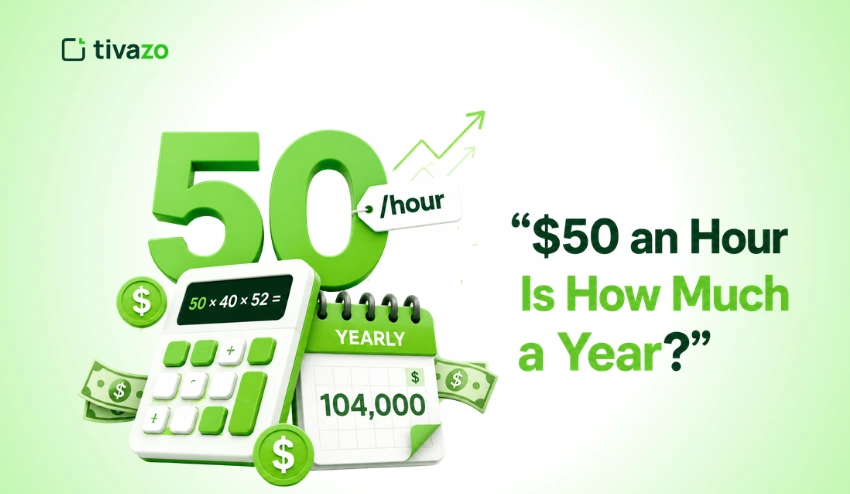
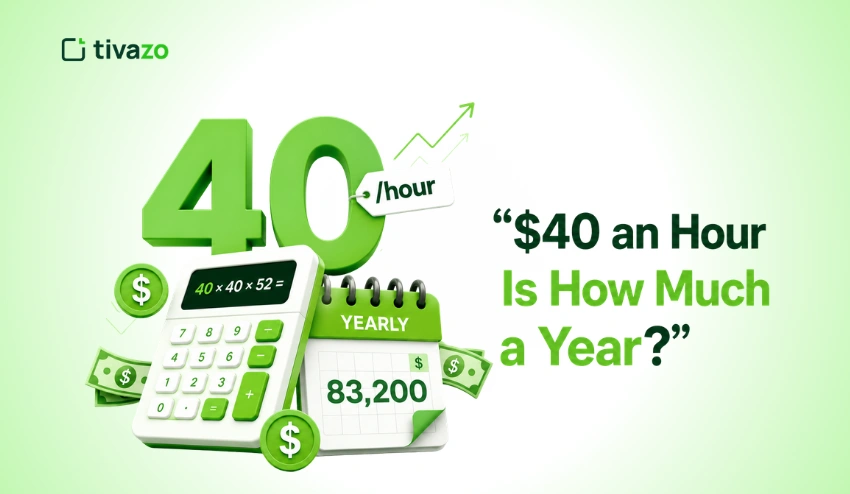
- $25 an hour is how much a year
- $30 an Hour Is How Much a Year After Taxes
- $40 an hour is how much a year
- $50 an hour is how much a year
Even a $5 increase in hourly pay can add more than $10,000 to your annual salary, making it easier to reach your savings and financial goals.
Conclusion
Understanding $20 an hour is how much a year helps you make smarter financial and career decisions.
At $41,600 per year before taxes, this wage can provide stability in lower-cost areas but may feel limited in expensive cities.
The real key is not just the hourly wage—it’s
- Growth potential
- Job stability
- Location cost of living
The yearly salary before tax is $41,600 in this case, which is on the middle side of the spectrum, and while it will provide a modicum of stability, it won’t necessarily provide long-term financial comfort in higher-cost areas.
But the $20/hour is not the only thing that is important about it.
First, stability matters. Full-time, regular work at $20/hour is worth a lot more than part-time, irregular work at a higher rate. Predictability enables financial planning, lessens financial stress, and can help with budgeting.
Secondly, location is key. In certain areas, $20/hour will provide a small but comfortable living. In some, particularly urban areas where rent is high, it may just be supplemented by basic needs.
That’s why salary is not the only thing to look at when deciding to take a job, always take the cost of living into account.
Thirdly, the most important factor is growth potential. Ideally, $20/hr should be a stepping stone and not the end. If the role provides skill development, promotions, and industry experience, over time, you can earn $25, $30, or more.
If there is no growth, you could end up earning the same amount as you did before, which may not be enough to cover the rising cost of living.
Last but not least, your financial result is more than just about what you make, it’s about how you handle it.
$20 an hour sounds like a lot of money to some people and not so much to others, depending on how you budget your income, keep track of your expenses, and realize your net worth.
Ultimately, $20 an hour isn’t simply a salary; it’s a baseline for developing monetary direction. But it can be the stepping stone to much higher future income with the proper choices and education.
$20 an hour is not just a wage—it is a starting point for long-term financial growth.