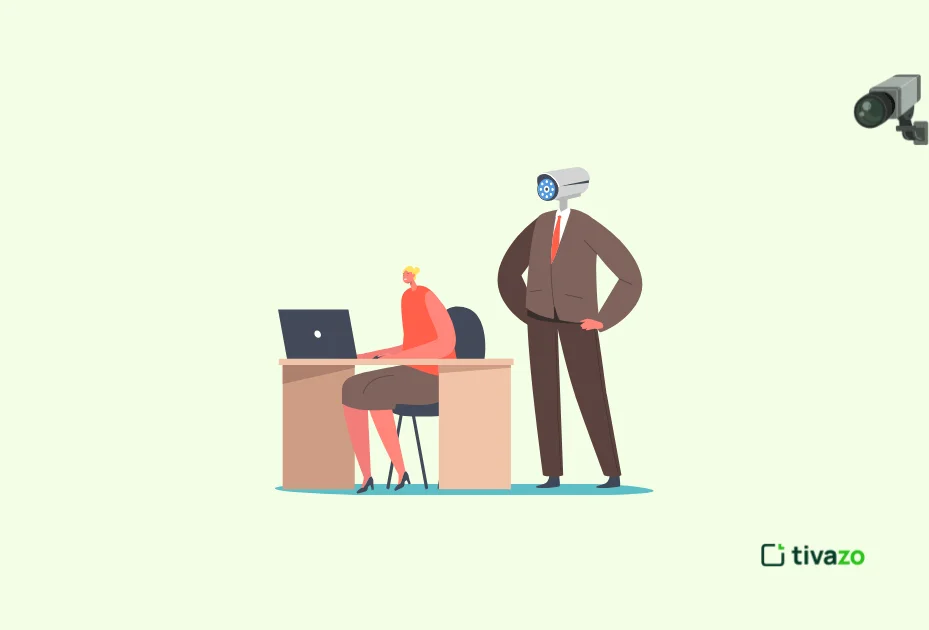
Ethical and transparent tracking of work activity, time, attendance, productivity, and performance for the purpose of enhancing business operations. Employee surveillance generally consists of covert, over-progressive, or fear-based monitoring for control rather than trust.
The difference is in purpose, transparency, consent, and boundaries. Monitoring helps teams work better. When there is surveillance, the employees feel like they are being observed.
Having visibility is crucial for modern businesses, particularly for remote, hybrid, BPO, agency, call center, and operational organizations. Managers must be aware of the people in the workplace, where time is being spent, whether projects are progressing or not, and where there are productivity deficits. However, that visibility shouldn’t be achieved at the expense of employee trust.
Hence, the question Employee Monitoring vs Employee Surveillance: What’s the Difference?‘ is important. The purpose is not to watch all of every move. The objective is to establish a fair system that clarifies to employees what is being tracked, why it is being tracked, and how the data is being utilized.
The cornerstone of this more health-focused approach is time tracking and employee monitoring, with live screenshots and idle alerts, timesheets, and employee performance insights that empower teams to boost productivity without over-managing.
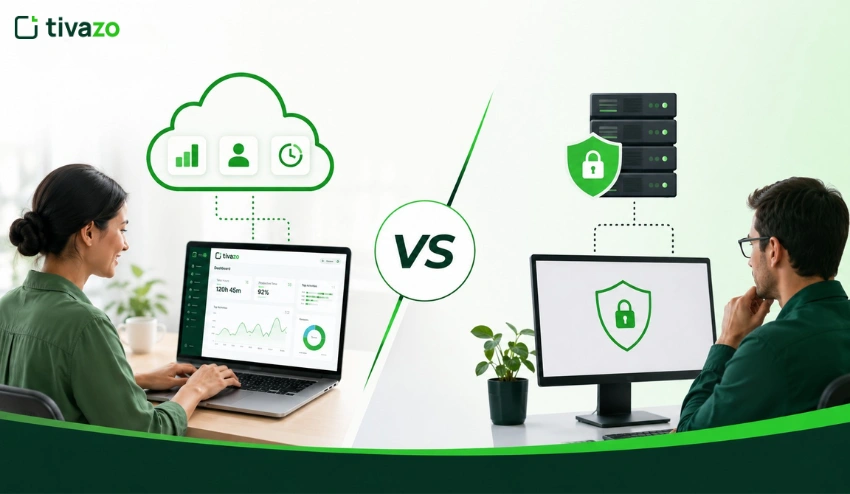
Employee Monitoring vs Employee Surveillance: The Core Difference
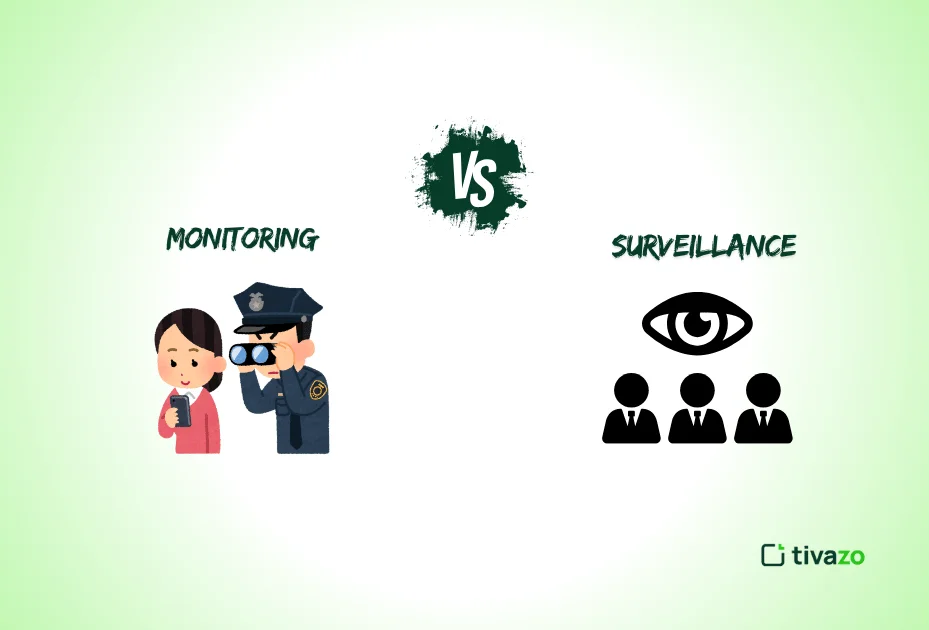
Employee monitoring is work-centric. Employee monitoring is management-oriented
Employee monitoring vs employee surveillance records business-related activity like work time, attendance, active time, idle time, app usage, screenshots, project time, and performance reports. It is typically reported to employees and linked to other clear business objectives such as payroll, productivity, accountability, and workflow improvements.
Employee surveillance, however, is mostly concealed or excessive. It could be related to monitoring employees without their explicit permission, monitoring personal activity, collecting more data than necessary, or involving the use of monitoring tools to pressure employees rather than to assist them.
| Area | Employee Monitoring | Employee Surveillance |
| Purpose | Improve productivity and accountability | Control or watch employees |
| Transparency | Employees know what is tracked | Tracking may feel hidden |
| Data Use | Work hours, reports, productivity insights | Excessive or unclear data collection |
| Trust Level | Builds clarity when done right | Can damage morale |
| Best Practice | Policy, consent, privacy controls | Often lacks boundaries |
Simply put, employee monitoring is asking: What can we do to make the team more effective?
Employee Surveillance questions: How do we monitor everything employees do?
This is a difference of magnitude!
Why Businesses Use Employee Monitoring
Employee monitoring in the business industry has become a reality due to a change in work. Sitting in the same office is not a constant for teams. There are many companies out there that are spread out across several remote teams, hybrid schedules, time zones, and departments.
If there is no visibility, managers can have difficulty answering fundamental questions:
- Which people are they now in the fields?
- What was the duration of a project?
- What jobs are taking longer than they should?
- Is there an over- or underload of employees?
- What are the delays in the process?
- Do timesheets provide payroll accuracy?
- Are managers able to detect patterns of productivity?
Employee monitoring can provide answers to these questions with data rather than educated guesses.
For instance, a manager might believe a project is behind schedule because one of their employees takes a long time to complete a task. However, the actual issue might be revealed through time tracking and performance analytics, such as excessive meetings, unclear tasks or assignments, multi-tasking, and waiting time between approvals.
That is where ethical monitoring comes in handy. It does not merely provide an overview of employee work. It provides businesses with insight into the actual work.
Why Employee Surveillance Creates Problems
The issue with employee monitoring is when an employee feels he or she is being monitored rather than supported.
If tracking is not obvious, over-ambitious, or stealth, staff members can feel uneasy, uncreative, and untrusted. This can create resistance and demotivate. Rather than increase productivity, surveillance can foster fear.
Some of the common symptoms of surveillance are:
- Monitoring employees without telling them.
- Keeping an eye on self-work hours
- When you don’t need to capture sensitive information
- Screaming/screaming or taking screenshots as punishment rather than understanding.
- Taking screenshots to punish, instead of understanding.
- Only measure productivity that is done using mouse clicks or typing on a keyboard.
- Not giving employees access to policies or expectations
- Data gathering for no business purpose
When I’ve seen productivity workflows, I’ve found it is not really about the tool. The danger is in introducing the tool. When managers tell employees, “We have to put this up to trap people,” employees don’t like that. The dialogue gets healthier when managers explain: “We’re doing this to be more accurate with payroll, better manage our workloads, and see our projects more clearly.
Tools are not the means of building trust. Policies, communication, and fair usage do.
Key Features of Ethical Employee Monitoring
Monitoring the employees should be transparent, limited, and useful in an ethical way. It should support the business but respect employees as persons.
A healthy employee monitoring program has the following elements:
- Communicate the employee monitoring policy.
- The awareness and consent of employees.
- Track work hours as they occur within the work time.
- Privacy-first screenshot settings
- Data is accessible by role.
- Access to data based on roles.
- Correct time sheets for payroll.
- Reports were based on trends rather than personal opinion
- Explanation of what is monitored is clear
- Explanation of what is not monitored is clear
- The review of monitoring practice regularly.
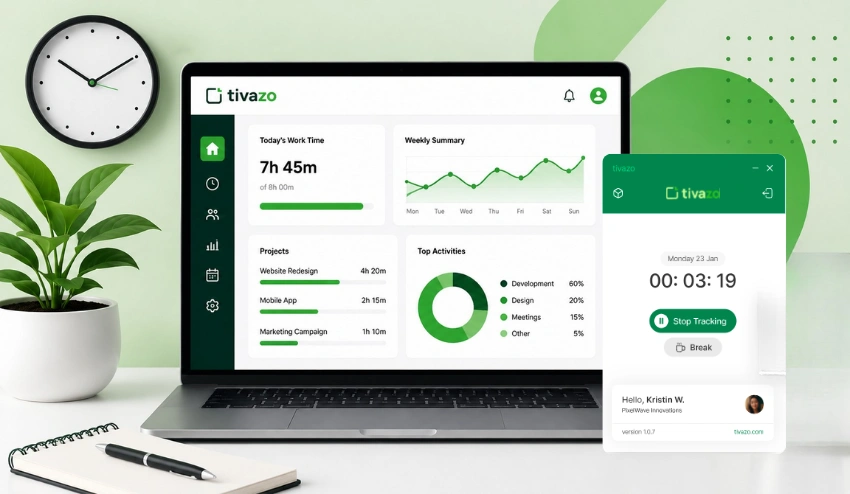
This is where Tivazo comes in. Tivazo enables teams to track time, monitor productivity, analyse idle and active times, take live screenshots, create timesheets, and analyse performance insights. It’s not about “watching workers without them knowing.” The concept is to “create visibility without micromanagement.”
That’s important because many businesses are looking for productivity reports, but will also need to keep employees happy.
What Should Companies Monitor?
Businesses need to track work-related data for use in operations, payroll, accountability, and improving productivity.
Useful data includes:
- Work time record – WTR
- Total work hours
- Time spent in Active and Idle modes.Active and Idle Time.
- Estimate the time it will take to complete a project or a task.
- Attendance records
- Timesheets
- Productivity trends
- Using a business app or site for work.Use of apps or websites in relation to work.
- Disclosure of screenshots, if required and relevant
- Reports for payroll or billing
- Employers are not permitted to supervise personal activity, personal messages, personal accounts, off-duty activities, or activities other than job performance.
A good second rule is that if the data isn’t improving work, payroll, security, or accountability, then you probably don’t need it.
Employee Monitoring and Privacy
The difference between monitoring and surveillance is privacy.
- The data that is gathered.
- Why is it collected
- Who can see it
- The length of storage duration
- How it impacts performance reviews.Its impact on performance reviews.
- Making a note of what is being discussed on the computer screen or not.
- Whether personal data is protected is a key aspect of this consideration.
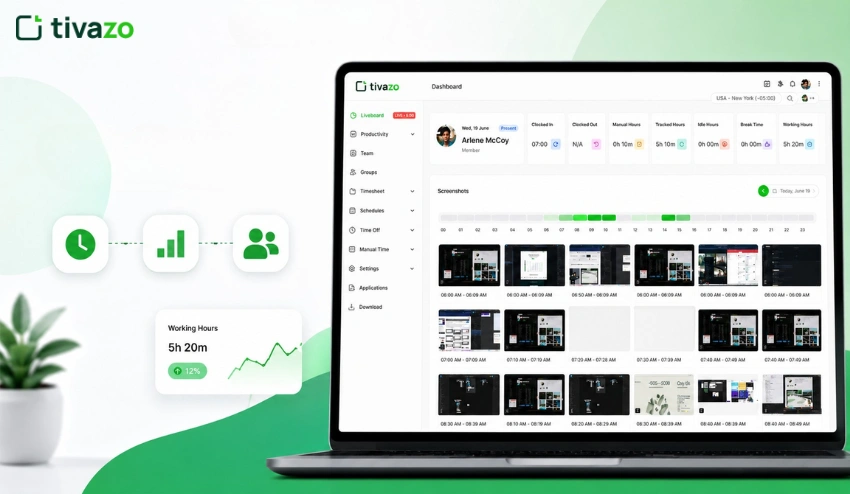
For instance, Tivazo’s live screen capture function can provide managers with insights into the progress of work, but with the right settings, communication, and expectations for privacy. Use screenshots to help hold people accountable, not to instill fear.
The top firms won’t conceal monitoring. They clearly discuss it onboarding, incorporate the data into the employee handbook, and remind staff that the data is used for payroll, productivity, and workload planning.
Employee Monitoring vs Micromanagement
Employee monitoring is not micromanaging.
Micromanagement occurs when managers are constantly involved, ask questions about all actions, and make the manager feel as though he or she has no choice but to take the place of the employees. If monitoring is done well, managers can do this without the need to interrupt workers again and again, minimising micromanagement.
A manager can view time logs, project progress, and productivity reports, for instance, instead of asking numerous times throughout the day, “What are you doing now?” That helps the employees have more room to work, while providing management with visibility.
This is one of the most significant advantages of Tivazo. It provides managers with real-time visibility, up-to-the-minute updates, screenshots, alerts when employees become idle, and trends in one dashboard, eliminating the need for constant chasing for updates.
Benefits of Ethical Employee Monitoring
If it is done right, employee monitoring is beneficial for both employers and employees.
It benefits businesses in the following ways:
- Accurate payroll
- Better project planning
- Improved productivity
- Reduced time theft
- Clearer performance reviews
- Faster issue detection
- Improved management of remote teams.Enhanced remote team management.
- Stronger accountability
- Easier client reporting
It supports employees with:
- Fairer recognition
- Clearer expectations
- Better workload balance
- Proof of work
- Fewer unnecessary check-ins
- More accurate pay
- Fewer problems with performance
The process must be fair. Monitoring should be done in order to identify problem areas, but also to track progress. It should also highlight significant performance, necessary to overwhelm workers, ineffective processes, and assistance requirements.
When Employee Monitoring Becomes Surveillance
When companies go too far with employee monitoring, it becomes surveillance.
Typically occurs when:
- Staff are not notified
- Work hours continue to be tracked after work hours.
- Too much data for managers to deal with.
- Private information is captured on screenshots
- Activity scores are not used in context
- Only activity levels are considered when determining the value of employees.
- When there is no human communication, monitoring takes its place.
- The company does not have a written policy.
For instance, when an activity has low activity time, that does not necessarily imply poor performance. An employee might be thinking, planning, reading information, on a call, working on a complex problem, or waiting to get on a system. This makes data a valuable tool for conversation, not decisions.
If monitoring is used, a good manager will take this data as a starting point: “I noticed that this project has a lot of idle time.” Had there been any hindrances in your work?”
A poor manager will employ it to make an accusation: “Your activity was poor, so you were not working.”
That difference matters.
How Tivazo Helps With Ethical Employee Monitoring
Tivazo is useful for businesses to keep track of work, but without compromising their privacy. It is meant for teams that require visibility without having to run with a ton of pressure.
Tivazo supports:
- Time tracking for remote, hybrid, and in-office teams.
- Tracking workers’ activities at work
- Real-time screenshots are displayed for progress tracking.
- Insights for idle and active time.Idle and active time insights.
- Timesheets and Reports for payroll
- Insights into performance and trends in productivity
- Manage roles, groups, and workspaces. Manage team members, teams, and workspaces.
- Dynamic connections with tools such as Google Calendar, Slack, Outlook, Jira, and API workflows.
The biggest take-home point from the Tivazo message is that monitoring shouldn’t be a fear-inducing process.
Tivazo allows managers to gain insights into the progress of work, pinpoint bottlenecks, access reports, and provide teams with data to assist them. Also, the employees are helped as they can demonstrate their hours, effort, and improvement.
Real-World Example: Monitoring Done Right
Now, try to picture a distant support team of 20 folks. Now, try to envision a distant support team of 20 employees. Managers, before the adoption of monitoring software work with manual updates, disjointed spreadsheets, and guesswork. Time spent on payroll is too long. There is an overburden of staff, and some have unclear workloads. Managers continually ask for status, and work is interrupted.
Once they have a tool like Tivazo in place, the team will be able to monitor work hours, track active and idle time, create timesheets, and visualize productivity trends. Managers no longer have to continually communicate with employees for updates. Staff have improved records of their work. Payroll becomes easier. Performance discussions are more fact-based.
That’s the proper way to monitor employees.
Now, let’s say the same company does it without informing employees, without a policy, and humiliates them in public using their activity levels. Now, if the same company does it without informing the employees, without a policy, and shames people in public based on their activity levels. That is surveillance. The same type of tool, but a completely different management approach.
Best Practices for Employee Monitoring in 2026

The focus for employee monitoring in 2026 should be on trust, privacy, and performance improvement.
Best practices include:
- Only use the monitoring for work-related purposes
- Notify employees before the start of tracking
- Do not monitor outside of the work time period
- Limit the number of screenshots used – only use when necessary.
- Where possible, use privacy masking.
- Look at general trends rather than individual minute-by-minute details
- Integrate information with human context.
- Set out explicit guidelines for managers.
- Protect employee data
- Use reports to enhance systems, not people
As the workplace is becoming more powerful with AI and automation, so must be the accountability of companies. But the more data, the better is not necessarily true. It’s all about better data and its use in a fair manner.
Conclusion
Don’t confuse employee monitoring with employee surveillance.
Employee monitoring is transparent, work-oriented, and has the goal of increasing productivity, payroll, accountability, and decision-making. Employee monitoring is too much, not clear, and can harm trust.
The simplest way to do this is to inform employees what is being monitored, why it is important, keep information private, and take advantage of the data to enhance employee performance.
Tivazo provides a good compromise for companies that desire visibility but not so much control. Tivazo allows teams to grasp work more accurately with time tracking, employee monitoring, live screenshots, timesheets, reports, and performance insights, with accountability being fair and practical.