Bad time tracking does not just result in small administrative headaches, but silently works on draining money out of your business every single pay cycle. Buddy punching is estimated to cost U.S. businesses an estimated 373 million annually (American Payroll Association). There is no rounding error. That is making a profit walk out the door.
The damage is not immediately spotted by most teams. It presents itself in the form of slightly inflated payroll, small compliance risks, or managers spending hours correcting timesheets rather than running operations.
In the long term, these little inefficiencies add up to actual financial loss and operational drag.
This article can help you to cut through the noise. You will find out what really makes good tools or costly mistakes, how various industries require different capabilities, and how to make a clear judgment about what you are doing.
In case you want to track the work hours of the employees, you can use tools such as time tracking, which can do away with guesswork and minimize manual errors.
The appropriate system not only can track time but also safeguard your margins and facilitate the way your team operates.
Why Manual Tracking is Costing You More Than You Care to Think

The error of manual entry is directly passed down to payroll. The slightest error in the calculation of hours worked may result in overpayments or underpayments, which both cause issues.
According to the Society of Human Resource Management, on average, 1-8% of total payroll is affected by payroll errors (SHRM, 2024). That might not be much; however, over a year, it would amount to thousands of dollars wasted or arguments that would take hours to settle. The fallout is easy: inaccurate payroll undermines confidence and costs money.
Time theft is more difficult to identify and equally as harmful. Buddy punching, longer hours, or rounding up of hours is something that is not easily noticed when systems are based on trust or manual logs.
Managers do not often get the visibility to spot patterns early, particularly in large, growing teams.
These slight anomalies over time have the effect of increasing labor costs with no increase in productivity. The resultant effect is a bloated payroll and no subsequent improvement in output.
The most expensive issue is compliance risk, and this is the least noticeable until it is too late. The misinterpretation of the overtime sheets or the lack of some breaks can be considered a violation of the labor laws, especially in those industries where the situation is strictly regulated.
In the absence of trustworthy records, companies find it difficult to justify themselves in case of audits. When you use manual processes rather than using systems, such as timesheets and reports, you generate accurate timesheets that you use for payroll.
You’re essentially gambling with compliance. The resultant effect is fines, legal exposure, and reputational damages.
The lesson learned: manual tracking does not break at all; rather, it breaks silently, and that is what makes it costly.
5 Features That Separate Good Software From Expensive Mistakes
1. Real-time tracking vs. manual entry
There is no guessing with real-time tracking. When employees digitally clock in and out, their working hours are recorded automatically, which is the opposite method of manually reconstructing the time later.
Manual entry depends on one’s memory and need for estimation, which causes the occurrence of errors. A system in which time is being caught as a matter of fact means the correctness of data is secured right at the outset.
2. Payroll integration
Fully independent systems result in duplicating the work. If your time tracking application is connected to payroll, data is transferred automatically, i.e., no re-entry is required.
This results in fewer mistakes and the saving of administrative time at each payment cycle. It also means that the hours that have been approved without a problem will be the ones paid down to the last cent.
3. Labor law compliance automation
Compliance should be the last thing you want to manage manually. The right systems have the built-in features that automatically calculate overtime, monitor breaks, and identify any violations so that these are addressed before turning into problematic situations.
This is even more important in highly regulated industries. Automation lowers the level of risk, and at the same time, it is the one doing all the work that you would probably need to watch over.
4. Employee monitoring and productivity visibility
The more knowledge managers have about their staff, the more educated managerial decisions they can make.
The features that support employee monitoring and idle time understanding are the ones that managers can use to work out the actual nature of the work done.
At the same time, these only help managers to come up with the inefficiencies they have to work on without even having to make big guesses. The main idea, after all, is to see what is going on and not to control every single detail.
5. Reporting and performance insights
Data alone is not sufficient—it needs to be interpreted and turned into action. Software that generates reports on activity trends and performance insights based on such data allows managers to recognize and anticipate problems, as well as determine how work can be optimized through proper staffing.
With the availability of such insights, managers will doubtlessly be able to make better decisions.
The best systems are those that, besides recording hours, also help you decide on ways of using your time in a better way.
Industry-Specific Needs: What Your Sector Really Demands
Healthcare
On one hand, healthcare professionals are heavily regulated by labor laws, and they work under constant pressure to keep the staff complement at a level that satisfies the service needs.
Hospitals and medical centers can not only keep track of forced breaks and adjust working hours with consideration of FLSA rules, but also communicate with each other across different departments.
Besides the understanding that failure to give an employee his/her break on time may not only lead to the company being fined but also expose it legally, employees having to work one day after another leads directly to their burnout, with nursing staff being especially vulnerable.
The right attendance management system is capable of guaranteeing that staff breaks are logged automatically, plus it can warn the manager in case of any compliance risk.
Scheduling of shifts allows even distribution of workload between different departments with the help of shift scheduling software.
Workforce management software, when integrated, enables managerial staff to view staffing peaks in real time and make the necessary adjustments swiftly.
Hospitals, health centers, and other medical service providers have to prevent situations where their staff, especially the nurses, end up working overtime.
This can be done by accurately keeping track of working hours, as that is the only way the managerial staff can intervene before the problem of staff exhaustion arises, leading to hospital staff no longer being in a position to provide patient care safely.
Result: fewer compliance violations, more balanced staffing, and less burnout of critical staff.
Construction
Construction is an industry where it is not easy to work with only one office location. Employees change from one site to another, projects have limited budgets, and labor expenses are one of the main elements that determine the profitability of a project.
When labor hours are not accounted for correctly, it is very easy for time to be either falsified or incorrectly assigned.
The problem is resolved by time-stamping mobile workers with GPS confirmation.
I.e., staff members can enter time from any site, and the location can be confirmed by managers automatically without any extra manual work.
As a result, it will be impossible to deceive with the time entries, as well as make a guess when there is no information at hand.
Project-level cost reporting comes from being able to link labor hours to project budgets. Meanwhile, an excellent staff time-tracking system will also be helpful for overtime computation in case teams have to work long hours under different circumstances.
The system, therefore, goes hand in hand with keeping a project on budget by avoiding too much salary that comes from hours spent going beyond control and not being accounted for properly.
When organizing your workforce with roles and team groups through tools like team management, construction managers can assign workers efficiently across multiple sites.
The outcome is clear: accurate labor tracking leads to tighter project budgets and improved profitability.
Retail
Retail staffing is highly time-dependent. Having too many employees during slow periods wastes money, but having too few during busy times results in poor customer experience.
Moreover, managing part-time employees with changing schedules complicates the matter even more. A robust system enables store managers to synchronize staff with customer flow.
Using past store traffic data, they schedule employees according to demand.
This way, they minimize overstaffing and understaffing, both of which have direct effects on profitability. Besides that, retail staff require adaptable scheduling software to handle regular updating of shifts.
As employees are always changing shifts or modifying their availability, manual monitoring soon becomes a nightmare.
Computerized programs are essential for keeping timetables correct and up-to-date without the need for continuous human interference.
Knowing who is present guarantees that workers act in accordance with their timetable and that the time they spend working corresponds to what was scheduled.
This is a crucial factor when it comes to retaining uniform service quality. Results are not long to come: making better staffing choices improves customer experiences and enables better control over labor costs.
How Does Tivazo Streamline Time and Attendance Management?
Tivazo is very intuitive and demands very little manual intervention from the very first moment it is installed.
Work hours are tracked automatically through time tracking software running silently in the background, so you don’t have to depend on employees to remember to enter their time accurately every time.
It even has an idle detection feature that does not count the time when a computer is not being used as working time, thus giving you accurate time tracking data and productivity measurement.
What you get is the ability to see the whole picture at a glance via the live screenshot monitoring tool, which was created to enhance understanding and not to keep watch.
If you want to get a better idea of how it works, this article shows the live screenshot monitoring feature of Tivazo. explains the balance between transparency and privacy.
Managers can see patterns and workflows without constantly watching individuals, which keeps the focus on productivity, not control.
Timesheets and reports are created on their own, and at the same time, they are prepared for the payroll cycle.
You do not have to go through the tedious task of reworking the sheets; you simply have the option to look over and agree on the described time that has already been structured correctly.
Integration of payroll software and time tracking systems can be realized without extra time or manual correction, with support coming from time management and payroll.
Through the use of team management tools, you can assign people to different roles and only give them access to the things that they are in charge of.
In such a way, managers can focus on what they need to see, while employees get a minimalist UI for time-tracking purposes.
It is a very effective way of keeping things in order as your team grows.
Performance heatmaps and activity trends are digital representations of data that have been analyzed and interpreted, so you get a clear list of facts rather than a mass of numbers.
You know the most productive hours of your teams, the areas where the resources are bottlenecked, and the way the shifts in the workloads change through time.
With the help of these inputs, you are able to make changes before there is a need to deal with heavy problems. The process of getting started with Tivazo is a piece of cake.
To be exact, the step-by-step installation guide provides an easy walkthrough of the program without first needing to be on a computer.
The bottom line is that Tivazo merely logs hours—it creates a detailed, comprehensible, and practical insight into how your workforce operates.
Choosing the Right Tool Based on Your Team Size
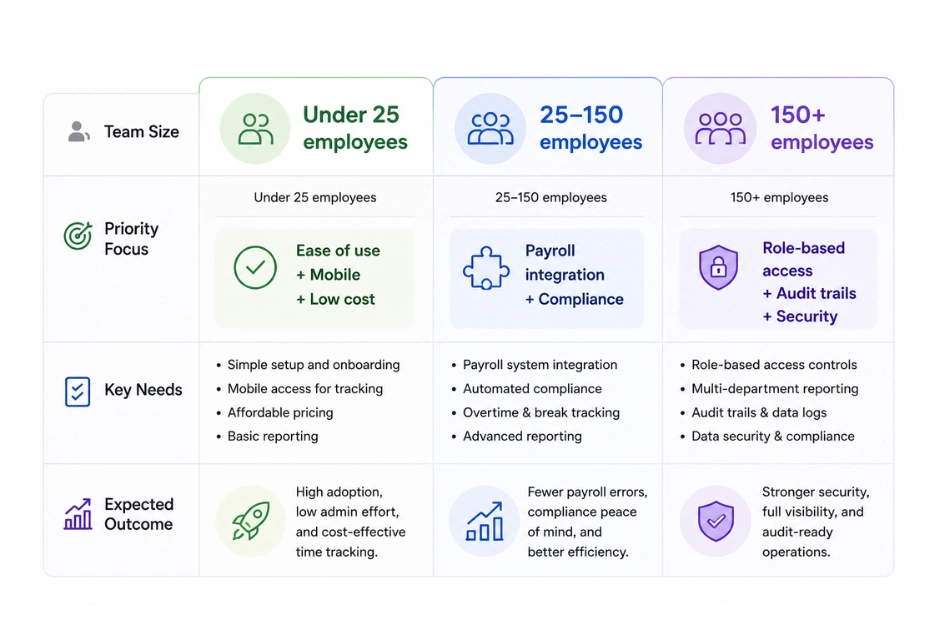
Small teams under 25 employees need simplicity above all else. If a system is complicated, people won’t use it consistently.
Focus on tools that are easy to set up, mobile-friendly, and affordable. At this stage, adoption matters more than advanced features.
A simple system that everyone uses correctly is far more valuable than a complex one that gets ignored.
Teams between 25 and 150 employees start to feel the impact of inefficiencies. Payroll errors become more expensive, and compliance requirements become harder to manage manually.
This is where payroll integration and automation start to matter. You need systems that reduce administrative work and ensure accuracy at scale.
Larger teams above 150 employees require structure and control. Role-based access, multi-department reporting, and audit trails become essential.
Data security is no longer optional — it’s a requirement. Systems must protect sensitive employee information while maintaining compliance with regulations. Solutions that prioritize security, like those explained in how Tivazo secures your workforce data, help reduce risk at this level.
Choose the simplest system that fully supports your current size—not the most complex one you might need someday.
What a Smooth Implementation Actually Looks Like?
A successful rollout starts with understanding your current process. Before introducing new software, check how your team currently clocks time, where mistakes happen, and which tasks take up the most time.
This step will enable you to set up the new system to address actual problems rather than creating additional ones. After you decide on your tool, customization must be in line with your workflow.
Establish roles, set policies, and make sure that the tracking rules reflect your team’s working style.
During this stage, questions will come up, and resources like FAQs help resolve them quickly.
Workers must realize how the system will help them and not just how it works.
Setting clear expectations and rules, for example, as discussed in Tivazo’s employee handbook, will also ease the changeover.
It’s common for the first two weeks to drag slightly as people get used to the new methods of working, managers check the data more thoroughly, and minor glitches become apparent. That’s quite normal.
After this, work generally becomes quicker and more even. Continual monitoring and making refinements wrap up the rollout.
Take initial data to fine-tune your settings, enhance your precision, and fill in any voids.
A great system changes along with your team instead of imposing strict processes on them.