You have passed the phone interviews, the technical interviews, and the behavioral interviews. You are now at the final interview—the last obstacle between you and the job offer. Each answer counts at this point. The questions are deeper, and your competition is sharper.
In this guide, I will take you through 20 final interview questions, the reasons why they are asked, and how to answer them. You will also receive tested preparation methods, sample answers, and intelligent questions to ask the interviewer. These tips will help you bag the offer whether you are just about to get your first job or you are making a career change.
Key Highlights:
- Final interview questions help employers evaluate your leadership, communication skills, problem-solving ability, and cultural fit—not just your technical qualifications.
- Preparing answers with the STAR (Situation, Task, Action, Result) method helps you give clear, structured, and results-focused responses.
- Support your answers with measurable achievements and real workplace examples to demonstrate the value you’ve delivered in previous roles.
- Research the company, understand the role, and prepare thoughtful questions to ask the interviewer before your final interview.
- Salary discussions should consider the entire compensation package, including benefits, career growth opportunities, and work flexibility—not just base pay.
- Whether your interview is in person or virtual, confidence, professionalism, and effective communication can significantly improve your chances of receiving a job offer.
Quick Answer
Final interview questions are the last questions employers ask before making a hiring decision. They focus on leadership, communication, cultural fit, problem-solving, and your ability to contribute to the organization over the long term. Unlike earlier interview rounds, the final interview evaluates whether you’re the best overall candidate, not just the most qualified.
What Are Final Interview Questions?
Employers’ final interview questions are the last set they ask before deciding whether to hire you. At this point, you’ve proven you have the necessary skills and experience. The company is now looking to find out if you’re the long-term candidate for the position, the team, and the company’s culture.
Final interview questions are not as much about establishing the fact that you are qualified for the job but about how you think, communicate, problem-solve, and contribute to business success.
Behavioral and situational questions are common when applying for a position and help an interviewer get a better idea of how you’ve dealt with real-world challenges in the past, how you’ve worked with others on teams, and the quantifiable results you’ve produced in previous jobs.
Your last interview could involve a hiring manager, department manager, senior manager, or even the CEO. There is also the option of meeting other players who you will be playing with in the future in some teams to determine how well you will fit in with the other players.
Since only a handful of candidates remain in the final interview, many think the final interview is just a formality. In fact, this can be the final deciding factor.
Employers assess finalists for their leadership skills, communication skills, cultural fit, confidence, and long-term goals. Professionalism and structure to answers are critical—even good technical candidates may miss an opportunity if they don’t show them.
The key to preparing is to familiarize yourself with typical interview questions, do some research about the company, and practice answering questions with concrete examples from your past.
Using the STAR approach to your answers (Situation, Task, Action, Result) can help you clearly communicate your achievements and show what you can offer to the organization.
What Is a Final Interview?

A final interview is the final step of the hiring process. It is where employers are guaranteed the right choice. You have already proved that you meet the technical skills requirement, but now they want to know whether you will be able to fit in their company culture, long-term goals, and team dynamics.
This is not another interview round but a strategic conversation that is concerned with:
- How you can add value to the job description.
- Your approach to decision-making, conflict, and leadership.
- Whether your career story fits into the vision of the company.
Consider it as the due diligence of the employer prior to their investment in you. Next, let’s look at who will be in the room.
Who Is a Final Interview With?
The last interview is usually conducted by hiring managers, senior executives, department heads or even the founder of the company. With bigger organizations, you might encounter a panel comprising of HR, your prospective manager, and cross-functional team members.
When meeting with hiring managers: Be prepared to be asked specific questions regarding your previous projects, problem-solving abilities, and your willingness to begin.
With executives: You will be asked about your vision of the long term, leadership style, and your representation of the company.
With peers: They can inquire about teamwork, communication, and your role in work-life balance in a team.
Having an idea of who you will meet will enable you to prepare appropriate examples. This leads us to why final interview questions are so important.
Virtual Final Interviews Are Becoming More Common
Many businesses are doing final interviews remotely these days, especially if hiring remote workers or employees who work from home. Video interviews help businesses reach out to candidates from different locations and minimize scheduling issues and travel expenses.
Although the interview format has changed, employer expectations remain the same. Interviewers still assess your communication skills, professionalism, confidence, and rapport-building skills.
Use the internet, camera, microphone, and video conferencing software before a virtual interview. Pick a place where there is little or no noise, good lighting, and no distractions, and dress the part like you would for an interview.
Always look at the camera and not at the screen, never interrupt the interviewer, and stay on point and succinct. It is also helpful to have a resume, a portfolio, and notes with you to answer questions with more ease without looking like you’re not prepared to do so.
With the future of remote work, employers are increasingly appreciating candidates who can work effectively in the digital workplace and communicate effectively in virtual environments.
Importance of Final Interview Questions
By the time you get to the final round you are already one of the top 2-3 candidates. It implies that there is little room to make mistakes and the interviewers are seeking reasons to hire you—or to get rid of you.
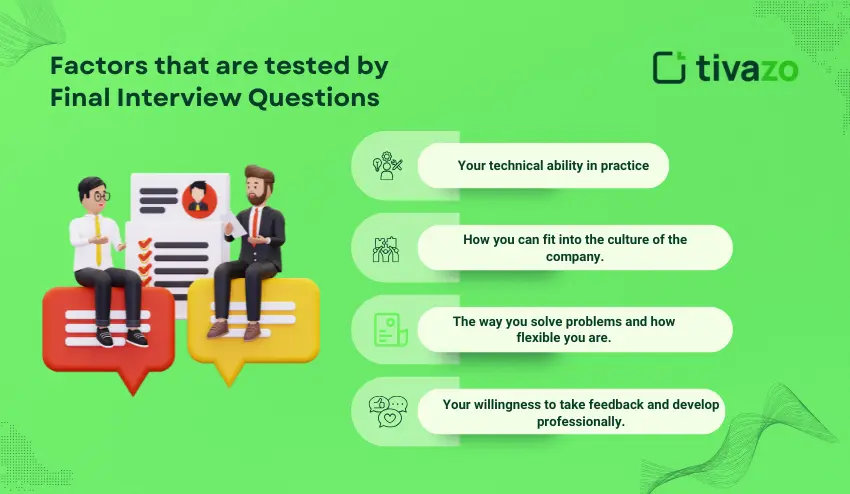
Final interview questions are important since they are used to test:
- Your technical ability in practice.
- How you can fit into the culture of the company.
- The way you solve problems and how flexible you are.
- Your willingness to take feedback and develop professionally.
For example, when you are asked to describe a situation when you had to lead a project with strict deadlines, the interviewer is testing whether you are able to handle pressure, communicate, and at the same time deliver results, which is a skill that is important in project management or fast-paced jobs.
Why the Final Interview Matters More Than Earlier Interview Rounds
At the end of the day, the last interview will have already convinced your employers you have the technical skills and experience that they are looking for.
Instead of paying attention to your resume and basic skills, as in the earlier interview stages, the final interview is where the hiring manager will look at you as a whole and decide if you are the most suitable candidate.
At this stage, only a handful of finalists are being shortlisted by employers. Although the qualifications between the candidates may be similar, other key attributes like communication skills, leadership, problem-solving, professionalism, and cultural fit are major considerations in the hiring process.
Interviewers also wish to know how you will help the organization in the long term. They’ll determine if your career aspirations are consistent with the company’s direction, if you can work well with others, and if you are able to handle work-related situations and difficulties. Having clear and organized responses with concrete results to demonstrate can make you memorable to the interviewers.
Where possible, tell why your work is important to the business rather than just stating your duties. Refer to changes you made, objectives you accomplished, or efficiencies you put in place.
If you can include examples of measurable employee performance in your answers, this helps make them more credible and will help show the added value you provided in previous jobs.
Having thoughtful examples ready for your interview will make you sound more confident and consistent, which will help the employer visualize you as succeeding in the role.
What Employers Really Evaluate During the Final Interview
1. Leadership Potential
One of the major things that an interviewer is looking for when it comes to a final interview is to see if you can handle responsibility, problems on your own, and going the extra mile. Managers are not the only candidates employers are interested in, but those who demonstrate initiative, accountability, and the ability to make decisions in the heat of the moment are.
To talk about your leadership skills, don’t go on about being a “leader. Rather, talk about times you planned a project or were able to assist a colleague, fix a procedure, or implement a new idea that added value for the business. Answers that are backed with quantifiable results are much more effective—they show impact instead of opinion.
Employers also seek candidates who recognize their strengths in the workplace and how those strengths help their team succeed. When you are brainstorming answers to this kind of question, you may find our guide to employee strengths examples useful to help you discover and articulate your best qualities in your workplace.
2. Communication Skills
We have already discussed the importance of communication in the workplace. During the final interview, strong communication is one of the most valuable skills that are assessed.
As well as working with your colleagues, clients, managers, or stakeholders, you’ll probably be working with them on a regular basis, no matter what position you’re applying for.
Interviewers gauge your clarity in presenting ideas, interacting with challenging individuals, conveying complex information, and answering unanticipated questions. They also watch how you listen, your confidence, and how professional you are during the interview.
In answering questions, aim to give structured answers, with clear examples but not too many words. Clear, confident communication with brevity is usually a more powerful impression than delivery of generic or unfocused answers.
3. Problem-Solving Ability
Nearly all final interviews will have questions to assess your critical thinking and decision-making skills. Employers want to know how you’ll deal with problems, prioritize tasks, analyze information, and perform tasks when under pressure.
Instead of stating what your roles are, talk about what you did and the results you delivered. For instance, discuss your ability to cut down on project delays, boost customer satisfaction, enhance efficiency, or optimize internal procedures.
When you back up your results with measurable achievements, your answers are more credible. Lots of companies measure success in terms of performance, productivity, and business results.
By learning how companies analyze employee performance data, you can better present clear and evidence-based answers to your interview questions, proving your worth.
4. Cultural Fit
Sure, they may get past the final interview, but the job offer goes to the one who is the right cultural fit. Employers are looking for candidates whose values, work ethic, and communication style match the values of the company or organization.
Preparing for your meeting, find out about the organization’s mission, recent successes, core values, and culture. In the interview, discuss the importance of those values and give examples to prove you can work collaboratively, be flexible, and develop positive working relationships.
Keep in mind that cultural fit means being like the other people, not the same. Rather, it’s an illustration of your ability to be a positive influence and uphold the company’s values and working culture.
5. Long-Term Career Goals
The recruitment and induction process of new staff members involves a lot of time and money. This means that employers seek candidates who view the job opportunity as a long-term opportunity for growth, rather than a temporary one.
Know how you will work within this role and how you will grow your skills and abilities within the company. When you show people that you’re interested in learning, improving, and growing with the organization, they can see that you want to be a part of the business in the future.
How to Use the STAR Method to Answer Final Interview Questions
A lot of the questions you’ll see in the final interview are related to how you’ve dealt with situations like the ones you’re asked about. A great method for responding to these questions is the STAR approach, which is a structured strategy for keeping your answer clear, relevant, and results-oriented.
The STAR method is an acronym that means:
Situation: Summarize the context or challenge that you encountered.
Task: Tell what you were responsible for or what you were trying to do in that situation.
Action: Describe the exact actions you took to solve the challenge.
Result: Give the quantifiable result of your actions; numbers and achievements are helpful.
If an interviewer asks you, “Tell me about a time you solved a difficult problem,” just writing about the problem is not enough. Tell the interviewer about the circumstances and what you did, and finally, discuss the good outcomes you had.
The STAR approach will not only help you present your answer in an easier-to-follow way, but it will also show your communication skills, problem-solving abilities, and your influence on former employers.
By preparing multiple STAR stories ahead of time, you can be confident in answering a range of behavioral and situational questions during your interview.
Types of Final Interview Questions You Should Expect
While each company has its own process for interviewing, most final interviews are held similarly. Employers usually use a mix of behavioral, situational, technical, and culture fit questions to determine your overall fit for the position.
This knowledge of each type of final interview question can help you to craft better examples and not be taken aback during the interview.
| Question Type | What Employers Want to Learn |
| Leadership Questions | Can you take initiative and make decisions? |
| Behavioral Questions | How have you handled situations in the past? |
| Technical Questions | Do you have the skills required for the role? |
| Problem-Solving Questions | Can you think critically under pressure? |
| Culture Fit Questions | Will you work well with the team? |
| Salary & Logistics Questions | Are your expectations aligned with the company? |
20 Examples and Categories of Final Interview Questions
With that in mind, let’s break down 20 examples you might face. I’ve grouped these questions into five categories so you can prepare holistically.
1. Final Interview Questions About Role Fit & Leadership Potential
These final interview questions indicate whether you are able to manage projects, make decisions in a stressful environment, and generate quantifiable change. Show how your past experience and skills match the job requirements with examples of real life.
- Tell me about a project you managed in a short time frame.
Present a scenario in which your leadership and project management capabilities had a direct effect. To make your answer organized, use the STAR method. - What are some special skills or experiences that make you the best person to fill this position?
Emphasize the most appropriate skill set and previous experiences. Do not give generic responses—look at quantifiable impact. - What do you do when there are competing priorities?
Employers would like to know your decision-making model, be it impact vs. urgency, data-driven, or consensus-driven. - How would you plan in 30-60-90 days should you be hired?
A good plan demonstrates that you are proactive, well-organized, and prepared to get going.
2. Final Interview Questions About Culture Fit & Behavior
Employers are interested in whether you will fit in their corporate culture. They will want to know how you deal with feedback, work life balance, and what motivates you. Your responses indicate how you will fit in the team, and I ask you Final Interview Questions accordingly.
- What are your values and how do they match ours?
Refer to their mission statement and give personal examples. - Tell me about an occasion when feedback made you better.
This shows that you are coachable and appreciate constant development. - What do you do to manage work and your own life?
Connect your response to the ability to balance work and life and still produce. - What keeps you going when you are faced with a difficult project?
The interviewers would like to know that you are driven by more than a paycheck.
3. Final Interview Questions About Problem-Solving & Technical Skills
These questions test your technical and problem-solving skills in practice. You can anticipate being asked how you have addressed difficult problems, how you have managed changing priorities, and how you have applied tools such as project management software to increase efficiency.
- Take me through a technical problem you have solved.
Select an example that demonstrates both technical ability and imaginative thought. - What do you do when everything is urgent?
Talk about systems such as the Eisenhower Matrix or agile sprint planning. - Give me an example of a process that you have refined through software or automation.
Share details in case you have introduced project management software. - Tell me about a project you learned something from, even if it was a failure.
Employers appreciate resilience and the capacity to learn from failure.
4. Final Interview Questions About Logistics & Practicalities
In this case, the emphasis is on the practical aspect: when you can start working, what salary you are supposed to get, what benefits package you want to have, and how flexible you are in the relocation. Realistic answers, which are clear, assist the employer in planning the next steps.
What is the earliest you could take the job?
Be realistic about notice periods and have a definite start date.
What do you expect to be paid?
Many employers will discuss salary during the final interview as they want to ensure your salary requirements are in line with their budget and can be met.
Do research on the salaries prior to the interview, depending on experience, industry, location, and responsibilities. Instead of stating a specific figure, offer a realistic range for salary based on market research.
For example:
In my experience, with the responsibilities of this position and market rates, I am looking for compensation of $70,000 to $80,000, but am open to discussing the full compensation package (including benefits and future growth opportunities).
It is also crucial to be aware of the various compensation structures. Other jobs pay an hourly wage, and some have fixed salaries, plus benefits, per year. Knowing the difference between hourly vs. salary can help you better assess job offers.
Think about healthcare, bonuses, retirement plans, paid leave, professional development opportunities, and flexible work schedules as compensation.
An employee payroll management guide may also assist you in understanding the compensation management of organizations before getting an offer so that you can ask relevant questions.
Use research to base your answer and be prepared to negotiate salary ranges.
Which benefits are of the greatest importance to you?
Talk about the benefits package that suits your lifestyle, such as healthcare or flexible work hours.
Would you move to another place?
Tell the truth but be open-minded.
5. Final Interview Questions To Ask Employer
The last interview will be your last opportunity to ask probing questions. You should ask about the measures of success, the possibilities of growth, the future, and how the company encourages work-life balance.
- In six months, how will this job be successful?
Demonstrates that you are a forward thinker. - What is the work-life balance in the team?
Assists you in knowing what to expect and the culture. - Which big initiatives can I work on during the first year?
Keeps you in line with strategic company objectives. - Is there anything in my background that you would like me to explain?
Allows the interviewer to tackle concerns prior to their decision.
How to Prepare for the Final Interview
1. Master the STAR method
Use the Situation, Task, Action, Result format to prepare detailed responses. Prepare bullet-point illustrations of leadership achievements, technical abilities, and problem-solving situations so you can recall them in the interview.
2. Research your interviewers
Find their LinkedIn profiles, company bios, or projects that they have recently worked on. Knowing their priorities will enable you to frame your responses in ways that will fit their interests and the current objectives of the company.
3. Draft a 30-60-90-day plan
Write a plan of what you would like to achieve in the first month, three months, and six months. It is proactive, strategic, and ready to make a contribution on day one.
4. Practice discussing salary
You should be ready to offer a researched salary range that is industry standard and experience-based. Back it up with good reasoning and a little bit of give and take, but understand your bottom line.
5. Prepare your own questions
Ask intelligent questions regarding the growth opportunities, team culture, or upcoming projects. This indicates that you are not only assessing the company, but also the company is assessing you.
6. Do mock interviews
Practice with a career coach, mentor, or even a close colleague. You can also use an AI mock interview and seek honest tips on how to improve your tone, body language, and clarity to ensure you deliver perfectly. Seek honest tips on how to improve your tone, body language and clarity to ensure you deliver perfectly.
7. Close with a confident summary
Close by repeating why you are a good fit for the job, how you can help, and how you are excited to be part of the team.
Final Interview Checklist
Before attending your final interview, use this checklist to make sure you’re fully prepared.
- Research the company’s mission, products, and recent achievements.
- Review the job description and prepare examples that match the required skills.
- Practice answering common final interview questions using the STAR method.
- Prepare measurable accomplishments from your previous roles.
- Print extra copies of your resume if attending an in-person interview.
- Test your internet connection, camera, and microphone for virtual interviews.
- Prepare thoughtful questions to ask the interviewer.
- Research salary expectations before discussing compensation.
- Dress professionally according to the company’s culture.
- Send a personalized thank-you email within 24 hours after the interview.
Additional Tips to Win the Offer
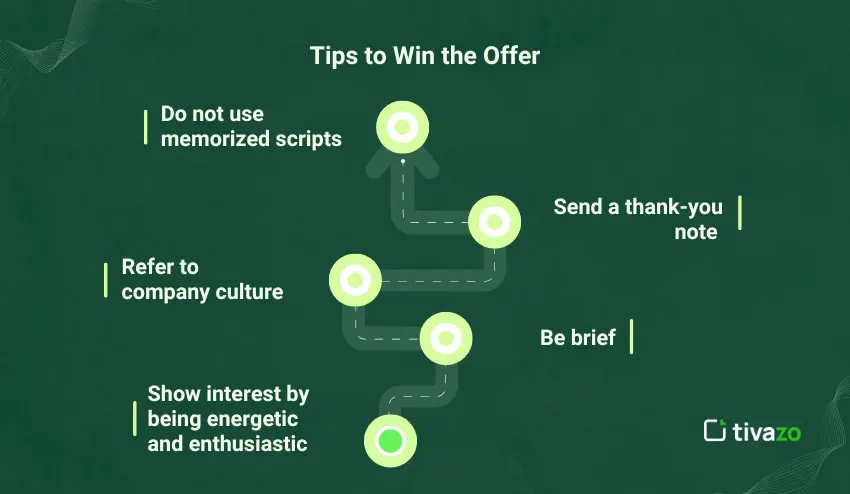
- Show interest by being energetic and enthusiastic – Show interest by being energetic and enthusiastic by using positive body language, an engaged tone and active listening.
- Be brief– Answer questions with clarity and provide sufficient details without losing the track.
- Refer to company culture– Name certain values, projects or accomplishments that resonate with your abilities.
- Send a thank-you note – Within 24 hours, send a brief, personalized email, summarizing the main points of the discussion.
- Do not use memorized scripts– Have talking points but speak in your own voice.
Final Interview Questions to Ask the Interviewer
Your questions may make an impression. Seek those that are curious, strategic, and fit with the company:
- What is my performance going to be measured by?
- What are the growth opportunities in this position?
- What is the role of leadership in helping career moves within the company?
- What are the tools or processes that make your team successful?
Common Final Interview Mistakes to Avoid
Mistakes can happen in the end that could decrease a well-experienced candidate’s chances of getting offered, even during the final interview. Knowing these common mistakes can help you be better prepared and look like a confident, prepared candidate.
1. Giving Generic Answers
Avoid vague statements like “I’m hardworking” or “I’m a team player.” Instead, support every claim with real examples and measurable results.
2. Failing to Research the Company
Finalists should be familiar with the company’s mission, values, products, and recent accomplishments.
3. Speaking Negatively About Previous Employers
Remain professional when discussing previous workplaces. Focus on lessons learned rather than criticism.
4. Talking Too Much
Write full and concise answers. STAR is a method that guides you to keep your answers on target.
5. Forgetting to Ask Questions
Well-considered questions show curiosity, preparation, and interest in the job.
6. Ignoring Body Language
Avoid distractions when interviewing via video, maintain eye contact, smile naturally, and sit confidently.
7. Not Following Up
An excellent thank-you email provides a final good impression and leaves a positive mark of interest.
Conclusion
Once you make it to the last interview, you’ve already proven that you have the skills and experience required to excel in the position. This is when companies will be determining which candidate will be the most valuable asset to the organization’s team in the long term.
Your communication skills, measurable success, problem-solving, and fit will spell the difference between a finalist and a job offer.
While preparing, refresh your memory of some of the most frequently asked interview questions, prepare your answers with the STAR method, research the company, and rehearse talking about your achievements in a self-assured manner.
Be sure to have well-thought-out questions to ask the interviewer, review the entire compensation package, and follow up with a professional thank-you email afterward.
If you prepare yourself and show your worth with integrity, you can have the last interview with ease and increase the odds of getting the job.