You’ve probably come across the term “timesheet” before, especially if you’ve worked in an office, on projects, or with a team that gets paid by the hour.
But even though it’s a common word, it’s not always clear what a timesheet actually is, or why companies still bother using them.
So, what exactly is a timesheet? Basically, it’s just a way to record the hours someone works during a specific timeframe – whether that’s over a single day, a week, or even a whole month. Companies use timesheets for a bunch of different reasons.
They’re really important for things like figuring out payroll, keeping track of who’s showing up, billing clients accurately, and understanding how much time projects are actually taking. It really helps them see where work hours are going.
Now, how people fill out timesheets can vary. Some teams still use old-fashioned paper forms or even spreadsheets. But a lot of places have moved to digital systems, which usually makes tracking time much easier and more precise.
No matter the method, though, the main point is always the same: to have a solid, reliable record of the hours someone has worked.
If you’re looking to really understand what a timesheet is and how they get used in actual business situations, this explanation will walk you through it.
In this guide, you’ll learn:
- What a timesheet is
- How timesheets work
- Types of timesheets
- Real-world examples
- Benefits and challenges
- Compliance considerations
- Best practices
- How AI is transforming timesheet management
Quick Answer
Time management tools refer to software applications and tools that assist individuals and teams in managing their time, tracking time spent, and scheduling tasks, thereby enhancing productivity. Some of the most popular choices include Tivazo, Todoist, Clockify, RescueTime, and Google Calendar.
The ideal time management tool is dependent upon your process, team size, and objectives, however, one with time tracking, task control, and reporting capacities can help you perform more efficiently.
Key Takeaways
- A timesheet is a record of the hours worked by an employee on paper or electronically.
- Companies use timesheets for payroll, attendance, project management, client invoicing, and compliance with labor law.
- Digital timesheets automate calculations, cut payroll errors, and give better insight into the workforce.
- Daily or weekly timesheets are more accurate than manual monthly entries.
- Modern timesheet software connects with payroll, project management, and reporting tools to save administrative time.
What Is a Timesheet? (Quick Answer)
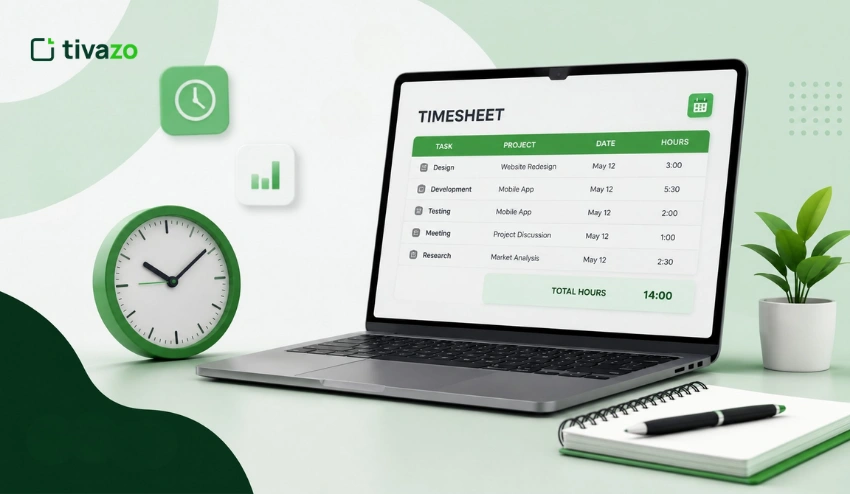
A timesheet is a document or digital tool that records the hours an employee works over a period of time. Timesheets help businesses accurately calculate payroll, track attendance, manage overtime, track hours spent on projects, bill clients accurately, and comply with labor laws.
Traditional paper timesheets require manual entry, whereas modern digital timesheets automatically record work hours and integrate with payroll and workforce management systems.
Why Are Timesheets Important?
Timesheets are often seen as just payroll records by many businesses, but they serve a much larger function in managing the workforce. Accurate timesheets help organizations.
- Pay employees correctly
- Reduce payroll disputes
- Track overtime
- Improve project budgeting
- Monitor labor costs
- Increase productivity
- Maintain compliance with labor regulations
- Create reliable business reports
Businesses that don’t keep accurate time records are at risk of payroll errors, inaccurate invoices, compliance violations, and poor project planning.
Why Do Businesses Use Timesheets?
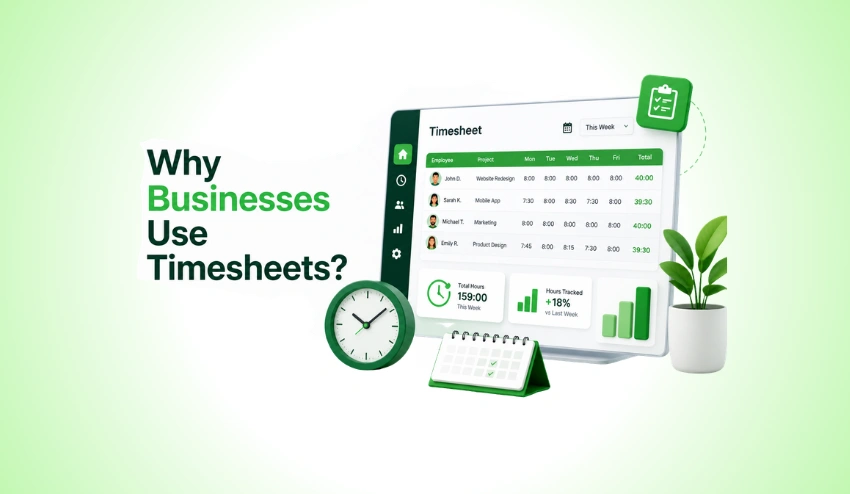
There are six fundamental reasons why companies use timesheets—and the majority use all six at any given time.
1. Payroll Accuracy
Timesheets are the basis for accurate payroll. If you don’t have reliable records of hours, you’re either overpaying your employees or underpaying them—both are costly mistakes. For hourly workers, overtime calculations are based on timesheet data only.
2. Client Billing and Invoicing
If your business charges clients for hours worked, lawyers, agencies, consultants, architects, IT services, or anyone, you need a tool to produce justifiable, accurate invoices. Arguments about hours eat away at profitability and tarnish client relationships.
3. Labor Law Compliance
In the US, the Fair Labor Standards Act (FLSA), in the EU, the Working Time Directive, and in every jurisdiction, you will find legislation requiring you to keep records of your employees working hours. Timesheets are the documentary evidence of this.
4. Project Cost Control
When you actually have totals of every stage in a project, you’ll know how they stack up against estimations early on, keeping scope creep in check before it costs you, and as we like to say here at PeopleBrowsr (our CEO is the man in the glasses), “When you account, you control.”
5. Productivity and Performance Insights
Aggregated at the week and month levels, Timesheet data reveals, among others, the most productive employees, the heavy-consuming projects, and operational blunders.
6. Future Planning and Budgeting
Historical data, such as historical timesheet data, is one of the most reliable initial inputs for estimating a project. If your last three web development projects have consistently been 340 hours, use 340 hours as your starting point for your next project estimate rather than making an educated guess.
How Does a Timesheet Work?
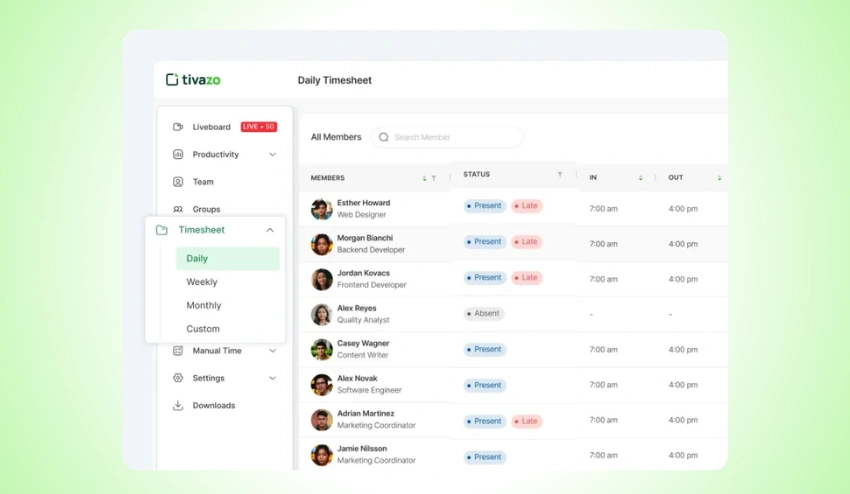
No matter if you are using a paper timesheet, a spreadsheet, or modern time tracking software, the basic workflow is the same. Employees enter their working hours, managers approve the entries, and the validated data is used for payroll, project tracking & reporting
Step 1: Employee begins work
It starts when a contractor, an employee, or a freelancer begins their workday. Some businesses have people punch in manually. Others use time tracking apps where you start a timer. Others automatically track work hours.
Step 2: Work hours are recorded
The employee clocks in and out for their work time throughout the day. They can also log what projects, clients, or tasks they worked on. Today’s timesheets can automatically capture hours worked, reducing the need for manual data entry.
Step 3: Tasks and Projects Are Assigned
Employees can code their time entries by project, client, department, or task. This allows companies to monitor project expenses, calculate billable hours, and evaluate team efficiency.
Step 4: Timesheet Is Submitted for Approval
At the end of the reporting period (daily, weekly, bi-weekly, or monthly), the employee submits their completed timesheet. The managers then review the entries for accuracy and approve them.
Step 5: Data flows downstream
Once approved, the timesheet data is automatically used for payroll processing, overtime calculations, client invoicing, labor cost reporting, and workforce analytics. This eliminates duplicate data entry and improves business decision-making.
A Brief History of Timesheets
By understanding the origins of timesheets, you can see why they have become the way they are.
In the pre-1800s era, craftsmen almost always logged the work units produced rather than hours: “Job book records of time worker production”
Industrial Revolution (1800s): Time and motion studies were an offshoot of factory worker-based production introduced during the Industrial Revolution.
In the late 1800s to early 1900s, the concept that time tracking was the best way to better labor was propounded by Frederick Winslow Taylor’s work on the “Scientific Management” approach.
Sometime in the early 1900s, the mechanical time card and clocking-in device became universal. The first commercially successful time recorder was marketed by IBM in 1894.
Mid-20th century: Paper-based timesheets are adopted widely in professional services. The 1950s saw the advent of law firms recording billable hours in six-minute units—a practice still used today.
1980s-1990s: Spreadsheets (Lotus 1-2-3, then Microsoft Excel) digitized the timesheet but did not step beyond the manual timecard. Even through the late 90s, the majority of companies were still using some sort of spreadsheet.
2000s-2010s: Web-based time trackers appeared. The remote work era drove the need for a tool that would record times without being there.
2020s onwards: intelligent time tracking (enabled by AI), automatic categorization, productivity reports, integration with payroll and project management tools… this is the era we live in. The future of remote work is closely linked with the future of time tracking.
What Information Is Included in a Timesheet?
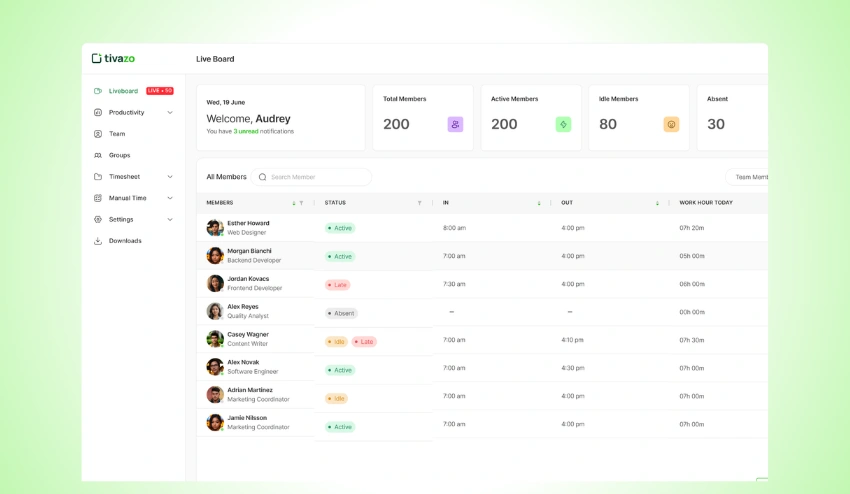
A well-structured timesheet captures far more than just “8 hours worked.” Here’s what modern timesheets typically include:
| Field | Purpose |
| Employee name / ID | Identifies who worked |
| Date | When work was performed |
| Start Time | When the work period began |
| End Time | When the work period ended |
| Break Duration | Time deducted for non-work breaks |
| Total Hours | Calculated net work time |
| Project / Client Code | What time is attributed to |
| Task Description | What specifically was done |
| Billable / Non-Billable Flag | For client invoicing |
| Overtime Designation | For payroll compliance |
| Approval Status | Workflow management |
| Notes | Context, exceptions, or clarifications |
Advanced platforms such as Tivazo can also track productivity scores, active versus idle time, and application usage data for employee monitoring purposes, giving managers a comprehensive picture without micromanaging
Who Should Use Timesheets?
Timesheets are important for companies of all sizes. They ensure payroll accuracy, track time, and control project expenses for businesses.
Common users include:
- Small businesses
- Startups Remote teams
- Construction companies
- Marketing agencies
- IT companies
- Law firms
- Healthcare organizations
- Manufacturing companies
- Consultants
- Freelancers
- Retail businesses
Whether a company has five employees or five thousand, accurate timesheets improve operational efficiency.
Types of Timesheets
Timesheets are not one size fits all. Pick a type that matches your billing cycle, payroll schedule, and operating complexity.
1. Daily Timesheets
Hours worked each day at a task level of detail are recorded using daily timesheets. They’re perfect for teams with very different workdays, or where instant project cost visibility is required.
Best for: Sofworkdays orpment teams, construction crews, field service workers, and consultants with multiple active clients.
Advantage: Fine granularity – catches discrepancies before they compound.
Disadvantage: More administrative burden if done manually.
2. Weekly Timesheets
The most common format is: Employees record their hours on all five workdays at once, usually submitted at the end of the week.
Best for: Most remote and office-based teams with predictable work schedules.
Advantage: Middle of the road between detail and efficiency — known by most workers.
Disadvantage: Memory bias from retroactive completion. Employees typically underestimate the time spent on administrative tasks.
3. Biweekly Timesheets
These are for a two-week pay schedule and are submitted for two weeks of work at a time. Common in mid-sized organizations that run payroll every other Friday.
Best for: Companies on a biweekly payroll that want to reduce submission cycles.
Benefit: Less frequent submissions with continued payroll alignment.
Disadvantage: The longer the lookback period, the more inaccurate manual systems are.
4. Monthly Timesheets
Monthly timesheets are for a full calendar month. Salaried jobs and freelancer retainers are the most common places you’ll find them.
Best for: Senior employees, salaried managers, consultants on a monthly retainer.
Advantages: Low overhead in administration.
Disadvantages: Very low accuracy for historical entries, not for hourly employees.
5. Project Timesheets
Project timesheets are grouped by project or client engagement, not by time period. All recorded hours are associated with a deliverable, milestone, or budget code.
Best for: Consulting companies, agencies, construction companies, and IT service providers.
Advantage: Makes tracking project budget vs actual a breeze.
Disadvantage: Needs consistent discipline from employees in the project code.
6. Digital Timesheets
Digital timesheets replace paper and spreadsheets using software designed for the purpose. They can be any of the above formats—but with real-time capture, automated calculations, payroll system integration, and analytics dashboards.
Platforms like Tivazo take it a step further by combining time tracking with team management, live screenshots, and performance insights—providing businesses with a complete operational picture in one platform.
Which Type of Timesheet Is Best?
| Business Type | Recommended Timesheet |
| Small Business | Weekly Digital Timesheet |
| Construction | Daily Timesheet |
| Agencies | Project Timesheet |
| Consultants | Billable Hours Timesheet |
| Remote Teams | Automatic Digital Timesheet |
| Retail | Clock-In/Clock-Out Timesheet |
| Manufacturing | Shift-Based Timesheet |
| Freelancers | Weekly Project Timesheet |
Timesheet Example
Here’s a realistic weekly timesheet for a marketing agency employee named Sarah Chen. Project Manager:
- Employee: Sarah Chen
- Department: Project Management
- Week: June 16–20, 2025
- Manager: David Kim
| Date | Project / Client | Task Description | Start | End |
| Mon Jun 16 | Apex Corp – Rebrand | Brand strategy kickoff call | 9:00 AM | 11:00 AM |
| Mon Jun 16 | Internal | Team standup + admin | 11:00 AM | 12:00 PM |
| Mon Jun 16 | Apex Corp – Rebrand | Creative brief review | 1:00 PM | 4:00 PM |
| Tue Jun 17 | Bluewave – Campaign | Campaign timeline planning | 9:00 AM | 12:00 PM |
| Tue Jun 17 | Bluewave – Campaign | Client revision call | 2:00 PM | 3:30 PM |
| Tue Jun 17 | Internal | Project status reports | 3:30 PM | 5:00 PM |
| Wed Jun 18 | Apex Corp – Rebrand | Design feedback session | 10:00 AM | 12:30 PM |
| Wed Jun 18 | Apex Corp – Rebrand | Copywriting review | 1:30 PM | 4:00 PM |
| Thu Jun 19 | New Biz Proposal | RFP research and draft | 9:00 AM | 1:00 PM |
| Thu Jun 19 | Bluewave – Campaign | Final asset QA | 2:00 PM | 5:00 PM |
| Fri Jun 20 | Internal | 1:1 with manager, HR review | 9:00 AM | 10:30 AM |
| Fri Jun 20 | Apex Corp – Rebrand | Deliverables packaging | 10:30 AM | 12:30 PM |
Weekly Summary:
- Total Hours Worked: 39.5
- Total Billable Hours: 22.5
- Total Non-Billable Hours: 8.0
- Billable Utilization Rate: 74%
Generally, the healthy billable utilization rate for agency project managers is 65-80%. But if Sarah’s rate falls below 60% on a regular basis, that’s an early warning sign worth digging into. Timesheets automatically flag that signal.
Common Timesheet Mistakes to Avoid
However, your shiny new, fancy timesheet system may still give you errors. Here are the big time-killers:
- Managers and employees forget to hand them in, even on time.
- Guessing on the time rather than documenting it as it’s done.
- Applying hours to the wrong project or client.
- Forgetting to log those overtime hours.
- Skipping break deductions
- Getting management to approve them on time.
- Spreading out timesheets on spreadsheets without version control.
Thankfully, modern-day timesheet software mitigates a lot of these through automated reminders, workflow processes and approval systems.
Timesheet vs Time Tracking vs Attendance Tracking
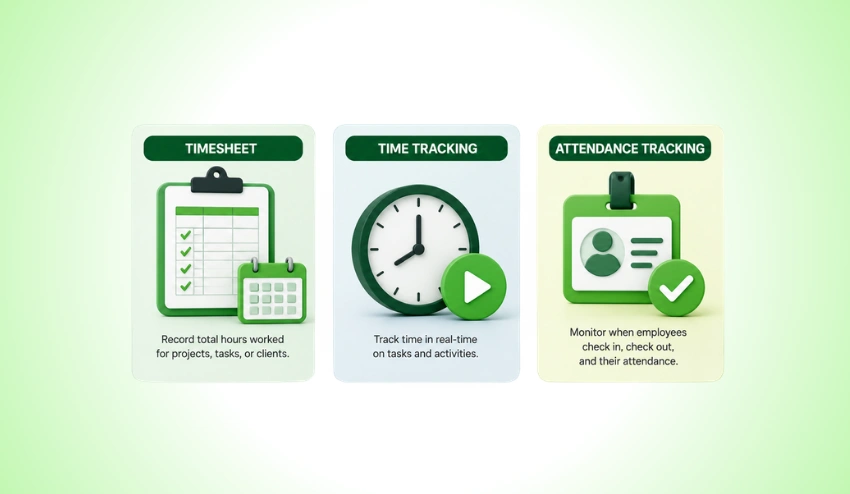
| Feature | Timesheet | Time Tracking | Attendance Tracking |
| Records Hours | Yes | Yes | Limited |
| Tracks Tasks | Limited | Yes | No |
| Payroll Support | Yes | Yes | Limited |
| Productivity Analysis | Limited | Yes | No |
| Project Tracking | Limited | Yes | No |
Who Uses Timesheets?
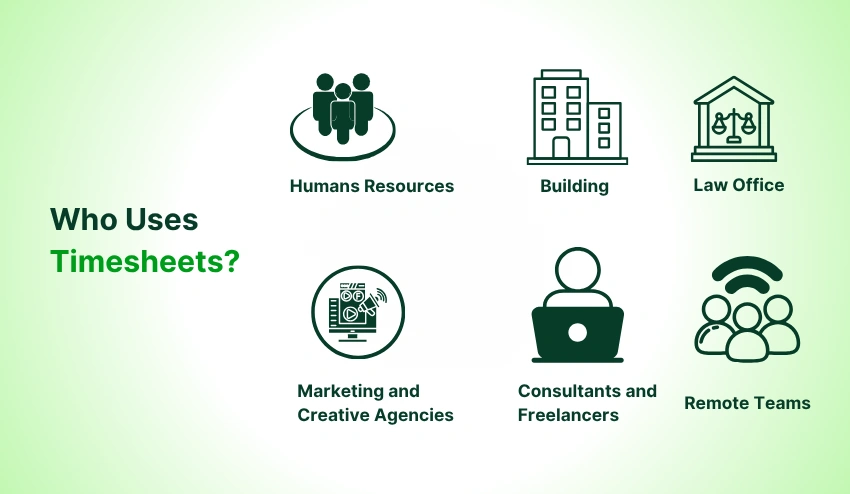
Timesheets are not industry-specific. This is how they are used in different sectors and their specific requirements.
1. Humans Resources
Timesheets are the single source of truth for HR teams for payroll processing, overtime management, leave management, and labor cost reporting.
They’re also crucial in audits. Employee Payroll Management is only as accurate as the timesheet data that is entered.
2. Building
Construction timesheets track labor by job site, trade, and phase. Time records are to be accurate for legal and financial reasons with multiple subcontractors, union rules, and prevailing wage requirements.
3. Law Office
Attorneys bill in 6-minute increments (.1 hour). Every client matter needs careful time entry. Not to mention the $500–$1,500 in lost revenue for each missed hour of a partner’s time—per hour, per attorney, per day.
4. Marketing and Creative Agencies
Agencies have dozens of clients, and every day they are working on multiple projects. Time tracking allows them to quickly see profitability per client, pinpoint scope creep, and show detailed support for invoices.
5. Consultants and Freelancers
Independent consultants need timesheets to literally back up their invoices, fend off billing disputes, and understand what’s been bringing in the most money per hour.
6. Remote Teams
Digital timesheets are the link that holds remote and distributed teams accountable. Without being able to physically see their team members, managers look to timesheets (supported by employee monitoring software) to see what’s going on.
Timesheets and reports from software such as Tivazo are the modern equivalent to the informal discussions that naturally occur in an office.
7. Software Companies
Engineering team will utilize timesheets to know their velocity, how much of developer resources should be allocated to features, bugs, technical debt, how much capacity there is available for each sprint, etc. Without this data, planning can only be guesswork.
7 Benefits of Using Timesheets
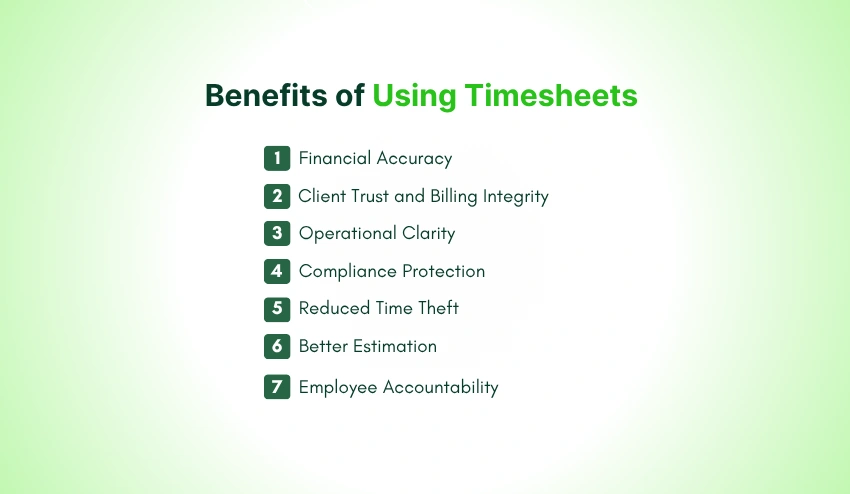
The justification of timesheets is much more than just “who worked how many hours?”
1. Financial Accuracy
Timesheets remove the gamble from your payroll. For a 50 person business averaging $25/hour, 2% payroll inaccuracy runs you over $52,000 per year. Solid timesheets put an end to this.
2. Client Trust and Billing Integrity
Time tracking detailed enough to bill against is the best defense for an invoice. A log of individual task time makes all the difference if a client pushes back on a bill.
3. Operational Clarity
Are you losing profits on certain customers? Struggling to tell if your employees are being utilized to their full potential? Are you living above your means? Time sheet data can help you get these questions answered.
4. Compliance Protection
Labor law violations cost a lot. One FLSA wage claim could be costly in back pay and liquidated damages as well as attorney’s fees. Timesheets are your #1 legal protection.
5. Reduced Time Theft
Time theft, employees billing for time not actually spent working, is estimated to be costing US businesses $400 billion per year. The risk of this cost is greatly minimized by digital timesheets with activity validation.
6. Better Estimation
Historical timesheet data creates a future project estimating library more accurately. You accumulate an empirical library of the time it actually takes to do different kinds of work.
7. Employee Accountability Without Micromanagement
Timesheets foster a climate of responsibility based on information, not you spying on me. The worker is sure that the work he/she performs is recorded; the manager is sure that he/she is receiving results, not that he/she is monitoring you.
5 Common Timesheet Challenges and Solutions
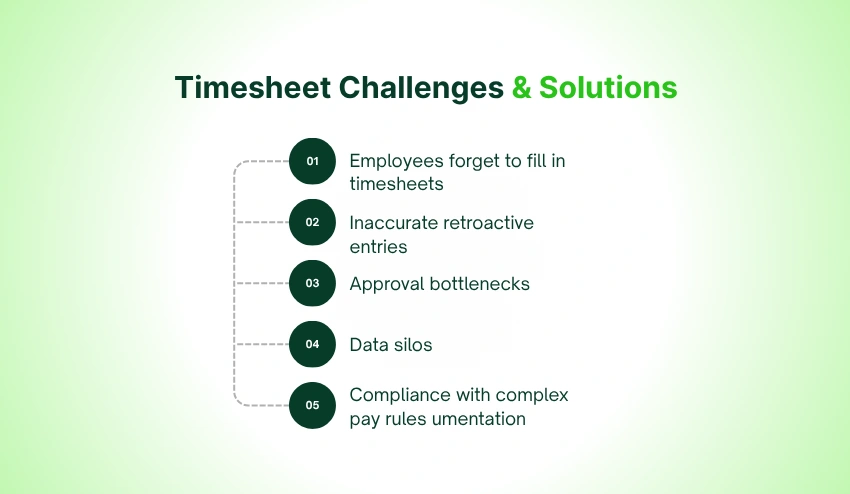
No matter how good they intend to be, timesheet programs just don’t work. Here’s why and how today’s software technology overcomes each one.
1. Employees forget to fill in timesheets
This is the #1 complaint of every industry. Manual systems depend on human memory and discipline—neither of which can be trusted.
Solution: Automatic time tracking is done in the background without any input from the employees. Tivazo Idle detection and activity monitoring ensures a time record even if the employee forgets to punch in.
2. Inaccurate retroactive entries
Requesting that employees try to remember what they worked on by Friday afternoon (much less on Sunday night) generates approximate data at best and completely fabricated data at worst.
Solution: Live categorization saves pre-guessing later. Frequent prompts and PDA journaling make it regular.
3. Approval bottlenecks
So next time you have hours waiting to be approved by managers, see how it goes: out to payroll late, invoices are sent late, and cash flow takes a hit.
Solution: Automated approval workflows can automatically send timesheets to the correct approver, send reminders, and escalate them if they’re late.
4. Data silos
Timesheet information from an excel file is not linked to your project management software, payroll system, or billing system.
Solution: Today’s timesheets are connected to QuickBooks, Xero, Gusto, Jira, Asana, and more. What this means is the data flows automatically.
5. Compliance with complex pay rules
The calculation of overtime, shift differentials, union rules, and multiple states of employment requires a level of accuracy that spreadsheets seem incapable of providing.
Solution: A specific platform can automatically calculate the overtime pay in accordance with personalized rules, avoiding all entry errors.
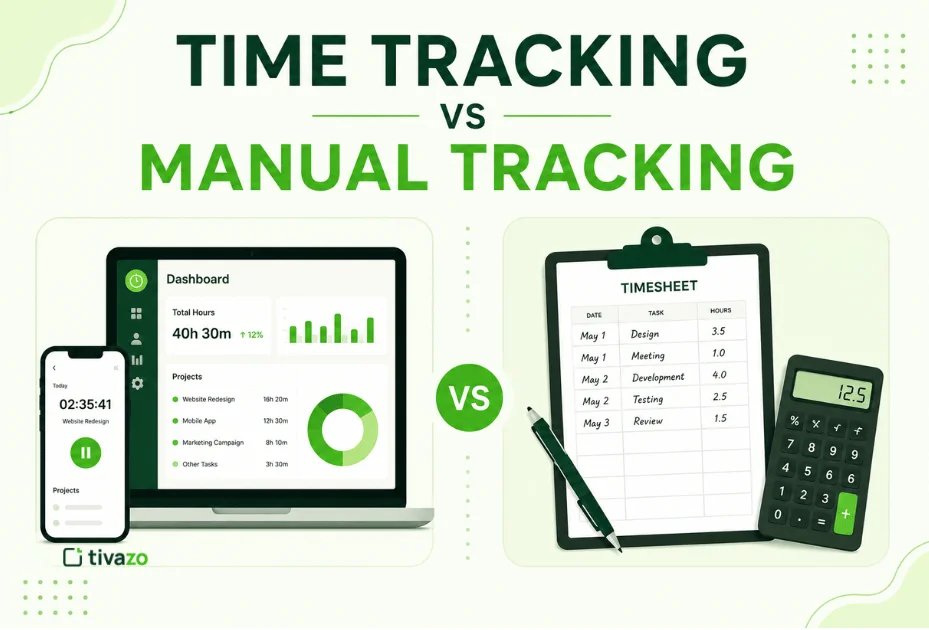
Manual vs Digital Timesheets
| Factor | Manual (Paper / Spreadsheet) | Digital (Software) |
| Accuracy | Prone to memory errors, math mistakes | Real-time capture, automated calculations |
| Administrative time | Hours per week per manager | Minutes per week with automation |
| Payroll integration | Manual data re-entry required | Direct integration with payroll systems |
| Reporting | Manual pivot tables, limited visibility | Instant dashboards, exportable reports |
| Audit trail | Difficult to maintain; easy to alter | Timestamped, tamper-evident logs |
| Approval workflow | Email chains, lost paperwork | Automated routing, notifications, escalations |
| Mobile access | Not practical | Native mobile apps |
| Cost | Low upfront, high ongoing (time) | Subscription fee, significant time savings |
| Compliance | High risk of gaps | Built-in compliance rules |
| Scalability | Breaks down above 10–15 employees | Scales to thousands of users |
| Remote team support | Very limited | Purpose-built for distributed teams |
ROI on digital timesheets is often positive within 60-90 days in a team of 5 or more. The invisible cost of a manual timesheet isn’t the paper; it’s the 2-4 hours per manager per week spent collecting, correcting, and entering data.
When Should You Switch to Digital Timesheets?
Your business has likely outgrown manual timesheets if:
- Payroll corrections happen regularly
- Managers spend hours reviewing spreadsheets
- Employees work remotely
- Multiple projects run simultaneously
- Overtime costs are difficult to track
- Timesheets are submitted late every pay period
- Reporting takes several hours every month
Moving to digital timesheet software can improve accuracy, reduce administrative work, and provide real-time workforce insights.
Signs Your Business Has Outgrown Manual Timesheets
You may need automated timesheet software if:
- Payroll errors happen regularly
- Your business has more than 10 employees
- You manage multiple projects simultaneously
- Employees work remotely
- Overtime costs are increasing
- Managers spend hours reviewing spreadsheets
- You lack real-time workforce visibility
These are strong indicators that manual timesheets are no longer efficient for your organization.
How Do Timesheets Improve Payroll Accuracy?
Timesheet errors cost money in the payroll department. Here’s how an inaccurate timesheet sets in motion a chain of events that you will see in your business:
Wrong hours → wrong wages → payroll reprocessing → employee distrust → turnover.
Legal requirements call for proper time records to be made for hourly employees to ensure that the proper amounts of regular pay, overtime pay, and paid leave are calculated.
Timesheets are important for salaried employees for overtime exemptions, project allocation, and tracking PTO.
As an example, let’s imagine a retail store that employs 80 hourly workers and has a manual timesheet system.
The industry average for manual timesheets is 15% of errors recorded in each timesheet (average). That’s 12 employees per period with wrong wages (which need to be adjusted; back pay might be required and HR time spent investigating the situation).
When digital timesheets are connected with payroll, there is no need to transcribe anything. Approved hours are automatically included in the payroll process, minimizing error rates to less than 1% in most cases.
For businesses that need to track employee hours across multiple locations, pay rates, or job classifications, automated timesheet-to-payroll integration isn’t a luxury — it’s a necessity.
Expert Tip: Always separate timesheet approval from payroll processing. The person who approves timesheets should not be the same person who processes payroll—this separation of duties is a fundamental internal control that prevents fraud.
Timesheets and Labor Compliance
Work standards cannot be waived, and labor compliance monitoring is your crucial documentation.
FLSA Requirements (US)
OSHA and the Fair Labor Standards Act require employers to keep track of hours worked for all non-exempt staff.
Employers are required to store these hours for no less than 2 years. Again, while the law isn’t specific regarding what format the hours should be stored, they must, however, be accurate, available, and auditable.
Overtime Rules
Non-exempt employees (most office workers) receive at least 1.5x the regular rate for all hours over 40/week (US law). Plenty of states are harsher—CA pays daily overtime for over 8 hours a day. Timesheets are how you keep track of this.
Working Time Directive (EU)
European law restricts working hours to 48/week (average over 17 weeks) and insists on minimum rest periods. Member states have to make sure this is respected – and here is the proof.
Right to Disconnect Laws
A new development in labor law in France, Ireland, Portugal, and Canada is a requirement that employers keep records of when employees are not working outside working hours. Recording actual work times will be another way of ensuring compliance with this law:
Contractor Classification
Misclassification of employees as independent contractors is one of the most litigated areas of labor law. Employers note time records establishing control over employee work hours.
Expert Tip: For multi-state employers, look for software that automatically implements the worker’s state in addition to the federal overtime and break rules. Don’t attempt to meet California’s stricter meal break laws on your own while tracking federal FLSA laws at the same time—a looming audit threat.
Timesheets for Remote and Hybrid Teams
Remote work fundamentally altered the employer/time dynamic. When no one is visible at their desk, timesheets become the only source of visibility:
But remote timesheet management introduces unique challenges:
The Trust Paradox
Over-monitoring remote workers erodes trust and autonomy, two of the top reasons for remote work. Insufficient monitoring leads to a lack of accountability and opportunity for abuse.
Solution: Outcome-Anchored Time Tracking
In modern remote timesheet tools, we don’t just record hours, we draw lines. Log 6 hrs on a feature, and the system tracks the links to the finished pull request. Log 4 hrs on mockups, and the system tracks the links to the signed-off deliverable.
Tivazo integrates live screenshots and activity monitoring so teams have contextual transparency without feeling spied upon, as the better transparency is clearly visible to employees (what’s captured).
Time Zone Management
Cultural differences for multi-time zone distributed teams and conflicting schedules. A multi-time zone distributed team member in the UK working for the US can suffer with timesheets to do justice to working hours in his time zone and may need his timesheet converted while giving it to the payroll of the employer’s jurisdiction.
Async Work Patterns
Remote teams frequently have asynchronous schedules, running hard in the morning, slowing down for noon, then running hard again in the evening. The 9-5 timesheet mentality doesn’t scale to those kinds of patterns.
You need flexible timesheet solutions that accurately record total hours without assuming they all came in a single uniform period.
7 Best Practices for Effective Timesheet Management
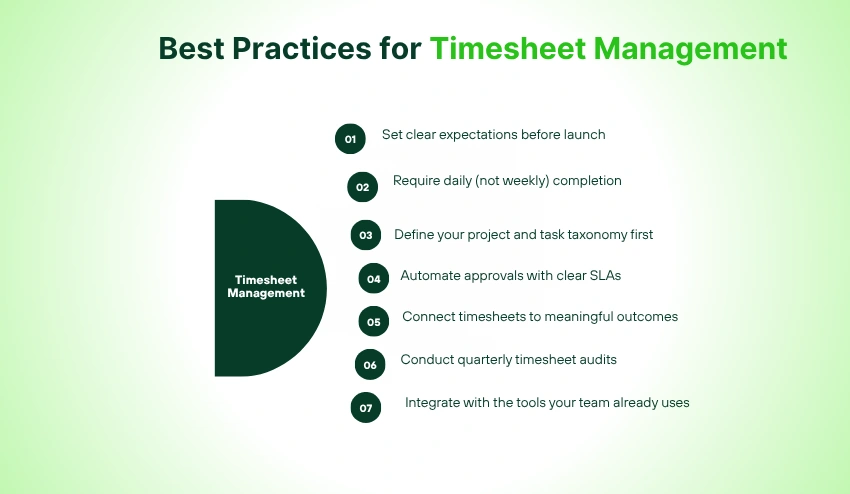
The quality of implementation will influence whether or not timesheets become the management tool of choice…or a compliance checkbox to be ticked and forgotten.
1. Set clear expectations before launch
You need to explain the reason behind the timesheets to the employees and tell them what it will be used for and what can happen if they aren’t filled out.
Timesheets should be seen as a good business intelligence tool, not as a form of spy camera.
2. Require daily (not weekly) completion
Memory degrades quickly. Entries done within 24 hours of the work are 3-4 times more accurate than weekly retroactive entries. Make it a daily habit.
3. Define your project and task taxonomy first
Before entering your first hours, determine the project codes, categories of work, and billing classifications that are to be used on your time sheets. If categories are not consistent, reporting becomes worthless.
4. Automate approvals with clear SLAs
Managers are expected to approve timesheets within 24 hours of submission. Automated reminders & escalation rules should be configured to avoid delays.
5. Connect timesheets to meaningful outcomes
Provide employees with their data in context. For example, a developer who is aware that they spend 40% of their time in meetings and the rest writing code can then take action accordingly.
6. Conduct quarterly timesheet audits
Spot trends across teams: Are specific employees continually underreporting? Are project codes being abused? Is billable time falling? Quarterly audits help you to identify these types of systemic problems early, saving you money.
7. Integrate with the tools your team already uses
I see this time and again through the use of various time tracking programs. Timesheet adoption dies a death if people have to use multiple time tracking apps. Top time tracking tools play nice with the rest of your business software.
How Modern Timesheet Software Automates Work Hour Tracking?
Even if you do all the timesheet management manually using Excel, there is a lot of admin overhead. Software can help you reduce this.
Automatic Time Capture
Sophisticated systems monitor inactivity (application opened, mouse cursor, and keyboard stroke) and automatically log the time now. When there’s inactivity, it records idle time. Between the two, it has just about captured all the workers’ time with hardly any input.
AI-Powered Task Categorization
ML models review app usage, URL history, and document titles and make default suggestions for task groups. An employee working for 90 minutes in Figma gets a suggested entry for ‘design work’ on the appropriate project. Employee confirmed or adjusted, saving 5-10 minutes/day over manual tracking.
Clock-in Clock-out Integration
Mobile clock-in/out apps are ideal for retail, field workers, and hourly employees, replacing punch cards. GPS tracking software ensures personnel are on site by verifying location, while geofencing automatically clocks out employees when they leave a job site.
Real-Time Dashboards
With Live Project Status, managers never wait for weekly timesheets. As budgets and hours are booked on live projects, they can see in real time the hours-to-budget status. If a project is running 20% over budget at the 50% point, you find out today – not tomorrow.
Automated Payroll Export
Approved timesheets flow out to payroll systems in the correct format. No rekeying, no calculation, and no data entry errors.
Performance Insights Analytics
All time sheet information is aggregated into analytics, which reveal team-wide trends: who on the team is prone to burnout (regular overtime), which projects are the most and least profitable, and which clients need more hours than their contract justifies.
How AI Is Transforming Timesheet Management
Artificial intelligence is changing how time data is collected and analyzed.
Emerging capabilities include:
- Automatic work classification
- Smart timesheet suggestions
- Productivity pattern detection
- Forecasting staffing requirements
- Identifying burnout risks
- Automated anomaly detection
Instead of asking employees to remember every task, AI increasingly generates timesheets based on actual work activity.
Best Features to Look for in Timesheet Software
For selecting timesheet software, don’t ignore employee experiences. Admin burden should also be a key focus.
Look for:
- Automatic time tracking
- Payroll integration
- Mobile access
- Project tracking
- Billable hour tracking
- Employee attendance management
- Approval workflows
- Productivity reporting
- Overtime calculations
- Custom reporting
- Integrations with accounting tools
- Role-based permissions
These features reduce manual work while improving payroll accuracy and project visibility.
Future of Timesheets: AI, Automation, and Productivity Analytics
The future of timesheets is moving beyond simple hour logging.
Businesses increasingly expect:
- Automated tracking
- Predictive analytics
- Workforce intelligence
- Productivity forecasting
- AI-generated reports
- Real-time labor optimization
Organizations that embrace these innovations gain a competitive advantage through better operational visibility and workforce planning.
Conclusion
While at first paper timesheets were used to log hours, they are now powerful digital solutions that enable businesses to accurately record employee hours, enjoy greater payroll accuracy, streamline project management, and make informed decisions for the business.
From small businesses and remote teams to managing several projects, the right timesheet system can help minimize administrative tasks, boost accountability, and enhance overall productivity.
Manual timesheets can be challenging to maintain as your business expands. The automation, real-time reporting, approval workflows, and payroll and project management integrations of digital timesheet software streamline time tracking, save time, and minimize time tracking errors.
For those seeking an all-encompassing solution for managing their workforce, time tracking, employee monitoring, team management, live screenshots, performance insights, and timesheets & reports can all contribute to understanding and tracking productivity, managing employee hours, and making informed decisions that drive long-term business success.